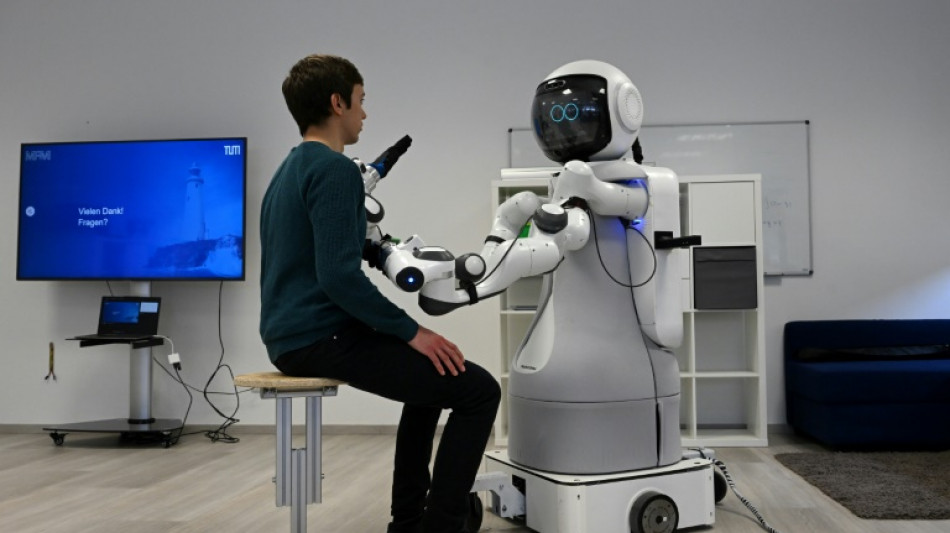
Lacking health workers, Germany taps robots for elder care / Photo: © AFP

The white-coloured humanoid "Garmi" does not look much different from a typical robot -- it stands on a platform with wheels and is equipped with a black screen on which two blue circles acting as eyes are attached.
But retired German doctor Guenter Steinebach, 78, said: "For me, this robot is a dream."
Not only is Garmi able to perform diagnostics on patients, it can also provide care and treatment for them. Or at least, that is the plan.
Garmi is a product of a new sector called geriatronics, a discipline that taps advanced technologies like robotics, IT and 3D technology for geriatrics, gerontology and nursing.
About a dozen scientists built Garmi with the help of medical practitioners like Steinebach at the Munich Institute of Robotics and Machine Intelligence.
Part of the Technical University of Munich, the institute based its unit specialising in geriatronics in Garmisch-Partenkirchen, a ski resort that is home to one of the highest proportion of elderly people in Germany.
Europe's most populous country is itself one of the world's most rapidly ageing societies.
With the number of people needing care growing quickly and an estimated 670,000 carer posts to go unfilled in Germany by 2050, the researchers are racing to conceive robots that can take over some of the tasks carried out today by nurses, carers and doctors.
"We have ATMs where we can get cash today. We can imagine that one day, based on the same model, people can come to get their medical examination in a kind of technology hub," said Abdeldjallil Naceri, 43, the lead scientist of the lab.
Doctors could then evaluate the results of the robot's diagnostics from a distance, something that could be particularly valuable for people living in remote communities.
Alternatively the machine could offer a more personalised service at home or in a care home -- by serving meals, opening a bottle of water, calling for help in case of a fall or organising a video call with family and friends.
- 'We must get there' -
In the Garmisch laboratory, Steinebach sat down at a table equipped with three screens and a joystick as he got ready to test the robot's progress.
At the other end of the room, a researcher designated as a test model took his spot in front of Garmi, which poses a stethoscope on his chest -- an action directed by Steinebach from afar via the joystick.
Medical data immediately appear on the doctor's screen.
"Imagine if I had had that in my old practice," Steinebach said, while moving the joystick.
Besides the retired doctor, other medical practitioners also visit the lab regularly to offer their ideas and feedback on the robot.
"It's like a three-year-old child. We have to teach it everything," Naceri said.
It's anyone's guess when Garmi might be ready on a commercial scale.
But Naceri is convinced that "we must get there, the statistics are clear that it is urgent".
"From 2030, we must be able to integrate this kind of technology in our society."
- Question of trust -
And if it is indeed deployed one day, residents of the Sankt Vinzenz retirement home in Garmisch, a partner of the project, will likely see Garmi whizzing down the corridors.
Just thinking about it made Mrs Rohrer, a 74-year-old resident at the home, smile.
"There are things that a robot can do, for example, serve a drink or bring meals," she said as Eva Pioskowik, the director of the home, did her nails.
Pioskowik, who battles with staffing shortages on a daily basis, said she did not expect the robot to take the place of health workers.
"But it could allow our staff to spend a bit more time with the residents," she said.
For Naceri's team, one of the major challenges is not technological, medical or financial.
Rather, it remains to be seen if most patients will accept the robot.
"They need to trust the robot," he said. "They need to be able to use it like we use a smartphone today."
J.M.Ellis--TFWP