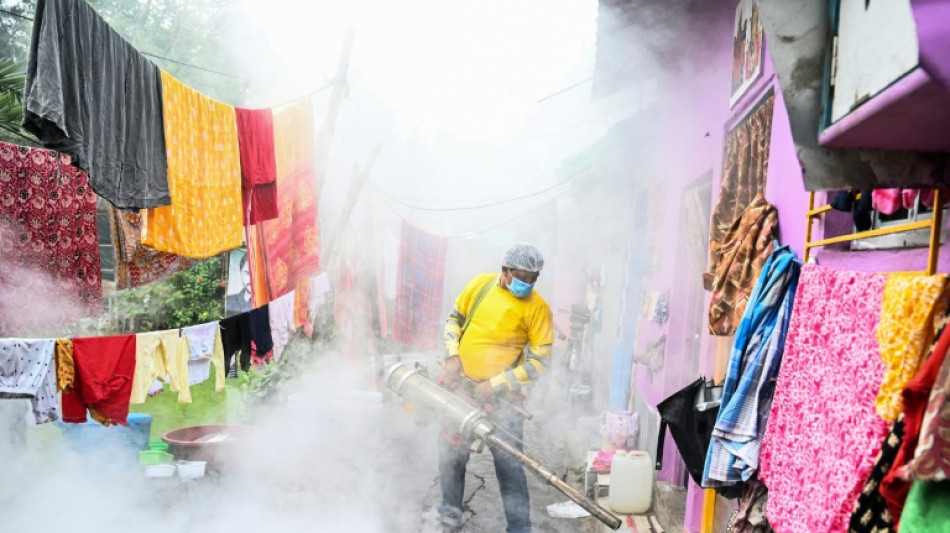
Dengue treatment advances in animal trials / Photo: © AFP

A new dengue treatment that could become the first to prevent and treat the virus has proven effective in initial trials in monkeys, according to new research.
Dengue is transmitted by mosquitoes and affects tens of millions each year, producing brutal symptoms that have earned it the moniker "breakbone fever".
It is endemic in dozens of countries, but no treatment exists, and two vaccines that have been developed are not yet universally approved.
Two years ago, researchers published work showing a compound could effectively prevent the virus from replicating in cell cultures and mice by preventing the interaction between two proteins.
Now the team has refined the compound and tested it in both mice and monkeys, with "very encouraging" results, said Marnix Van Loock, lead for emerging pathogens at the Janssen Companies of Johnson & Johnson, a drug company.
In rhesus macaques, a high dose of the compound known as JNJ-1802 "completely blocked viral replication", he told AFP, while in control animals viral RNA was detected between day three and seven after infection.
In monkeys, the compound was tested against the two most prevalent of the four strains of dengue, and only for its preventative properties, rather than for treatment.
But it was tested for both treatment and prevention in mice, against all four types of dengue, with successful outcomes, Van Loock said.
Dengue can cause intense flu-like symptoms, and sometimes develops into a severe form which can be fatal.
Because there are four different strains, getting infected by one does not protect against another, and catching dengue a second time is often more serious.
Researchers have warned that a warmer, wetter climate which is more hospitable to mosquitoes is likely to increase the prevalence of viruses passed on by the insect.
With no treatment available, efforts currently focus on reducing transmission -- including by infecting mosquitoes with a bacteria.
A vaccine called Dengvaxia is approved for use only in some countries and is effective against a single strain.
A second vaccine, Qdenga, was approved last December for use by the European Union, and it has also been greenlighted by Britain and Indonesia.
There are still questions to answer about the treatment however, including whether it could increase vulnerability to reinfection.
When people contract dengue, the presence of the virus in their blood generally stimulates a potent immune response that protects them from future infection.
But in some people, the immune response is weaker and that leaves them vulnerable to reinfection, which can produce more serious symptoms.
It is not yet clear whether preventing or reducing viral replication could produce that same vulnerability to reinfection.
The researchers will need to submit safety data from their current phase of testing before moving ahead with further trials involving humans, including field studies in areas affected by dengue.
Van Loock was reluctant to speculate on when a treatment might realistically be deployable.
"We are guided by the science and the data that we generate to really answer that question," he said.
L.Coleman--TFWP