The Fort Worth Press - Men urged to train themselves to notice household chores: study

USD -
AED 3.673098
AFN 64.000059
ALL 83.250054
AMD 377.390119
ANG 1.790083
AOA 916.999484
ARS 1398.981802
AUD 1.411433
AWG 1.8
AZN 1.685453
BAM 1.696352
BBD 2.017025
BDT 122.885307
BGN 1.709309
BHD 0.37815
BIF 2970
BMD 1
BND 1.278723
BOB 6.920298
BRL 5.199095
BSD 1.001487
BTN 92.872847
BWP 13.580798
BYN 3.052406
BYR 19600
BZD 2.014155
CAD 1.37004
CDF 2264.999906
CHF 0.788106
CLF 0.023031
CLP 909.386299
CNY 6.88685
CNH 6.88491
COP 3709.64
CRC 467.742425
CUC 1
CUP 26.5
CVE 97.149898
CZK 21.213201
DJF 178.332459
DKK 6.483365
DOP 60.049812
DZD 132.412457
EGP 52.2405
ERN 15
ETB 157.000244
EUR 0.867675
FJD 2.21345
FKP 0.749449
GBP 0.750045
GEL 2.710267
GGP 0.749449
GHS 10.904964
GIP 0.749449
GMD 73.999784
GNF 8780.000253
GTQ 7.671558
GYD 209.520258
HKD 7.83567
HNL 26.570009
HRK 6.541304
HTG 131.24607
HUF 339.5575
IDR 16957
ILS 3.09685
IMP 0.749449
INR 92.815102
IQD 1310
IRR 1313999.999944
ISK 124.409769
JEP 0.749449
JMD 157.249479
JOD 0.708977
JPY 159.382975
KES 129.349549
KGS 87.449871
KHR 4010.000306
KMF 427.000135
KPW 899.9784
KRW 1500.311728
KWD 0.306401
KYD 0.834501
KZT 483.111229
LAK 21475.000171
LBP 89549.999493
LKR 311.844884
LRD 183.501154
LSL 16.69036
LTL 2.95274
LVL 0.60489
LYD 6.394996
MAD 9.36375
MDL 17.460159
MGA 4165.000187
MKD 53.527928
MMK 2100.10344
MNT 3571.101739
MOP 8.084959
MRU 40.105001
MUR 46.580226
MVR 15.450588
MWK 1736.999564
MXN 17.65248
MYR 3.9165
MZN 63.910286
NAD 16.690022
NGN 1355.570239
NIO 36.7204
NOK 9.562325
NPR 148.591748
NZD 1.709827
OMR 0.384534
PAB 1.001483
PEN 3.417501
PGK 4.30075
PHP 59.8145
PKR 279.250183
PLN 3.704295
PYG 6472.539624
QAR 3.6435
RON 4.420216
RSD 101.90599
RUB 83.886284
RWF 1459
SAR 3.754608
SBD 8.045182
SCR 14.024827
SDG 601.000107
SEK 9.327955
SGD 1.279255
SHP 0.750259
SLE 24.602679
SLL 20969.510825
SOS 571.499594
SRD 37.374998
STD 20697.981008
STN 21.45
SVC 8.762663
SYP 110.58576
SZL 16.689994
THB 32.628002
TJS 9.578717
TMT 3.51
TND 2.932501
TOP 2.40776
TRY 44.220415
TTD 6.788466
TWD 31.872501
TZS 2603.73009
UAH 44.042968
UGX 3767.67725
UYU 40.557008
UZS 12137.500883
VES 447.80816
VND 26310
VUV 119.592862
WST 2.733704
XAF 568.900934
XAG 0.01298
XAU 0.000205
XCD 2.70255
XCG 1.80488
XDR 0.70688
XOF 570.50406
XPF 103.850283
YER 238.5502
ZAR 16.78505
ZMK 9001.199154
ZMW 19.583865
ZWL 321.999592
  • CMSC

    -0.0500

    22.9

    -0.22%

  • RBGPF

    0.1000

    82.5

    +0.12%

  • BCC

    -0.5200

    72.4

    -0.72%

  • GSK

    -0.8700

    52.54

    -1.66%

  • RIO

    -1.0250

    88.775

    -1.15%

  • NGG

    -2.0700

    88.35

    -2.34%

  • RELX

    -0.0600

    34.23

    -0.18%

  • AZN

    -1.2700

    190.02

    -0.67%

  • JRI

    -0.0500

    12.41

    -0.4%

  • BCE

    -0.2700

    25.74

    -1.05%

  • RYCEF

    -0.1300

    16.65

    -0.78%

  • CMSD

    -0.0340

    22.846

    -0.15%

  • BP

    0.5450

    44.395

    +1.23%

  • VOD

    -0.2250

    14.525

    -1.55%

  • BTI

    -1.8400

    58.71

    -3.13%

Men urged to train themselves to notice household chores: study
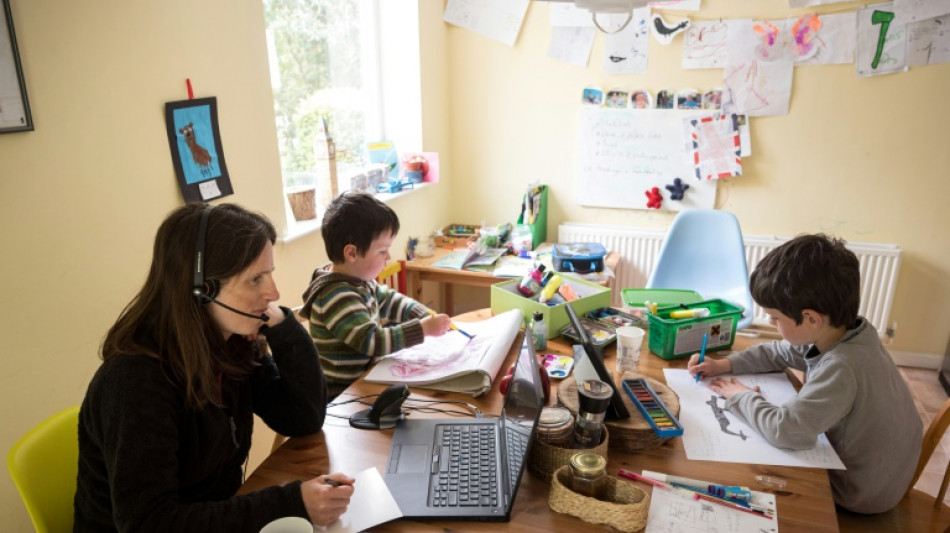
Men urged to train themselves to notice household chores: study / Photo: © AFP/File

Men urged to train themselves to notice household chores: study

Gender imbalance in shouldering domestic work is explained by different ways in which men and women perceive chores, philosophers at Britain's Cambridge University suggest.

Text size:

Women looking at an unclean surface may see something to be wiped whereas men may just observe a crumb-covered countertop, researchers argue in the journal Philosophy and Phenomenological Research.

They say data gathered during the pandemic, when both men and women spent time at the domestic coalface, throw up two important questions -- why women continue to take on most housework and why men believe it to be more equally shared than it is.

According to a survey of US households during the pandemic, 70 percent of women said they were fully or mostly responsible for housework, and 66 percent for childcare, roughly the same proportion as usual.

Tom McClelland, from Cambridge University's department of history and philosophy of science, said the fact that inequalities persisted and that many men continued to be oblivious meant that traditional explanations were not the whole story.

The researchers say "affordance theory" in which people experience objects and situations as having actions implicitly attached could explain the disparity.

According to the study, when a woman enters a kitchen, she is more likely to see dishes to be washed or a fridge to be stocked.

But the study was not about absolving men or making excuses, they said.

Perception is shaped on practice and people can train themselves into good habits, McClelland told AFP.

"If you're boiling the kettle, look to see if there are any crumbs that need wiping up. Over time you won't need the routine because the crumbs will start to grab your attention... They'll call out to be wiped up and you won't need to be so deliberate."

McClelland said the study was aimed at understanding such phenomena from an academic perspective and influencing policy areas such as paid paternal leave.

"One of the important things about parental leave is it's not just about the distribution of caring work during the early months of a child's life it's about how those early months tune you in to caring tasks in the future," he said.

"If a man has more extended parental leave, he'd be more tuned into those caring needs... and that would lead into more equitable distribution of caring and labouring in the future."

T.Mason--TFWP