The Fort Worth Press - Tiny meteorite may have caused coolant leak from Soyuz capsule

USD -
AED 3.672504
AFN 62.999727
ALL 83.270873
AMD 375.888706
ANG 1.790083
AOA 917.000355
ARS 1396.224797
AUD 1.411472
AWG 1.8
AZN 1.701015
BAM 1.694676
BBD 2.008379
BDT 122.349598
BGN 1.709309
BHD 0.37781
BIF 2960.677954
BMD 1
BND 1.274197
BOB 6.890426
BRL 5.200704
BSD 0.997171
BTN 92.084068
BWP 13.55123
BYN 2.990906
BYR 19600
BZD 2.005433
CAD 1.36967
CDF 2265.000019
CHF 0.786655
CLF 0.022962
CLP 906.680087
CNY 6.88685
CNH 6.880535
COP 3699.93
CRC 467.393376
CUC 1
CUP 26.5
CVE 95.544878
CZK 21.19755
DJF 177.563655
DKK 6.47893
DOP 60.863387
DZD 132.174184
EGP 52.362766
ERN 15
ETB 155.670589
EUR 0.86706
FJD 2.208982
FKP 0.749449
GBP 0.74916
GEL 2.710173
GGP 0.749449
GHS 10.864206
GIP 0.749449
GMD 73.502223
GNF 8738.713758
GTQ 7.638218
GYD 208.619099
HKD 7.838495
HNL 26.392042
HRK 6.524795
HTG 130.799092
HUF 339.005499
IDR 16960
ILS 3.095805
IMP 0.749449
INR 92.747396
IQD 1306.240929
IRR 1314000.000027
ISK 124.189585
JEP 0.749449
JMD 156.863595
JOD 0.709
JPY 159.125499
KES 129.615223
KGS 87.449522
KHR 4001.525051
KMF 426.999867
KPW 899.9784
KRW 1494.575034
KWD 0.30658
KYD 0.830969
KZT 480.462708
LAK 21398.089379
LBP 89293.757284
LKR 310.517081
LRD 182.476724
LSL 16.681412
LTL 2.95274
LVL 0.60489
LYD 6.383523
MAD 9.3506
MDL 17.395034
MGA 4151.340672
MKD 53.380151
MMK 2100.10344
MNT 3571.101739
MOP 8.04861
MRU 39.666049
MUR 46.510218
MVR 15.450275
MWK 1728.988766
MXN 17.650895
MYR 3.916502
MZN 63.909858
NAD 16.681412
NGN 1355.939656
NIO 36.696532
NOK 9.593196
NPR 147.335494
NZD 1.71098
OMR 0.384523
PAB 0.997097
PEN 3.408199
PGK 4.302203
PHP 59.815023
PKR 278.401043
PLN 3.69688
PYG 6464.107308
QAR 3.635584
RON 4.415802
RSD 101.841991
RUB 83.726506
RWF 1458.298132
SAR 3.755174
SBD 8.045182
SCR 13.735904
SDG 600.999795
SEK 9.323205
SGD 1.278095
SHP 0.750259
SLE 24.600507
SLL 20969.510825
SOS 568.861238
SRD 37.624971
STD 20697.981008
STN 21.229399
SVC 8.724736
SYP 110.58576
SZL 16.684502
THB 32.532979
TJS 9.557607
TMT 3.51
TND 2.939436
TOP 2.40776
TRY 44.218903
TTD 6.765591
TWD 31.907972
TZS 2606.229686
UAH 43.810984
UGX 3764.086078
UYU 40.534979
UZS 12100.600048
VES 447.80816
VND 26310
VUV 119.592862
WST 2.733704
XAF 568.378412
XAG 0.01276
XAU 0.000204
XCD 2.70255
XCG 1.79711
XDR 0.70688
XOF 568.388262
XPF 103.338171
YER 238.550219
ZAR 16.749845
ZMK 9001.258187
ZMW 19.449511
ZWL 321.999592
  • RIO

    -1.4750

    88.325

    -1.67%

  • CMSC

    0.0000

    22.95

    0%

  • NGG

    -2.3100

    88.11

    -2.62%

  • BTI

    -1.9600

    58.59

    -3.35%

  • RYCEF

    0.1200

    16.9

    +0.71%

  • GSK

    -1.1450

    52.265

    -2.19%

  • BP

    0.5200

    44.37

    +1.17%

  • BCC

    -0.9900

    71.93

    -1.38%

  • VOD

    -0.2900

    14.46

    -2.01%

  • BCE

    -0.1700

    25.84

    -0.66%

  • AZN

    -2.4700

    188.82

    -1.31%

  • RBGPF

    0.1000

    82.5

    +0.12%

  • RELX

    -0.0800

    34.21

    -0.23%

  • CMSD

    0.0250

    22.905

    +0.11%

  • JRI

    -0.0800

    12.38

    -0.65%

Tiny meteorite may have caused coolant leak from Soyuz capsule
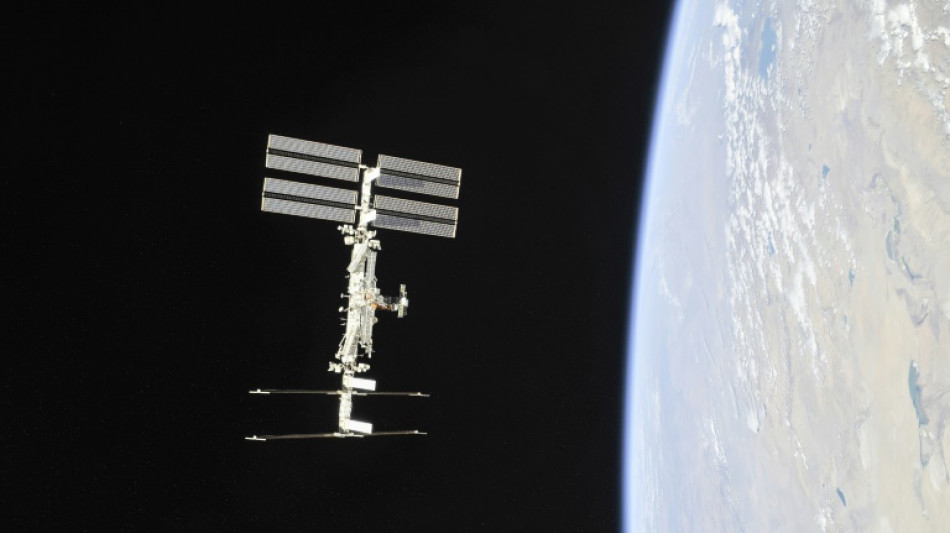
Tiny meteorite may have caused coolant leak from Soyuz capsule / Photo: © NASA/AFP

Tiny meteorite may have caused coolant leak from Soyuz capsule

Russian and NASA engineers were assessing a coolant leak on Thursday from a Soyuz crew capsule docked with the International Space Station (ISS) that may have been caused by a micrometeorite strike.

Text size:

The coolant leak forced the last-minute cancellation of a spacewalk by two Russian cosmonauts on Wednesday and could potentially impact a return flight to Earth by three crew members.

Russia's space corporation Roscosmos and the US space agency said the leak on the Soyuz MS-22 spacecraft did not pose any danger to the astronauts and cosmonauts aboard the ISS.

"The crew members aboard the space station are safe, and were not in any danger during the leak," NASA said.

It said ground teams were evaluating "the fluid and potential impacts to the integrity of the Soyuz spacecraft."

"NASA and Roscosmos will continue to work together to determine the next course of action following the ongoing analysis," NASA said.

The TASS news agency quoted Sergei Krikalev, a former cosmonaut who heads the crewed space flight program for Roscosmos, as saying that the leak may have been caused by a micrometeorite striking Soyuz MS-22.

"The cause of the leak may be a micrometeorite entering the radiator," TASS quoted Krikalev as saying. "Possible consequences are changes in the temperature regime."

"No other changes in the telemetric parameters of either the Soyuz spacecraft or the (ISS) station on the Russian or American segments have been detected," Krikalev said.

Soyuz MS-22 flew Russian cosmonauts Sergei Prokopyev and Dmitry Petelin and NASA astronaut Frank Rubio to the ISS in September.

It is scheduled to bring them back to Earth in March and another vessel would have to be sent to the ISS if Soyuz MS-22 is unavailable.

Prokopyev and Petelin had been making preparations for a spacewalk on Wednesday when the leak was discovered.

"The crew reported the warning device of the ship's diagnostic system went off, indicating a pressure drop in the cooling system," Roscosmos said. "At the moment, all systems of the ISS and the ship are operating normally, the crew is safe."

- White particles -

NASA said the leak had occurred on the "aft end" of Soyuz MS-22, which is secured to the ISS.

Dramatic NASA TV images showed white particles resembling snowflakes streaming out of the rear of the vessel for hours.

There are currently four other astronauts and cosmonauts aboard the space station in addition to Rubio, Prokopyev and Petelin.

NASA astronauts Josh Cassada and Nicole Mann, Japanese astronaut Koichi Wakata and Russian cosmonaut Anna Kikina were flown to the ISS in October aboard a SpaceX spacecraft.

Space has been a rare avenue of cooperation between Moscow and Washington since the start of Moscow's assault on Ukraine in February, and ensuing Western sanctions on Russia that shredded ties between the two countries.

The ISS was launched in 1998 at a time of increased US-Russia cooperation following their Space Race competition during the Cold War.

A.Maldonado--TFWP