The Fort Worth Press - Webb telescope spies hidden stars in stellar graveyard

USD -
AED 3.672504
AFN 62.999727
ALL 83.270873
AMD 375.888706
ANG 1.790083
AOA 917.000355
ARS 1396.224797
AUD 1.411472
AWG 1.8
AZN 1.701015
BAM 1.694676
BBD 2.008379
BDT 122.349598
BGN 1.709309
BHD 0.37781
BIF 2960.677954
BMD 1
BND 1.274197
BOB 6.890426
BRL 5.200704
BSD 0.997171
BTN 92.084068
BWP 13.55123
BYN 2.990906
BYR 19600
BZD 2.005433
CAD 1.36967
CDF 2265.000019
CHF 0.786655
CLF 0.022962
CLP 906.680087
CNY 6.88685
CNH 6.880535
COP 3699.93
CRC 467.393376
CUC 1
CUP 26.5
CVE 95.544878
CZK 21.19755
DJF 177.563655
DKK 6.47893
DOP 60.863387
DZD 132.174184
EGP 52.362766
ERN 15
ETB 155.670589
EUR 0.86706
FJD 2.208982
FKP 0.749449
GBP 0.74916
GEL 2.710173
GGP 0.749449
GHS 10.864206
GIP 0.749449
GMD 73.502223
GNF 8738.713758
GTQ 7.638218
GYD 208.619099
HKD 7.838495
HNL 26.392042
HRK 6.524795
HTG 130.799092
HUF 339.005499
IDR 16960
ILS 3.095805
IMP 0.749449
INR 92.747396
IQD 1306.240929
IRR 1314000.000027
ISK 124.189585
JEP 0.749449
JMD 156.863595
JOD 0.709
JPY 159.125499
KES 129.615223
KGS 87.449522
KHR 4001.525051
KMF 426.999867
KPW 899.9784
KRW 1494.575034
KWD 0.30658
KYD 0.830969
KZT 480.462708
LAK 21398.089379
LBP 89293.757284
LKR 310.517081
LRD 182.476724
LSL 16.681412
LTL 2.95274
LVL 0.60489
LYD 6.383523
MAD 9.3506
MDL 17.395034
MGA 4151.340672
MKD 53.380151
MMK 2100.10344
MNT 3571.101739
MOP 8.04861
MRU 39.666049
MUR 46.510218
MVR 15.450275
MWK 1728.988766
MXN 17.650895
MYR 3.916502
MZN 63.909858
NAD 16.681412
NGN 1355.939656
NIO 36.696532
NOK 9.593196
NPR 147.335494
NZD 1.71098
OMR 0.384523
PAB 0.997097
PEN 3.408199
PGK 4.302203
PHP 59.815023
PKR 278.401043
PLN 3.69688
PYG 6464.107308
QAR 3.635584
RON 4.415802
RSD 101.841991
RUB 83.726506
RWF 1458.298132
SAR 3.755174
SBD 8.045182
SCR 13.735904
SDG 600.999795
SEK 9.323205
SGD 1.278095
SHP 0.750259
SLE 24.600507
SLL 20969.510825
SOS 568.861238
SRD 37.624971
STD 20697.981008
STN 21.229399
SVC 8.724736
SYP 110.58576
SZL 16.684502
THB 32.532979
TJS 9.557607
TMT 3.51
TND 2.939436
TOP 2.40776
TRY 44.218903
TTD 6.765591
TWD 31.907972
TZS 2606.229686
UAH 43.810984
UGX 3764.086078
UYU 40.534979
UZS 12100.600048
VES 447.80816
VND 26310
VUV 119.592862
WST 2.733704
XAF 568.378412
XAG 0.01276
XAU 0.000204
XCD 2.70255
XCG 1.79711
XDR 0.70688
XOF 568.388262
XPF 103.338171
YER 238.550219
ZAR 16.749845
ZMK 9001.258187
ZMW 19.449511
ZWL 321.999592
  • RYCEF

    0.1200

    16.9

    +0.71%

  • GSK

    -0.9600

    52.45

    -1.83%

  • RIO

    -1.0400

    88.76

    -1.17%

  • RELX

    0.0800

    34.37

    +0.23%

  • NGG

    -2.3800

    88.04

    -2.7%

  • BCE

    -0.2050

    25.805

    -0.79%

  • CMSC

    0.0000

    22.95

    0%

  • BCC

    -0.7600

    72.16

    -1.05%

  • AZN

    -1.9100

    189.38

    -1.01%

  • VOD

    -0.2550

    14.495

    -1.76%

  • JRI

    -0.0650

    12.395

    -0.52%

  • CMSD

    -0.0600

    22.82

    -0.26%

  • BTI

    -1.9700

    58.58

    -3.36%

  • BP

    0.5000

    44.35

    +1.13%

  • RBGPF

    0.1000

    82.5

    +0.12%

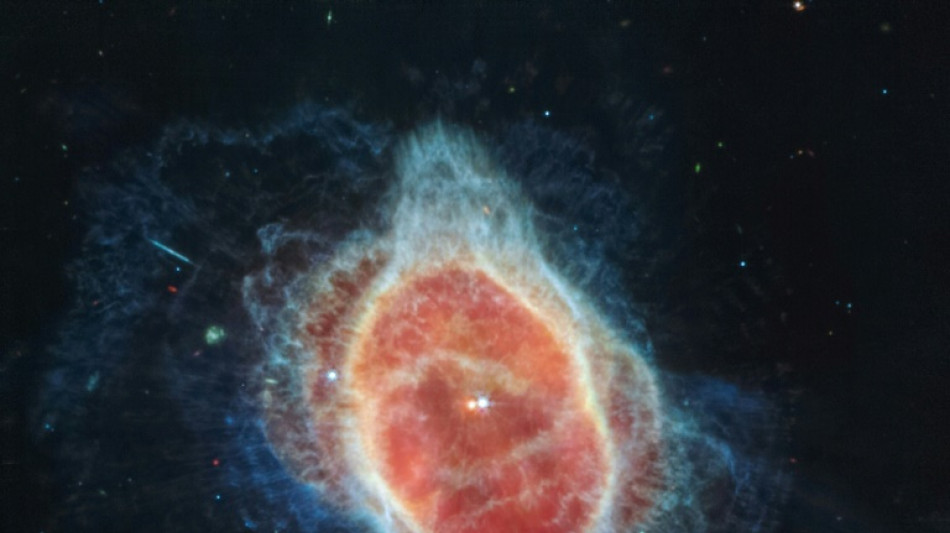
Webb telescope spies hidden stars in stellar graveyard
Webb telescope spies hidden stars in stellar graveyard / Photo: © NASA/AFP/File

Webb telescope spies hidden stars in stellar graveyard

It was one of the first famous images revealed by the James Webb Space Telescope earlier this year: a stunning shroud of gas and dust illuminated by a dying star at its heart.

Text size:

Now researchers analysing the data from history's most powerful telescope have found evidence of at least two previously unknown stars hiding in the stellar graveyard.

The Southern Ring Nebula, which is in the Milky Way around 2,000 light years from Earth, had previously been thought to contain two stars.

One, nestled in the nebula's centre, is a white dwarf star which in its death throes has been casting off torrents of gas and dust for thousands of years that in turn formed the surrounding cloud.

Sapped of its brightness, the extremely hot white dwarf is the less visible of the two stars seen in Webb images released in July.

The white dwarf has offered astronomers a view of how our own Sun may die one day -- billions of years from now.

Unlike our lonely Sun, it has a companion, the brighter of the two stars in Webb's images.

However this binary system, which is common across the Milky Way, does not explain the nebula's "atypical" structure, Philippe Amram, an astrophysicist at France's Marseille Astrophysics Laboratory, told AFP.

Amram is one of the co-authors of a study published in the journal Nature Astronomy on Thursday that has used Webb's observations to uncover more of the nebula's secrets.

Since the nebula was discovered by English astronomer John Herschel in 1835, astronomers have wondered why it has "such a bizarre shape, not really spherical," Amram said.

By analysing the data from Webb's infrared cameras, the researchers said they found evidence of at least two other stars inside the nebula, which has a diameter equivalent 1,500 times the distance from the Sun to Pluto.

While the new pair are slightly farther away from the white dwarf and its companion, all four stars -- or possibly even five -- are located in the centre of the nebula.

They are close enough to interact with each other, and their "exchanges of energy" create the nebula's strange shape, Amram said.

The Webb telescope, which has been operational since July, has already unleashed a raft of unprecedented data and scientists are hopeful it will herald a new era of discovery.

M.Cunningham--TFWP