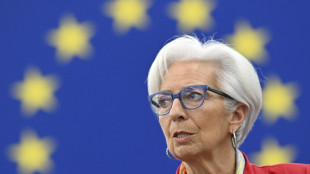
Christine Lagarde: unifying ECB chief in turbulent times / Photo: © AFP/File

Christine Lagarde, who will step down in February 2027 as president of the European Central Bank, has been seen as a unifying leader who headed the institution in turbulent geopolitical times and sought to strengthen it for a more uncertain world.
The veteran French politician's tenure was also rocky at times; she was criticised for policy missteps, notably failing to lift interest rates fast enough during the post-pandemic inflation surge.
Lagarde, 70, was the first woman to head the ECB when she was nominated in 2019, having previously been the first woman to head the International Monetary Fund.
She had a hard act to follow after Mario Draghi, the Italian economist credited with steering the eurozone through the sovereign debt crisis that began in 2009 with his vow to do "whatever it takes" to preserve the single currency.
Nevertheless, most observers agree that Lagarde's consensual leadership style unified the central bank's governing council, which sets interest rates for the 21-nation euro area, and that it has been less riven by disputes than during the Draghi era.
Lagarde "made everyone feel they were part of the same team", a council member told AFP, speaking on condition of anonymity. "Seven years later, that spirit is still there."
Highlighting her desire to find a middle ground between the ECB's "hawks" -- who favour rate increases -- and "doves" who prefer looser policy, she described herself as an "owl".
"My ambition is to be this owl that's often associated with a little bit of wisdom," she said in 2019. Afterwards she was often seen wearing an owl brooch.
Lagarde did not have an easy start, however.
Just months into her tenure, she faced criticism after saying the ECB was "not here to close spreads" between member states' borrowing costs, as Italy's government bond yields surged as the economy was battered by the coronavirus lockdowns.
Following fury in Italy and further sharp rises in borrowing costs, the ECB quickly changed course, announcing a massive pandemic emergency bond-buying programme.
- 'Madam Inflation' -
But the central bank's biggest misstep during her tenure was perhaps its flat-footed response to the inflation surge triggered by the easing of Covid lockdowns and the Ukraine war energy shock, which pushed prices to a record above 10 percent in 2022.
"The ECB was slow to raise rates -- probably six months slow," Andrew Kenningham of Capital Economics told AFP, while acknowledging that other central banks had also not acted quickly enough.
The failure to get to grips with surging prices earned Lagarde the unflattering moniker "Madam Inflation" from Germany's top-selling tabloid Bild, which also criticised her taste in luxury fashion.
When the ECB did decide to move, however, it moved rapidly.
Policymakers began a historic tightening campaign, lifting its benchmark rate from negative territory in mid-2022 to a record four percent in late 2023.
On the positive side of the ledger, analysts say the central bank has introduced a raft of innovations under Lagarde's leadership that could help it cope with a more uncertain world.
She has warned that upheavals -- like Covid, US tariffs and energy shocks -- may be the new normal, and that policymakers must be prepared.
In 2021 she led the ECB's first strategy review for two decades, which aimed to make policymaking clearer by setting out how it would respond to changes in inflation and the broader economy.
And in 2022 the bank created a crisis-fighting tool, the Transmission Protection Instrument (TPI), that allows the ECB to buy bonds of a eurozone member if yields rise uncontrollably and there is a risk of financial stress spreading.
The tool has never been used, though recently there has been speculation the ECB could step in to help France as its borrowing costs soar amid debt worries.
"The ECB has equipped itself with increasingly flexible tools," Frederik Ducrozet, head of strategy and macroeconomic research at Pictet Wealth Management, told AFP.
- 'Rebellious little girl' -
Away from policy, Lagarde's time heading the ECB was marked by simmering discontent among some of the central bank's roughly 5,000 employees in Frankfurt.
A study commissioned by staff representatives in 2024 found that cases of burnout were on the rise, with unions pointing to concerns about favouritism. The ECB responded by saying it took the health and well-being of staff seriously.
Lagarde, a lawyer by training and the daughter of teachers, had a modest upbringing spent mostly in the French port city of Le Havre.
In her autobiography, to be published in early 2027, she says she was a "rebellious little girl", determined to show that people did not need "the right name" to succeed.
"I have broken a few glass ceilings along the way," she told Elle magazine this year. "I hope that, thanks to that, other women understand they can too."
bur-sr/fz/js
G.George--TFWP