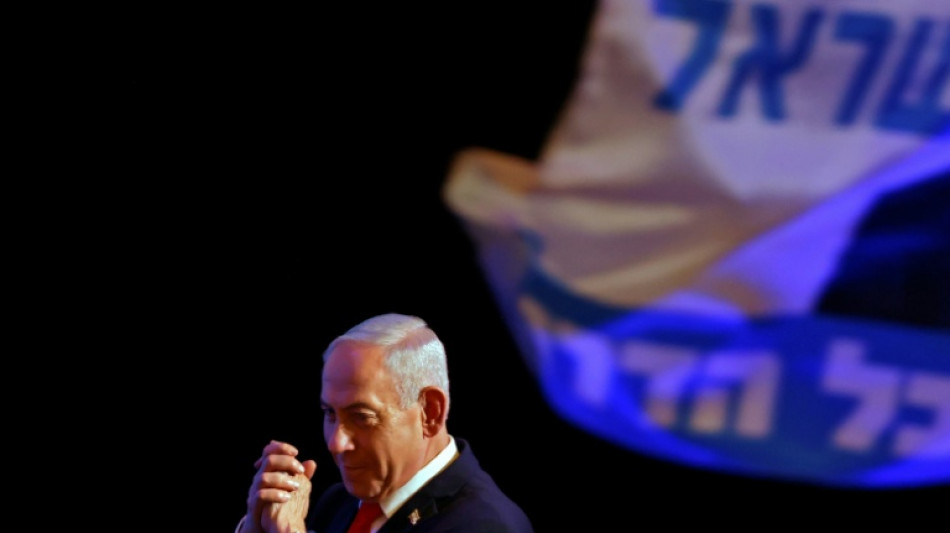
Israeli Arab parties hold key as Netanyahu falls short of majority / Photo: © AFP

Results from Israel's hard-fought election pointed Wednesday to no clear winner as a leader of the Arab minority appealed to a hesitant opposition to join forces to end the divisive reign of Prime Minister Benjamin Netanyahu.
With more than three quarters of the vote counted, Netanyahu's right-wing bloc was slightly ahead but still short of a majority in Tuesday's election, the first since the October 7, 2023 attack which has led Israel to wage war in Gaza and across the region.
Both Netanyahu, Israel's longest-serving prime minister who is allied with far-right and ultra-Orthodox Jewish parties, and Gadi Eisenkot, a former military chief leading a broad opposition bloc, vowed that they would seek to form the next government.
But neither looks set to reach the 61-seat threshold for a majority. With 77 percent of ballots counted, Netanyahu's bloc had 54 of the 120 seats in parliament and Eisenkot's opposition had 49.
The final results could still change but one place of clear gains was among Israeli Arab lists which were set to jump to 17 seats.
Voters from the community, descendants of Palestinians who stayed after Israel's creation and who make up around 20 percent of the population, have been enraged by the Netanyahu government's ultra-nationalist Jewish vision for the country and the Palestinian territories.
Yousef Jabareen, head of the leftist Arab-majority Joint List, said the Israeli public had voted for new leadership, and "anyone who wants to offer a substantive and genuine alternative to Netanyahu's blood-soaked government will have to talk to us".
"It's either the continuation of racism, the continuation of exclusion and the continuation of supremacy, or a genuine Jewish-Arab partnership," he said.
Eisenkot has resisted allying with Arab parties. Netanyahu during the campaign relentlessly attacked the opposition by saying it would put Arabs in power, running on the slogan: "Either the Right or Palestine."
Yair Golan, the head of Israel's main left-wing party and a member of Eisenkot's camp, became the first member of the opposition camp to call for an alliance with Arab parties.
"Netanyahu lost. I know how to count to 120," Golan said in a social media post.
"We must no longer accept Netanyahu's racist division between Jewish votes and Arab votes."
But Eisenkot's camp also includes right-wingers who share many of Netanyahu's hawkish views and have adamantly rejected working with Arab lawmakers.
Arab lawmakers could also give Eisenkot support in parliamentary votes on an ad hoc basis, enabling him to maintain a minority government without joining a coalition, although few observers believe such an arrangement would survive for long.
- Iran conflict -
A lack of a clear majority for either camp could mean weeks spent trying to cobble together coalitions, with possible new elections on the horizon if negotiations fail.
"Maybe everybody lost in these elections but the Arab parties. And for the Arab parties, it's unclear that they can make use of their huge success," Hebrew University of Jerusalem political scientist Gideon Rahat said.
A stalemate could in the immediate term benefit Netanyahu, who would remain caretaker prime minister until a new government is formed.
Both Netanyahu and Eisenkot appeared to indicate another factor was on the horizon -- a Israeli attack alongside the United States on Iran.
Netanyahu ordered bombing campaigns against Iran both last year and earlier this year, reluctantly stopping only after President Donald Trump reached a now-moribund ceasefire.
In the days leading up to the election, Netanyahu repeatedly called for the overthrow of Iran's government. News reports, which Netanyahu denied, said military top brass pushed back on his plans for pre-election action.
Trump has said that the United States is no longer negotiating with Iran but will not attack until after next Tuesday's US midterm elections, in which his Republican Party is forecast to lose ground.
Speaking to supporters at a rally, Netanyahu said that Israel had a "unique opportunity" with Trump to "forever eliminate the existential threat of Iran".
Eisenkot in his own post-election appearance warned Israel's security chiefs that they must serve the national interests and not the political needs of Netanyahu, who is a caretaker prime minister "without a mandate".
"Netanyahu, don't you dare use Israel's security for your political needs," Eisenkot said.
- President's role -
All eyes will be on President Isaac Herzog, who usually keeps a low-key ceremonial role but who must decide whom to task with the first chance to form a government.
Herzog has reportedly supported a unity government, which could take on more urgency if Netanyahu attacks Iran, although Eisenkot has publicly ruled out serving with him.
Netanyahu, who has served as prime minister on and off for more than 19 years, has divided Israeli society.
Facing criminal charges over corruption that he denies, Netanyahu has sought to revamp the judiciary.
He has also allied with far-right champions of extremist settlers who attack Palestinians in the West Bank with virtual impunity.
"Our fear is that these elections might result in the emergence of an even worse leader and those who are more violent and bloodthirsty," displaced Gazan Huda al-Houli told AFP.
T.Mason--TFWP