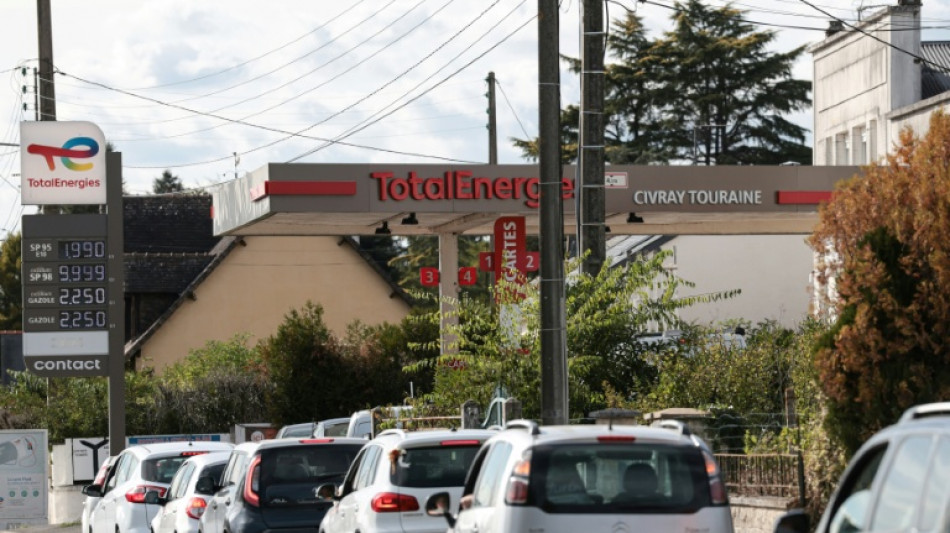
Why diesel prices are rising more than crude oil / Photo: © AFP/File

Prices at the pump for diesel and other fuels are hitting fresh highs as the wars and the Middle East and Ukraine have not only choked off crude supplies, but also damaged refineries, with the resulting capacity constraints increasingly being felt.
- How much crude is lacking? -
French officials recently estimated that the global market is missing about 10 million barrels of crude oil per day.
It is a considerable amount given the global economy had been consuming on the order of 105 million barrels per day before the Middle East conflict broke out.
Iran's blocking of the Strait of Hormuz shut in around 20 million barrels per day initially, but Saudi Arabia had shifted some exports to the Red Sea and some tankers have resumed transits.
Saudi exports via the Red Sea are now down as Iranian-backed Houthis have gained control of the Bab al-Mandab Strait.
The shock on global markets has been attenuated because nations had ample commercial plus strategic reserves as production had outstripped consumption in 2025.
Meanwhile consumption has dropped by more than one million barrels per day, according to the International Energy Agency (IEA), with China in particular sharply reducing crude imports and shifting to other energy sources.
The IEA estimates that what it calls observed global oil stocks are now down by around 507 million barrels from before the war. This figure does not include countries like China that do not report data on their reserves.
- What's the problem with diesel? -
Diesel prices have been setting fresh records in both Europe and the United States.
It is at a record average $6.52 per gallon in the United States on Monday, according to the AAA automobile association
In France it hit a record average of 2.41 euros per liter (around $10.40 a gallon) on Sunday, according to an AFP analysis.
"The current world energy crisis, then, is largely a crisis in petroleum products, refined from crude oil, rather than in petroleum itself," Nobel Prize-winning economist Paul Krugman wrote in a recent post.
"And its proximate cause is a global shortage of refining capacity," he added.
Western nations have banned the import of Russian petroleum products and Russia has also introduced fuel export bans as Ukrainian attacks have damaged its refineries.
That has left Russia's remaining buyers scrambling for supplies, pushing up prices.
Gulf nations are also big exporters of refined petroleum products, and Iranians have targeted refineries in the region.
That means that even if transit through the Strait of Hormuz were to resume immediately the diesel market would remain tight for some time.
"Diesel prices have risen across all regions because the disruption is global, but Europe is particularly exposed," as it is a net importer of the fuel, said Janiv Shah, vice president at the consultancy Rystad Energy.
- What options? -
There are few short-term options.
"Technically, there is some unused capacity on paper, but very little that can be activated quickly and supplied with the right crude," Shah said.
A resumption of oil shipments through the Strait of Hormuz would likely be the quickest way to bring down prices, he said, as it would allow Asian refineries to be supplied.
Toril Bosoni, head of the International Energy Agency's oil industry and markets division, warned last week that "if Gulf supplies remain constrained in the coming months and commercial inventory buffers continue to deplete rapidly, higher prices and further demand reductions may be required to close the supply-demand gap".
Rystad's Shah said that rising prices would help reduce diesel consumption, but that the impact would be limited.
"Diesel demand is relatively insensitive in the short term because trucking, agriculture, construction and industry have few immediate alternatives," he told AFP.
T.Gilbert--TFWP