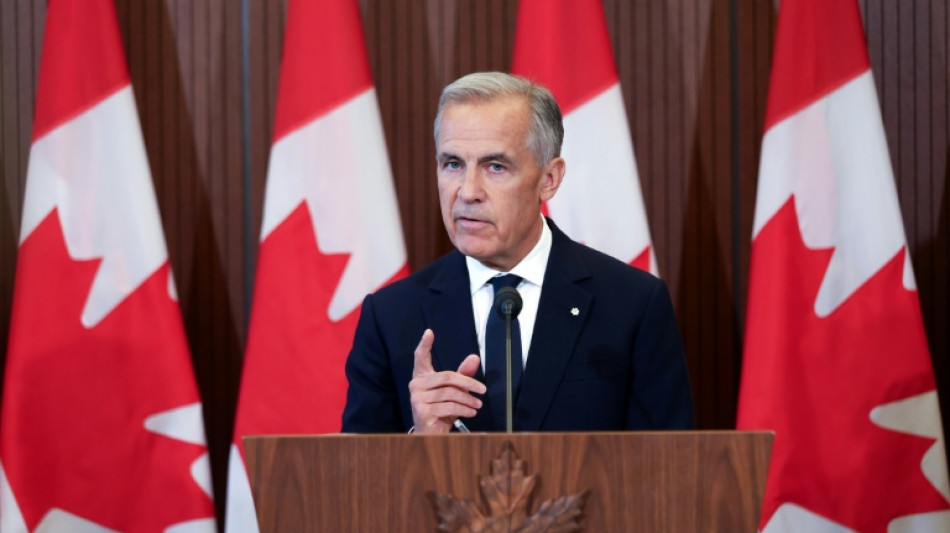
Mark Carney, the former central banker who said 'no' to Trump / Photo: © AFP

Canadian Prime Minister Mark Carney is more seasoned as a banker than a politician but has shown a confident touch in standing up to US President Donald Trump and navigating a trade war that threatens his nation's economy.
"We are masters in our own house," the prime minister said on Saturday, just hours after breaking off trade talks with the United States and ordering his negotiators back to Ottawa.
Despite the risks this decision poses to Canada, which is heavily dependent on exports to the US, Carney can boast of broad support, with 76 percent of the public praising his stance toward Washington, according to a weekend poll.
"Mark Carney has the means to achieve his ambitions because the country is behind him," says Genevieve Tellier, a professor of political science at the University of Ottawa.
After Washington slapped Canada with 50-percent duties, Canada on Tuesday announced counter-tariffs of its own.
Former head of Canada's central bank, Carney, 61, was not known for his charisma -- unlike his flamboyant predecessor Justin Trudeau, from the same Liberal Party -- but has nevertheless managed to kindle a patriotic flame among Canadians weary of American attacks.
It was trade tension with the United States that propelled him to power -- two months after Trump began his second term -- as Canadians saw him as a protector of their economy.
Replacing Trudeau as leader of his party and the government in March 2025, he won a general election a month later, to everyone's surprise.
"He transformed into a politician quite quickly; it was a surprise," said Tellier.
- The Davos Turning Point -
A blunt speech Carney gave at January's World Economic Forum marked a turning point for him on the international stage.
Declaring that the world was in the midst of a "rupture in the world order," he called on middle powers like Canada to unite.
"If we're not at the table, we're on the menu," he said.
The speech sent a message that Carney was positioning himself "as an international leader with a different, credible vision," Tellier said.
After studying at Harvard and Oxford, Mark Carney made his fortune as an investment banker at Goldman Sachs in New York, London, Tokyo and Toronto.
In 2008, at the height of the global financial crisis, he was appointed governor of the Bank of Canada by a conservative prime minister, Stephen Harper.
Five years later, he was chosen by a conservative British prime minister, David Cameron, to head the Bank of England, becoming the first foreigner to lead the institution.
In this role, he would face the economic turmoil caused by Brexit, after the UK decided to leave the European Union.
- 'Difficult phase' -
Declaring Monday that "America has changed," the Canadian leader is moving forward with determination: seeking new trading partners, launching major projects and boosting military spending.
Carney has notably forged closer ties with the EU and is set to discuss soon the strengthening of that partnership.
In Armenia in May, he emphasized that the EU and Canada were not "doomed" to submit to a "brutal" international order.
Carney was born in Fort Smith, a remote town in Canada's Northwest Territories, and was raised in Edmonton, Alberta, a province rich in hydrocarbons.
He wants to construct a new pipeline to the Pacific in order to export Canadian oil to Asia and thus reduce the need to sell to the American market.
But by "putting his foot down" with Trump, Frederic Boily, a political science professor at the University of Alberta, Carney "will now enter a somewhat more difficult phase" where he will have to manage the impact on Canada's economy and his popularity.
T.Dixon--TFWP