Polish businesses press Warsaw, Kyiv to end political rift / Photo: © AFP

When Wojciech Kostrzewa, who represents some of Poland's biggest firms, went on a Polish economic mission to Kyiv last month, he found a "very good" atmosphere and a collaborative spirit with his Ukrainian counterparts.
But a political row erupted just days later over events that took place over 80 years ago.
Ukrainian President Volodymyr Zelensky infuriated Poles by signing a decree naming a military unit after the UPA, nationalist insurgents during World War II who also took part in massacres against Poles.
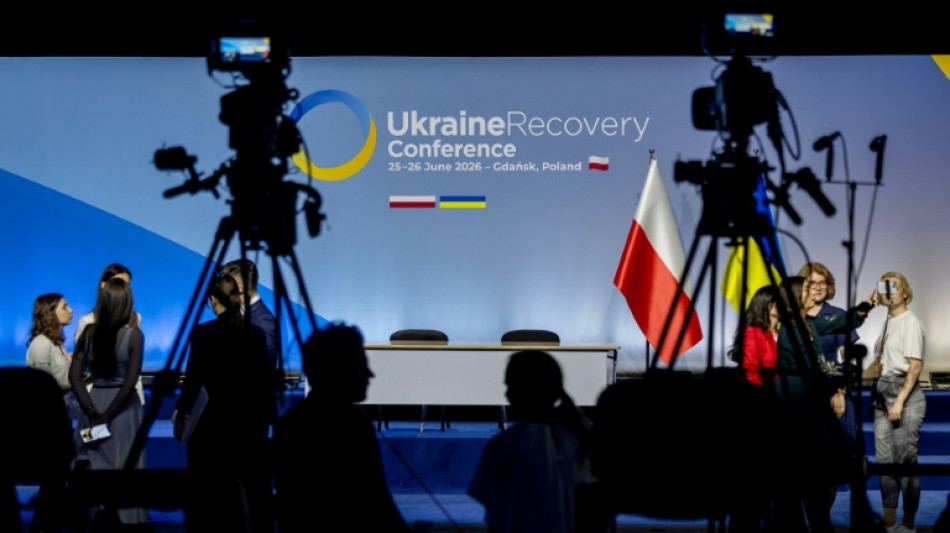
The dispute soon spiralled into the worst between the neighbours and allies since the start of the Russian invasion in 2022 -- culminating in Zelensky skipping the Ukraine Recovery Conference in Gdansk.
Now Kostrzewa, who heads a business union, is appealing to both sides to set the feuding aside and focus on the economy.
"It's about building the future and not being busy with the past," the influential entrepreneur told AFP in Poland's Baltic resort of Sopot.
Kostrzewa was one of several Polish executives who signed an appeal to both governments urging them not to "squander" their close ties.
"The aim was to normalise relations and exclude the economy from this dispute, which should be for historians," he said.
He had hoped the Gdansk conference last week -- where Zelensky's absence loomed large but where officials and business executives from both sides struck deals and mingled -- would be a first step.
But that hope began to fade over the weekend.
Warsaw expects Zelensky to reverse his UPA decision, something Kyiv maintains is unacceptable.
At the Gdansk gathering, Polish Prime Minister Donald Tusk called for "mutual respect" and also "understanding (of) one's own history", an apparent reference to Ukraine.
Zelensky said meanwhile on Sunday that "Nobody will ever again dictate to Ukrainians what heroes we honour."
- Part of Poland's 'ecosystem' -
Poland is home to more than two million Ukrainians, both refugees who fled Russia's invasion and economic migrants who have lived in the European Union country for years.
But anti-Ukrainian sentiment has risen in Poland in recent months, now also echoed by the nationalist President Karol Nawrocki and hard-right parties who seek to build on historical differences to boost their support.
"The business community is directly against that," Kostrzewa said, noting that Poland's Ukrainian workforce was a "very important part of Poland's economic ecosystem".
Poland is also Ukraine's main trading partner in Europe, and serves as a logistics hub for exports from Ukraine since its airspace has been closed since the war began.
Around 30,000 Ukrainian-owned companies operate in Poland, most of whom registered after the war erupted, Kostrzewa said.
"Part of Ukraine's economy is already in the EU thanks to Poland," he said. He also believes that Poland-based Ukrainians could be instrumental in helping Kyiv's bid to join the bloc.
Despite the current tensions, Poland, which underwent a series of reforms in the 1990s before joining the European Union in 2004, remains a model for Ukraine in private conversations.
"It shows that a country that was bankrupt at the start of the 1990s could -- thanks to reforms and efforts by both the political class and society -- become the 20th (largest) economy in the world," Kostrzewa said.
- 'We want to help' -
The Gdansk conference focused on Ukraine's post-war reconstruction, with Polish firms hoping their proximity will help them avoid being overshadowed by Western rivals if and when a war settlement is reached.
Some Polish and Ukrainian businessmen in Gdansk told AFP the clash was exclusively political.
"It's just for the political class," said Ukrainian-born Vitalii Hulakov, who was representing a Polish manufacturer at the event.
But others said it had nonetheless come up in conversations.
"We're not politicians. We want to help and develop business," said Michal Rzepnikowski, whose company exports Polish prosthetics to Ukraine.
His Endolink firm began transporting humanitarian aid to Ukraine at the start of the war. It then evolved into a business operation, providing medical equipment for hospitals and rehabilitation centres.
He said clients and providers on both sides of the border usually acknowledge that it was not the time for a historical reckoning while Europe's worst was since WWII drags on.
"Both sides have reached the conclusion that this is not a priority during the war," Rzepnikowski said.
S.Weaver--TFWP