'New rules': life in world epicentre of jihadist terror / Photo: © AFP

The epicentre of global jihadism is today firmly planted in Africa's Sahel, where extremists are steadily expanding beyond the rural areas where they first sprang roots, killing thousands, roiling governments and sowing terror.
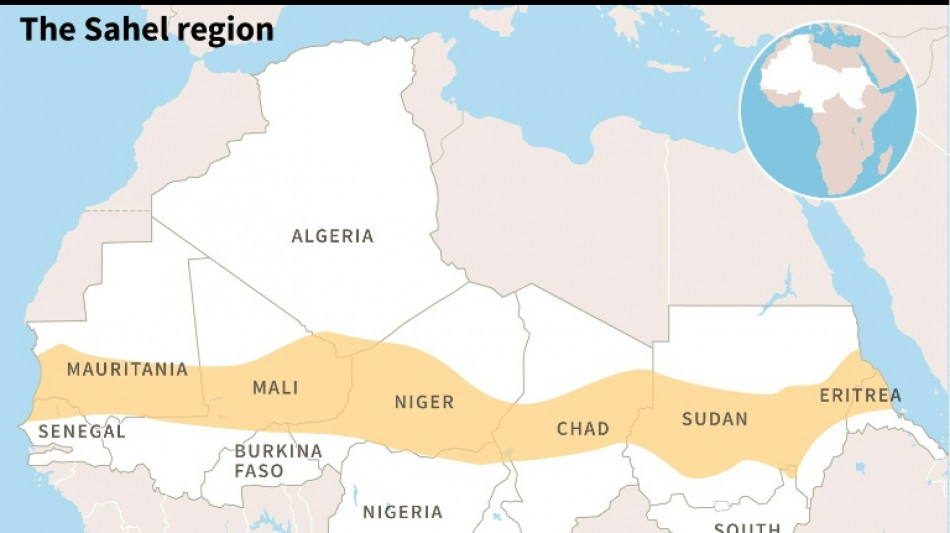
A semi-arid belt of land that stretches from the Atlantic Ocean along the southern rim of the Sahara desert to the Red Sea ("sahel" means "coast" in Arabic), the Sahel region has become ground zero for the same unyielding ideology that convulsed Afghanistan and Syria.
"We live every day with the fear of another attack," said Mathias in Burkina Faso who, like others interviewed for this story, spoke on condition of anonymity for security reasons.
From western Mali to the shores of Lake Chad, AFP spoke to some dozen people living under the thumb or threat of jihadist groups, who dictate how locals live, move around and work.
Over the last decade three groups have extended their influence in the strip of land that separates Africa's dry, harsh Sahara desert-dominated north from the humid savannahs of the south: Islamic State (IS) group, Boko Haram and the Al-Qaeda-linked Group for the Support of Islam and Muslims (JNIM).
Since 2020, the area in the Sahel affected by jihadist attacks has doubled, conflict monitor ACLED says.
"The epicentre of global terrorism is in Africa," General Dagvin Anderson, of US Africom, said.
Their methods vary. Boko Haram is notorious for mass kidnappings, IS factions rely on blind terror and the JNIM embeds itself locally through violence and politics.
But all have killed thousands, uprooted communities and left governments scrambling to stop them.
"What was once concentrated primarily in northern Mali has spread across much of the central Sahel... and increasingly into the borderlands of coastal west Africa," Heni Nsaibia, a senior ACLED analyst, said.
The groups can now work "across vast territories, conduct large-scale attacks and increasingly challenge state control in rural areas", Nsaibia added.
Large-scale attacks have even hit the capitals of Niger and Mali this year, further stepping up the pressure on their military leaders.
The IS leadership is currently African, while Al-Qaeda relies on extortion, kidnapping and other illegal activities in the Sahel for its funding, Anderson, of Africom, said.
The IS group says that 86 percent of its global operations in early 2026 took place in Africa -- about twice as many as 2024.
Both military and civilian governments have struggled to contain the jihadists' territorial advance -- and the ideas driving it -- in a region a quarter of the size of the European Union.
- 'Town is dying' -
In Mali, which has been grappling with the jihadist insurgency since the early 2010s, the groups have recently expanded into new areas, including the southwest near Senegal and Mauritania.
The JNIM has effectively imposed a blockade on the town of Nioro du Sahel after making agreements with local leaders.
Its fighters now control who can leave.
"There are new rules," one resident told AFP. "A woman must not be seen with a man she isn't married or related to. She cannot go out without a veil, even to the fields."
The group also collects taxes, often around 10 percent of harvests or income, promising protection in return.
"Honestly, the town is dying. Everything is sad," the same resident added.
In recent years, the JNIM has switched tactics, targeting the state more directly while stepping into the vacuum it leaves behind in rural areas.
In Farabougou, another central Malian town under blockade, Aly, a resident, said the group acted harshly if rules were broken.
"They are violent when they need to punish," he said. "But outside that, they are courteous and fair. They don't commit abuses like the gendarmerie."
He said disputes were resolved quickly under their version of Islamic law. "They don't take bribes... Cases that were stuck in court for 10 or 20 years have been settled," he added.
But if order is maintained, it is because of deep-seated fear.
In Dourtenga, in central Burkina Faso, Mathias described the panic "in schools whenever students hear the rumbling of motorbikes", a reminder of an April attack in which his village was looted and burned.
"One morning, they dragged a tailor into the square and flogged him" for having cigarettes in his shop, a trader said.
"They said it was a warning for everyone."
- 'You have to pay' -
Some 2,500 kilometres (1,550 miles) east in Nigeria's Borno state on the edge of Lake Chad, a different group follows a similar pattern.
Boko Haram remains a powerful force after nearly two decades despite the rise of a rival IS-linked faction.
Goni, a transporter in his sixties, has lost all his trucks, once used to move goods between the key city of Maiduguri and neighbouring Cameroon. They were all set on fire.
"Things have gone from bad to worse for me and my family over the past year due to a surge in Boko Haram attacks," he told AFP.
With no money coming in, he said he had to divorce three of his four wives.
Abdullahi, a fisherman, said that even subsistence farming was not enough to live off.
"People can no longer go to the fields for fear of being killed or kidnapped," he said. "If you want to farm, you have to pay taxes."
As in Mali, local leaders have cut deals allowing armed groups to collect taxes.
But it has emptied out dozens of villages, with families fleeing to cities like Maiduguri.
- 'Governance crisis' -
Between western Mali and eastern Nigeria, a region spanning more than one million square kilometres (386,000 square miles), safe areas are hard to find.
In southern Niger's Tera, once a peaceful farming town, life is now a struggle.
"We're barely getting by. Many able-bodied men have moved to urban centres. Fear of being robbed or killed has strangled economic activity," a resident said.
The number of fighters across west Africa is unclear but some UN estimates suggest it is around 20,000.
Entire communities live under jihadist rule, particularly in rural areas long abandoned by the state.
"There is a localisation of jihad in the central Sahel," said Jean-Herve Jezequel, project director at the International Crisis Group.
"There is a serious governance crisis... states have often neglected rural areas and failed to address conflicts over land and resources," he added.
The instability is spreading beyond the Sahel, into northern Benin and Togo, where the JNIM is recruiting and carrying out attacks on the army.
Social tensions add to the conflict, with mostly Muslim Fulani herder communities often accused of filling jihadist ranks and frequently targeted by security forces.
"This is the very fuel of the jihadist narrative as they try to appear as protectors of the marginalised," Bakary Sambe, director of the Dakar-based Timbuktu Institute, said.
As jihadists gain ground, their ideology follows.
The tolerant Islam that has been rooted in the Sahel has been "increasingly replaced by a Salafist Wahhabi Islam", which has "spread at great speed" notably due to its strong resonance on the internet, Sambe said.
"An open road is being created for radical Islam to present itself as an alternative," he added.
- Collaboration call -
Despite the scale of the crisis, the response across west Africa remains divided.
Relations between Mali, Burkina Faso and Niger -- all ruled by the military -- and other regional nations broke down after the coups that brought the juntas to power.
The three quit regional bloc ECOWAS last year, accusing it of failing to support them, and cooperation on the ground has stalled, even as armed groups move freely across borders.
Western military involvement has ended in some areas, while other foreign powers such as Russia have stepped in, but without clear results.
"Terrorism... cannot be defeated by a single state. There must be collaboration, a pooling of forces," Ivorian Deputy Prime Minister Tene Birahima Ouattara told AFP.
He reached out to the Sahelian countries this month, saying he was "sincerely ready" to resume cooperation.
For now, joint efforts are limited and, according to researcher Andrew Lebovich, jihadists may soon head north.
It is possible that terror cells and plots in the future target North Africa, "given the involvement of the Maghreb states -- particularly Algeria and Morocco -- in the Sahel", he said.
burx-pid-bdi/rh/kjm/yad
W.Matthews--TFWP