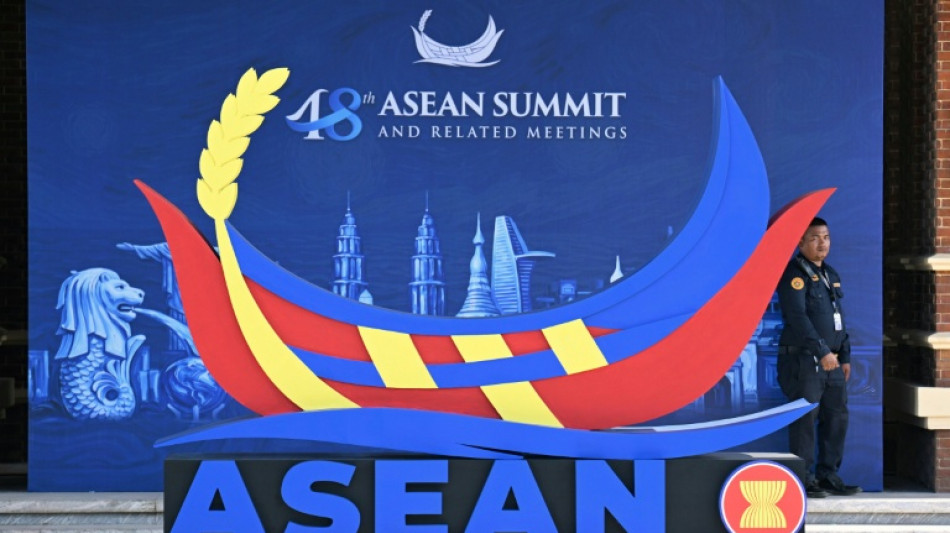
Wars in Middle East, backyard loom over ASEAN summit / Photo: © AFP

Leaders of the ASEAN states are descending on the central Philippines for what President Ferdinand Marcos has pledged will be a "bare bones" summit focused on economic issues tied to the Middle East war.
While supply chain woes sparked by the US-Israeli attack on Iran may dominate talks, the Association of Southeast Asian Nations, now 11 strong with the addition of Timor-Leste, has a still-raging civil war in its own backyard.
Here are a few of the topics the region's leaders may discuss this week.
- Strait talk -
Dwindling fuel supplies, soaring food costs and the safety of migrant workers near the Middle East conflict zone will be the most pressing issues at the summit, Marcos said in March, days after declaring a national energy emergency.
"What we really need at this time is for leaders to talk about... how can we help each other," he said, batting down rumours the summit could be called off entirely amid the crisis.
But while ASEAN has issued broad statements about energy cooperation, it has no existing mechanisms that mandate action.
The bloc's decades-old Petroleum Security Agreement, for instance, a fuel-sharing scheme aimed at ensuring energy stability, has never been invoked and is purely voluntary.
The Philippines said Wednesday it had endorsed a group "response to the crisis" in the Middle East it hoped to issue this week, without providing details.
That document would likely include a call to reopen the Strait of Hormuz and ensure freedom of movement in other critical sea lanes, according to an ASEAN diplomat who had seen an early draft and spoke to AFP on condition of anonymity.
- 'Normal relations' -
ASEAN member state Myanmar has been formally excluded from summits like the one in Cebu since its military junta snatched power in a 2021 coup that triggered a bloody civil war and crackdown on dissent.
Whether or not a recent election that installed junta leader Min Aung Hlaing as president -- or the decision to move democracy leader Aung San Suu Kyi from prison to house arrest -- will inch it closer to a return to the fold is unclear.
Min Aung Hlaing said his government would "work to restore normal relations" with ASEAN after he was sworn in as president last month, but the bloc -– which has worked fruitlessly to restore peace for years -- appears far from a consensus.
Thai Foreign Minister Sihasak Phuangketkeow told AFP in January that Bangkok had proposed a "calibrated engagement" with the new government, saying he hoped the election could be the "start of the transition".
"A good number" of the bloc's members hold similarly "pragmatic" views, Philippines Foreign Minister Theresa Lazaro said at that month's ASEAN summit.
But at least a few countries are believed to be setting the bar higher.
The ASEAN diplomat who spoke to AFP said the bloc had "only one card" to play with Myanmar: full diplomatic recognition.
On Wednesday, the Philippines praised Myanmar's decision to move Suu Kyi to house arrest while asking that a special envoy be granted "brief access" to the 80-year-old.
- Code of conduct -
A declaration on "maritime cooperation" is also expected to emerge from this week's summit, but not the long-sought-after Code of Conduct for the South China Sea.
ASEAN and China have been negotiating a code of conduct to regulate behaviour in the contested maritime area for more than two decades since the idea was first proposed.
Brunei, Malaysia, the Philippines and Vietnam all have claims in the critical waterway, which China claims in nearly its entirety despite an international ruling that its stance has no legal basis.
The Philippines, which has seen its ships engage in repeated clashes with Chinese vessels, said in February it hoped to bring long‑running talks to a conclusion this year while serving as ASEAN chair.
However, talks have stalled repeatedly over disagreements on the code's scope, enforcement and legal status.
Manila-based geopolitical analyst Don McLain Gill told AFP this year that while the Philippines could be expected to stress maritime security, any pact China would agree to would lack teeth.
The Southeast Asian diplomat, meanwhile, said there was "no way" Beijing would sign anything legally binding but would instead seek a "political declaration".
T.Gilbert--TFWP