After three years of war, Sudan confronts devastation as donors gather in Berlin / Photo: © AFP

Three years into the war in Sudan that has killed tens of thousands, displaced millions and spawned numerous war crimes allegations, Germany said Wednesday it hoped donors would pledge more than $1 billion towards humanitarian efforts.
Speaking ahead of the start of a meeting of international donors in Berlin, German Foreign Minister Johann Wadephul said: "We want to achieve more than at the last conference in London, that was a billion dollars."
"It seems to be working," he told the Deutschlandfunk broadcaster, adding: "There are more pledges coming in now, we are working on this.
Despite the global diplomatic focus being on Ukraine and Iran, "this big humanitarian catastrophe in Africa must not be forgotten," Wadephul said.
As well as rallying donors, the conference aims to revive faltering peace talks, although the two sides fighting the war, the Sudanese army and the paramilitary Rapid Support Forces, have been excluded.
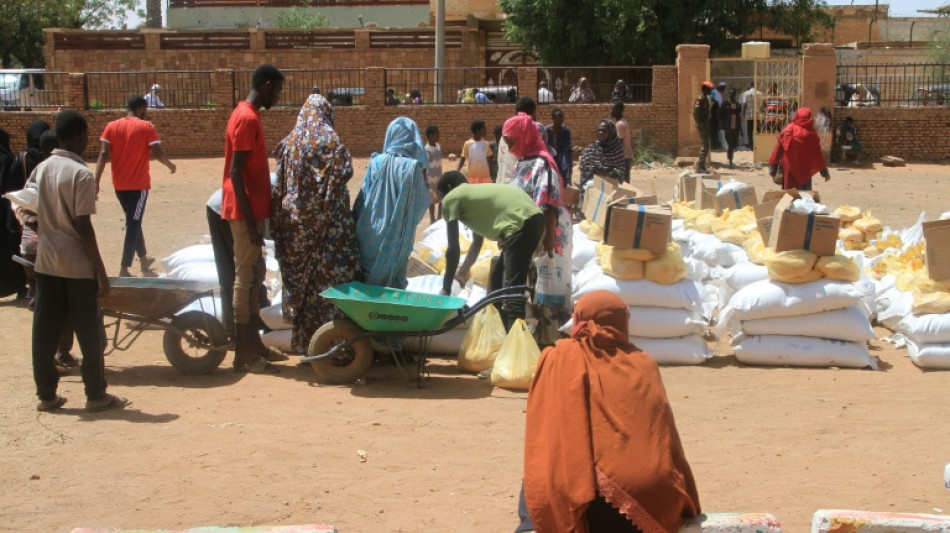
The vast majority of Sudanese people have been plunged into poverty by the conflict, with 11 million uprooted from their homes and nearly twice as many facing hunger.
"People are exhausted," said Amgad Ahmed, 42, who has lived in Omdurman, Khartoum's twin city, throughout the conflict.
"Three years of war have worn people down. We have lost work, savings and any sense of stability," he told AFP.
The meeting in Berlin brings together governments, aid agencies and civil society groups and follows similar conferences hosted by London and Paris over the past two years.
- Semblance of normality -
The war between Sudan's army and the RSF has killed tens of thousands of people.
Nearly 700 civilians have been killed in drone strikes since January alone, with attacks escalating on both sides, particularly in the southern Kordofan region and Blue Nile State, according to the United Nations.
A semblance of normality, however, has taken root in the capital Khartoum since the army retook control of the city last year.
In parts of the city, reconstruction has already begun. Markets have reopened, traffic has returned to streets that were once largely empty, while national secondary school exams were held this week after nearly two years of widespread school closures.
According to the UN, around 1.7 million people have returned to Khartoum.
But danger still lurks among the soot-stained buildings, with authorities slowly working to clear tens of thousands of unexploded bombs left behind by the fighting.
- 'Heartbreaking' -
Al-Basheer Babker al-Basheer, 41, who visited Khartoum twice this year after three years away, said the city would need years to recover.
"I was happy to come back," he told AFP. "But when I went into the city centre, it was heartbreaking."
"The road to the university where I studied is no longer the same. The walls are black," he said. "They are not the same places we used to go to."
Diplomatic efforts towards peace led by the United States, Saudi Arabia, the United Arab Emirates and Egypt -- referred to collectively as the Quad -- have so far failed.
Saudi Arabia, Egypt and Turkey back the Sudanese army, while the UAE is accused of arming the RSF. All sides deny direct involvement.
Quad-led talks stalled after army chief Abdel Fattah al-Burhan accused the group in November of bias because of Abu Dhabi's membership.
Wadephul said that, despite the absence of the parties to the conflict, he hoped the Berlin meeting would "give actors on the ground the opportunity to speak to each other".
"There are many external actors involved in this war," said Luca Renda, the UN Development Programme's representative in Sudan.
"And as long as this continues, unfortunately, the chances of peace are very slim."
Beyond widespread infrastructure destruction, the war has pushed Sudan deeper into hunger and poverty, with humanitarian funding at just 16 percent of what is needed, Renda said.
Famine was declared last year in North Darfur capital El-Fasher and Kadugli, the capital of South Kordofan, with 20 additional areas at risk, the UN said.
W.Knight--TFWP