Saudi oasis town adjusts to life in the firing line / Photo: © POOL/AFP/File

For generations, a Saudi oasis town has been a favoured spot for stressed visitors from the nearby capital Riyadh to come and decompress.
But the serenity in Saudi Arabia's Al-Kharj has been rattled after it found itself in the line of fire from Iranian attacks.
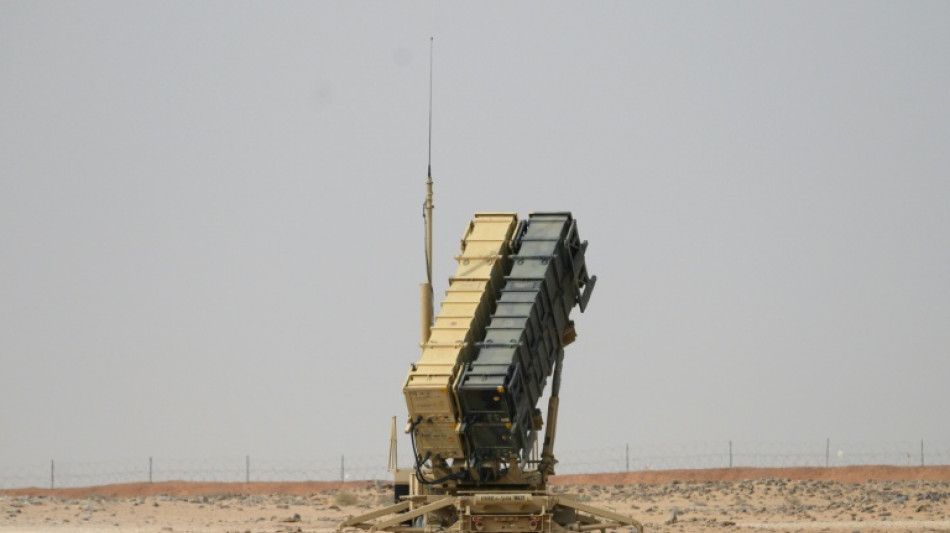
Renowned for its dates and palm-lined streets, the town also lies on the edge of the sprawling Prince Sultan Air Base.
Last month, US media outlets said at least a dozen American soldiers were injured by an Iranian attack on the base. Iranian officials later boasted of hitting an advanced surveillance aircraft that costs hundreds of millions of dollars.
Several aerial refuelling planes also suffered damage in the attack, the reports said.
Tehran has unleashed punishing waves of attacks targeting its Gulf neighbours, accusing them of serving as a launchpad for American strikes, following the US and Israeli attack on Iran that began on February 28.
The residents of Al-Kharj, however, have remained largely stoic in the face of regular barrages that now fly overhead.
"We hear the loud sounds of interceptions, but we rarely see anything in the sky," Abdullah, a resident in his 60s, told AFP. He asked that only his first name be used because of sensitivities around security issues in the kingdom.
- First civilian deaths -
Al-Kharj was the scene of the first civilian deaths in Saudi Arabia after the war erupted, when two migrants working in the city were killed on March 8 after a projectile hit a residential area.
And just last week, two people were injured after debris from a drone interception crashed down on three homes.
Six more homes were also damaged in another similar incident, according to Saudi authorities.
"This is unusual in Al-Kharj," Abdullah told AFP after afternoon prayers at a local mosque.
"Life is normal and continues as usual without any change or panic."
Iran's Revolutionary Guards have accused Saudi Arabia of hosting advanced American fighter aircraft on its territory, including "F-35 and F-16 fighter jets", along with facilities for storing and refuelling aircraft.
US forces returned to Saudi Arabia in 2019, following an agreement between Washington and Riyadh, with media reports at the time suggesting that hundreds would be hosted at Prince Sultan Air Base.
The base was a command centre during the first Gulf war and later briefly during the US invasion of Iraq in 2003 before all American troops were pulled out of the kingdom.
The presence of US forces in Saudi Arabia has been a point of contention with more conservative elements of Saudi society in the past, who see the presence of foreign troops in the land of Islam's two holiest sites as an affront to their religion.
The issue was later cited as one of Osama Bin Laden's reasons for launching the September 11 attacks on the United States in 2001.
- Checking war updates -
But at first glance, much of Al-Kharj's tranquil environment offers few hints of its martial history.
The area has long been a centre of agricultural production, with its green fields and bountiful orchards offering a striking contrast to the vast tracts of desert that cover most of the kingdom.
At a local restaurant visited by AFP recently, customers during the lunch rush could be seen checking on the latest war updates on their phones in between bites of rice and meat.
"Al-Kharj is now in the news, and friends call to check on us with almost every update," said government employee Turki, who also gave just his first name.
Even as Iran fires regular salvos at the base, AFP did not see any signs of a heavy security presence there.
However, residents said worries about the next barrage are ever present, and phones buzz regularly with messages warning of incoming attacks.
"I would be lying if I said I'm not afraid when I hear the explosions or when I learned about the deaths of the foreign workers," Batool, a 21-year-old student wearing a black niqab, told AFP while sipping coffee at a local cafe.
Despite the new danger, Batool said she will not give in to fear.
"As you can see, I'm studying outside," she added.
"My routine has not changed at all because of the war."
S.Jordan--TFWP