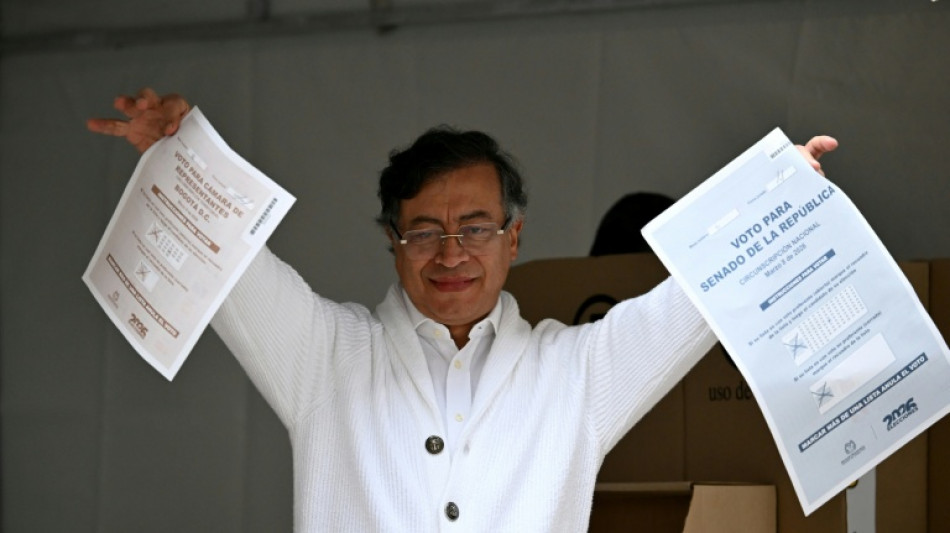
Colombia's left boosted by legislative vote / Photo: © AFP

President Gustavo Petro's left-wing coalition was on track to be the largest bloc in Colombia's next Congress on Monday, after a better-than-expected showing in legislative elections.
The result gives Petro's allies a lift ahead of a tight May 31 presidential vote -- overcoming concerns about political violence, stalled reforms, government infighting, and record cocaine production.
Initial results showed Petro's Historic Pact on course to hold the biggest contingent in the Senate and possibly the lower chamber, though still far short of a majority in either.
Projections suggested the coalition could win about 25 of the Senate's 100 seats, an increase of five from the last election. Official tallies may take several days to complete.
Sunday's vote passed off largely peacefully, a relief after a campaign season marred by the killing of more than 60 political and community leaders, including a presidential hopeful.
Whoever replaces Petro in August will confront a splintered Congress that will force any incoming administration to build alliances to pass laws.
Petro, a former guerrilla and Colombia's first leftist president, is barred by the constitution from running again.
"We remain polarized both in the Chamber and in the Senate," said 56-year-old bank employee Francisco Vargas.
"Let's hope that for the good of the people, the president who comes in is not so extreme and keeps their promises."
- Race for the presidency -
The presidential frontrunners are currently leftist Ivan Cepeda and right-winger Abelardo de la Espriella.
Cepeda is the son of an assassinated communist senator and rose to prominence investigating former president Alvaro Uribe's ties with right-wing paramilitaries.
His main conservative rival is De la Espriella, a lawyer who brands himself "The Tiger."
Critics call him extreme, though he recently told AFP he was a democrat who would "respect the constitution."
A new challenger also emerged on Sunday when Senator Paloma Valencia won a center-right primary by a wide margin.
She is backed by powerful ex-president Uribe and could appeal to conservatives uneasy with De la Espriella's harder rhetoric.
Uribe's opposition Democratic Centre was expected to rise from 13 to roughly 17 senators, according to early calculations.
But it remains well below its strength before Petro took office in 2022 and Uribe himself failed to win a seat.
Sunday's results also marked the political exit of the former FARC guerrillas. Under the 2016 peace deal, their party had held ten guaranteed congressional seats from 2018 to 2026.
With that period over, all 17 of their candidates failed to win the election, and their coalition did not clear the threshold to remain a legally recognized party.
"We reaffirm our unwavering commitment to implementing the peace agreement," the former rebels said. Security, health, and inequality were among voters' top concerns.
"There is still a lot to do on security," said David Murillo, a 29-year-old recruiter, who had hoped for more support for centrist candidates.
Two activists who fielded an AI-generated candidate named Gaitana for an Indigenous-reserved seat also failed to win representation.
M.Cunningham--TFWP