Trump warns of longer Iran war, Rubio points at Israel / Photo: © AFP

President Donald Trump warned Monday of a longer Iran war and refused to rule out ground troops, as his top diplomat suggested the timing of the US military operation was triggered by Israel.
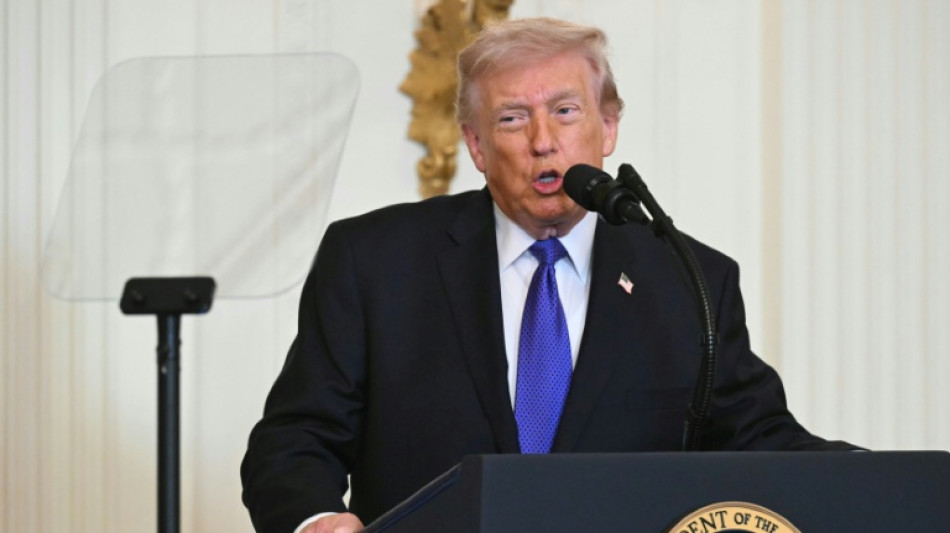
Trump's brief remarks at the White House were his first in public since launching the strikes, after two Truth Social videos and a string of sometimes contradictory phone calls to media outlets.
But Secretary of State Marco Rubio's comments about Israel later added to the mixed messaging about the war, launched by a president who long campaigned against US entanglements in the Middle East.
Speaking at the start of a medal presentation event at the White House, Trump insisted that he needed to strike, saying it was the "last, best chance" to hit Washington's decades-long arch-foe.
The 79-year-old Republican also warned that an extended war was possible, even as he said operations were currently running ahead of schedule.
"From the beginning we projected four to five weeks, but we have capability to go far longer than that," Trump said.
The US president also for the first time clearly laid out four explicit goals for Operation Epic Fury.
"First, we're destroying Iran's missile capabilities...Second, we're annihilating their navy...Third, we're ensuring that the world's number-one sponsor of terror can never obtain a nuclear weapon," he said.
"Finally we are ensuring the Iranian regime can't continue to arm, fund and direct terrorist armies outside of their borders."
- 'Very wise' -
But Rubio later said Trump's "very wise" decision came after learning Israel was going to strike and fearing Tehran would retaliate against US forces -- despite Trump making no such claim earlier.
"We knew that there was going to be an Israeli action. We knew that that would precipitate an attack against American forces, and we knew that if we didn't preemptively go after them before they launched those attacks, we would suffer higher casualties," Rubio told reporters.
Asked if the United States faced an imminent threat from Iran -- a key threshold in the United States as Congress constitutionally has the power to declare war -- Rubio again pointed to the Israeli plans.
Trump's avoidance of any major national address or press conference to make the case for the war, the biggest US conflict in the Middle East for two decades, is a major break from other presidents.
Instead he has had brief phone calls with a series of media outlets.
He refused to rule out sending US troops into Iran in an interview with the New York Post on Monday.
Such a move could risk far higher casualties than the six service members killed so far.
"I don't have the yips with respect to boots on the ground," Trump said, using a golf term for anxiety. "Every president says, 'There will be no boots on the ground.' I don't say it."
Trump also spoke to CNN on Monday, flagging what he said would be an escalation in the assault on Iran. "The big wave hasn't even happened," he said. "The big one is coming soon."
- 'This is not endless' -
The rest of Trump's administration was also silent until a press conference by Pentagon chief Pete Hegseth and top US military officer Dan Caine on Monday morning, in which Hegseth also signaled that deploying troops inside Iran had not been ruled out.
Asked if there were already boots on the ground, Hegseth told the news conference: "No, but we're not going to go into the exercise of what we will or will not do."
Hegseth insisted the conflict would not drag on like past long-running US wars in Iraq and Afghanistan.
"This is not Iraq. This is not endless," said Hegseth, an Iraq veteran.
Trump's virtual silence on the justifications and goals in Iran had sparked criticism from members of his Make America Great Again movement, who bought into his pledges of an end to foreign wars.
But the White House has been trying to straighten out its messaging over the past 24 hours.
Replying to one MAGA critic on social media, Trump's Press Secretary Karoline Leavitt said Monday that Trump had laid out "clear objectives."
S.Rocha--TFWP