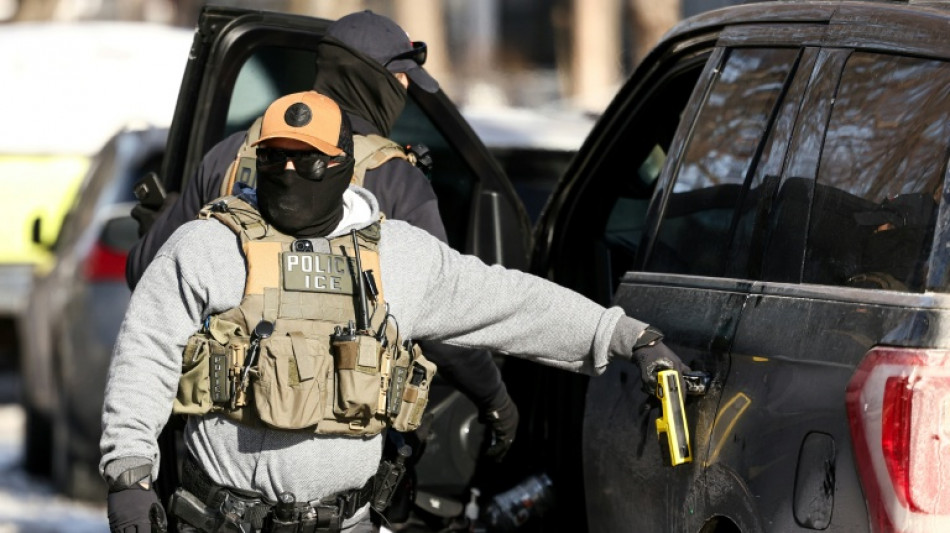
Native Americans on high alert over Minneapolis crackdown / Photo: © AFP

Inside a Native American community center in northern Minneapolis, Jessica Glidden is getting her tribal identity card issued as the city has become the focus of President Donald Trump's immigration crackdown.
"With all of the (immigration) operations happening in the metro area, having your tribal ID is very important because I feel like folks are being racially targeted and profiled right now," said Glidden, a 42-year-old member of the Bois Forte tribe.
"It's just an added, extra layer of protection to have."
Minneapolis and its twin city Saint Paul form one of the largest Native American populations in a metropolitan area of the US.
With tens of thousands of people, it is also a stronghold of Native American activism.
Immigration and Customs Enforcement (ICE) agents "are targeting people because they have brown skin," said Crow Bellcourt, head of a Native American advocacy organization, recounting the recent arrest of one of his friends who was detained for about 12 hours before being released.
"We were the first peoples here. It's just crazy," he said.
"It shouldn't be happening to us in our own country. This is our land."
- 'Slap in the face' -
Bellcourt, a member of the Chippewa tribe, said the community had pre-existing fears when ICE operations began.
"When we heard 1,500 ICE agents were coming, we knew that it was going to affect all brown people," he said.
Robert Rice, owner of the Pow Wow Grounds cafe, a central hub for the Native American community in south Minneapolis, condemned the targeting of his community.
"How dare they? It's a slap in the face. So how do I feel about it? Disgusting," he said.
To enter Rice's cafe through its yellow and red facade, customers have to knock on a door that is locked "for the safety of our customers and employees," according to a sign.
Another sign reads: "Everyone is welcome here. Except ICE."
Rice, a member of the White Earth Nation, recalls trips made by many tribes to Minneapolis to provide their members with tribal identity cards -- recognized as official documents in the US by century-old legislation -- since the anti-immigration crackdown launched here in December.
Since Native Americans have been caught up in the anti-immigration raids, more people have started to wear the ID cards around their necks every day.
Bellcourt has worn his for nearly a month.
"My cousin joked about attaching her tribal ID card to a lanyard, and I thought it was a good idea so I could show it if I get stopped," he said.
- 'A lot of fear' -
One Native American woman, who spoke on condition of anonymity, said the ID cards offered some comfort amid the operations.
"It gives me some sense of security to take a first step in protecting myself," she said.
Arlene Raymond, who has lived in Minneapolis for nearly 50 years, said Native Americans are supposed to feel safe on their lands but noted many do not feel secure now.
"We're living with a lot of fear," she said.
"Our tribal ID is something that we hold close to us, but now even closer. We've never had to show it. We've never had to wear it to prove who we are. It's quite scary."
Fort Snelling stands near the federal building used by ICE on the outskirts of Minneapolis.
In the 19th century, more than 40 Native American men were hanged there, and over 1,500 Native Americans, including women, children and the elderly, were detained at the site after being forcibly removed from their lands.
Today in the city, Native Americans are adorning their ID cards to avoid similar detention.
"It's something that you never thought that you would have to do," said Raymond.
"It's something that's not new to us, but new for now."
J.P.Estrada--TFWP