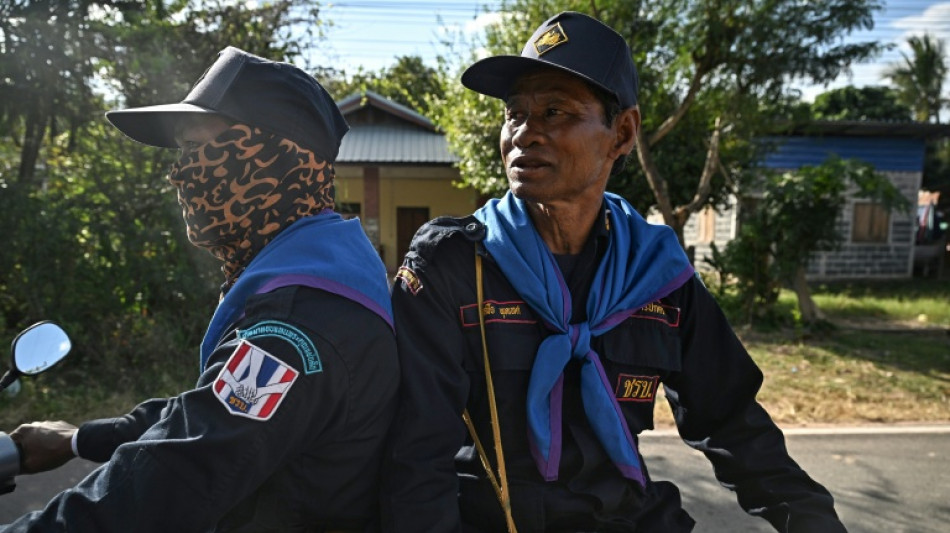
Volunteers patrol Thai villages as artillery rains at Cambodia border / Photo: © AFP

Ten kilometres from Thailand's disputed border with Cambodia, farmer-turned-village security guard Narongchai Putthet stands at a roadside checkpoint, his rifle slung across his navy blue uniform.
The 60-year-old is one of a small band of volunteers appointed by local authorities to protect rural Thai communities now largely deserted after a week of back-and-forth military bombardments over the Southeast Asian neighbours' contested frontier.
The volunteers are their community's eyes and ears during the renewed clashes, which have killed at least 27 people and are rooted in a dispute over the colonial-era demarcation of their 800-kilometre (500-mile) border.
Their duties include guarding empty homes from potential looters, caring for livestock and manning checkpoints outside their village -- mostly quiet except for the dull thud of distant artillery echoing through dry rice fields.
It's an unusual kind of service, carried out at great personal risk and for no pay.
"Even though we don't get a salary or an allowance, it's worth it," Narongchai told AFP.
"At least we get to help our fellow villagers. We do it with a volunteer's heart."
Komkai Seehanam, chief of a village in Buriram province, leads the 20-member team responsible for safeguarding the property of about 500 residents.
"Am I afraid? Of course," he told AFP on Saturday.
But some people needed to stay behind and look after their neighbours' things, the 55-year-old said.
"We truly care," he added.
- Trained to protect -
With more than 250,000 Thais in shelters and tens of thousands more evacuated elsewhere since fighting broke out on December 7, the few who remain in their villages nap in bunkers by day and patrol at night.
The volunteers know their village by heart -- which family raises pigs and which fields hold the cattle pens.
On their rounds, they stop to feed cows and pour water for dogs that race to greet them.
Between patrols, Narongchai and Komkai rest under tin roofs or inside a newly built bunker reinforced with tyres and sandbags.
"If someone has rice or vegetables, they share them with the volunteers. We all make do together," Komkai said.
To become guards, they received basic training from the army, police and local authorities in survival skills, first aid and how to deal with unexploded ordnance.
"They showed us how far bullets can travel, where shells might fall and what to do if one doesn't explode," Komkai told AFP. "That knowledge helps us protect others."
He said training also covers moving safely under fire.
"Everyone's safety has to come first," he added. "It's our duty and this is our home no matter what."
- Waiting, worrying -
At an evacuation shelter in Buriram's Chang International Circuit race course, around 70 kilometres (43 miles) from the village, Narongchai's wife, Uthai Putthet, sits on a straw mat anxiously awaiting updates.
"How are things right now? Have you eaten anything today?" the 53-year-old farmer asked him during a video call.
Since a previous round of deadly border clashes this summer, women, children and seniors have typically evacuated rural farming communities first, while men stay behind to guard property.
This past week of fighting has kept Narongchai and Uthai apart -- each new barrage extending their separation.
"In July, I had to stay at the shelter for about 15 days... now the firing is happening every day and people are wondering 'will we have to stay like this for months or up to a year?' It's really disheartening," Uthai told AFP.
Another evacuee, Nattamon Pawaputo, also awaits word from her husband and cousin, both volunteer guards in another border village.
"I'm worried about them. I can hardly sleep," said the 52-year-old, recalling them telling her about the never-ending shelling.
Like they did in July, Narongchai and his team remain at their posts for now, standing guard under bursts of heavy fire.
He knows that even a ceasefire will offer him little relief. "Even if it ends, we'll still be on edge," Narongchai said.
"After the last round of fighting, whenever I hear thunder, I still think it's shelling."
B.Martinez--TFWP