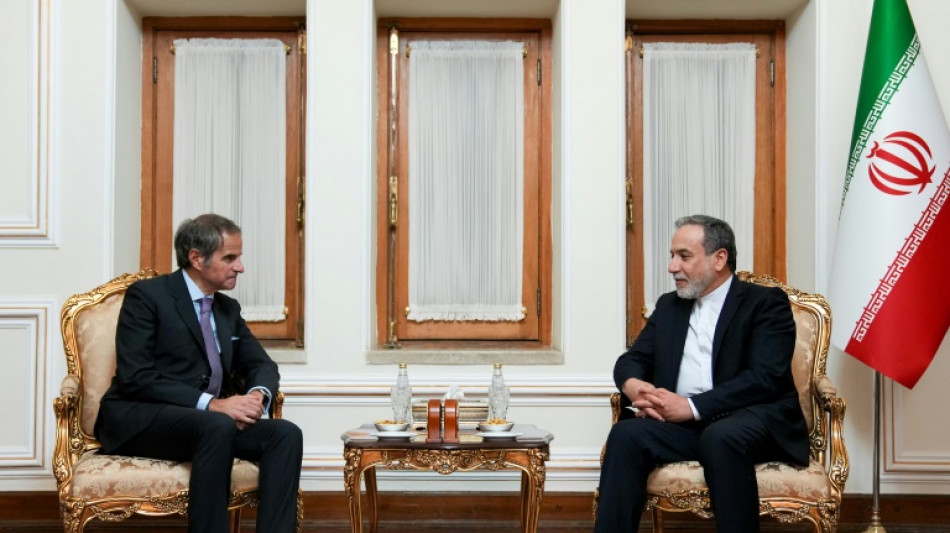
Iran boosts highly enriched uranium production: IAEA / Photo: © Iranian Foreign Ministry/AFP

Iran has ramped up production of highly enriched uranium, according to a confidential UN watchdog report, as Tehran said Saturday that it had received US proposals to settle its long-running nuclear dispute with the West.
Iran rejected the report by the International Atomic Energy Agency (IAEA), the latest move in years-long efforts to restrict its nuclear activities over fears that it is seeking to develop nuclear weapons.
The IAEA report, seen by AFP, said Iran had sharply increased its stockpile of uranium enriched to up to 60 percent, close to the roughly 90 percent level needed for atomic weapons.
Iran rejected the report, which came amid high tensions in the Middle East over Israel's military offensive in Gaza, with Tehran's foreign ministry calling it a "political" manoeuvre.
The ministry accused Israel of providing "unreliable and misleading information" to the IAEA for the report, "contrary to the IAEA's principles of professional verification".
Iran's Foreign Minister Abbas Araghchi said earlier Saturday that he had received "elements" of a US proposal for a potential nuclear deal following five rounds of talks mediated by Oman.
Omani Foreign Minister Badr al-Busaidi "paid a short visit to Tehran today to present elements of a US proposal which will be appropriately responded to in line with the principles, national interests and rights of the people of Iran," Araghchi said on X.
The IAEA report said Iran had an estimated 408.6 kilogrammes of uranium enriched to up to 60 percent as of May 17, up by 133.8 kilogrammes since the last report in February.
Iran's total amount of enriched uranium now exceeds 45 times the limit authorised by the 2015 agreement with world powers, and is estimated at 9,247.6 kilogrammes.
"The significantly increased production and accumulation of highly enriched uranium by Iran, the only non-nuclear weapon State to produce such nuclear material, is of serious concern," the IAEA said.
In a separate in-depth report, the IAEA criticised "less than satisfactory" cooperation from Tehran over its scrutiny of its nuclear programme, specifically noting Iran's lack of progress in explaining nuclear material found at undeclared sites.
- Iran says nuclear arms 'unacceptable' -
Western governments have long suspected Iran of seeking to develop a nuclear weapons capability to counter the widely suspected but undeclared arsenal of its arch-foe Israel.
Iran has denied seeking nuclear arms and says it needs the uranium for civilian power production.
Following the IAEA report, Israel on Saturday accused Iran of being "totally determined" to acquire nuclear weapons.
"Such a level of enrichment exists only in countries actively pursuing nuclear weapons and has no civilian justification whatsoever," a statement from Prime Minister Benjamin Netanyahu's office said.
In response, Araghchi reaffirmed the country's longstanding position, saying Tehran rejected nuclear weapons.
"If the issue is nuclear weapons, yes, we too consider this type of weapon unacceptable," Araghchi, Iran's lead negotiator in the talks, said in a televised speech. "We agree with them on this issue."
Araghchi's remarks came a day after US President Donald Trump said Iran "cannot have a nuclear weapon", while expressing hope of striking a deal soon.
On Thursday, Araghchi hit out at what he called "media speculation" that the two sides were close to an agreement, saying he was "not sure if" a deal was "imminent".
Iran has held five rounds of talks with the United States on a new agreement with major powers after Trump abandoned the process during his first term as president in 2018.
No date or venue has yet been announced for the next round but Araghchi said Wednesday that he expected an announcement from mediator Oman in the "next few days".
Washington has said Iran's uranium programme must cease but Tehran insists it has a right to pursue it under the nuclear Non-Proliferation Treaty.
- 'Very good talks' -
Israel has repeatedly threatened military action, after pummelling Iranian air defences during two exchanges of fire last year.
Trump said Wednesday that the United States was having "very good talks with Iran", adding that he had warned Netanyahu against striking its nuclear facilities as it would not be "appropriate right now".
Trump has not ruled out military action but said he wants space to make a deal first, and has also said that Israel, and not the United States, would take the lead in any such strikes.
Trump adopted a "maximum pressure" policy against Tehran after abandoning the 2015 agreement and reimposed sweeping sanctions which the deal had lifted in return for UN-monitored restrictions on Iran's nuclear activities.
Iran continued to honour the agreement for a year, but then began rolling back its own compliance with its terms.
Uranium enriched to up to 60 percent is far beyond the 3.67-percent limit set by the 2015 agreement.
In recent days, Tehran has said that if a deal is reached, it may consider allowing US inspectors to join the IAEA monitoring teams.
T.Dixon--TFWP