Hawaiian Honeycreepers Face Extinction as Mosquitoes Spread Avian Malaria to Higher Forests

Conservationists on the Hawaiian island of Kaua‘i are urgently relocating remaining honeycreeper populations to higher elevations as a massive surge in mosquitoes spreads avian malaria into previously safe forest zones. With wild populations plummeting and no natural immunity to the disease, experts warn that without immediate intervention, several endemic bird species could vanish from the wild by the end of the year.
Conservationists on the Hawaiian island of Kaua‘i are urgently relocating remaining honeycreeper populations to higher elevations as a massive surge in mosquitoes spreads avian malaria into previously safe forest zones. With wild populations plummeting and no natural immunity to the disease, experts warn that without immediate intervention, several endemic bird species could vanish from the wild by the end of the year.
Deep within the Alaka‘i plateau, located 4,000 feet above sea level in Kaua‘i’s remote mountains, the forest has fallen silent. For staff at the Kaua‘i Forest Bird Recovery Project, this quietness serves as both a memorial to species already lost and a warning of impending extinction. Last year, the island lost its last wild ‘akikiki, a tiny gray bird found nowhere else on Earth. Now, only a few dozen ‘akikiki remain, housed in captive breeding centers on O‘ahu and Hawai‘i Island.
The same trajectory threatens other endemic species. The ‘akekeke, a small greenish-yellow honeycreeper, has a wild population estimated by wildlife biologists to be down to just a handful. Populations of the olive-green Kaua‘i ‘amakihi have collapsed from approximately 9,000 birds in 2023 to fewer than 500 this year. The ‘anianiau, a lemon-yellow bird previously thought to number over 3,000 in the wild in 2023, has also dropped to only a few hundred individuals.
In June, researchers presented a stark projection to local lawmakers: every one of Kaua‘i’s endemic honeycreeper species could be lost as soon as Christmas. Lisa “Cali” Crampton of the Kaua‘i Forest Bird Recovery Project noted that populations previously estimated in the hundreds are no longer being seen at all.
This sudden decline follows an unprecedented swarm of southern house mosquitoes invading Kaua‘i’s higher-elevation forests, a development that surprised both scientists and conservationists. These mosquitoes carry avian malaria, a disease that can kill honeycreepers after just one or two bites. Because the birds evolved on islands without mosquitoes for millions of years, they lack natural immunity to the pathogen.
Jeff Foster, a professor of biological sciences at Northern Arizona University, identified rising global temperatures as the primary driver behind the mosquito expansion. Warmer conditions have allowed the insects to move farther up into higher elevations. While Kaua‘i’s mountains rise to only about 5,000 feet and lack the high-elevation forests found on taller islands like Hawai‘i and Maui, the warming trend has pushed mosquitoes into the honeycreepers’ remaining habitat.
Foster explained that drier conditions in Kaua‘i’s forests actually provide better breeding grounds for mosquitoes, contrary to expectations in other regions. Additionally, because Kaua‘i’s mountains are shaped like plateaus rather than steadily inclining peaks, there was no steep transition zone where scientists could have observed a gradual decline in bird populations. The mosquito boom appeared sudden only because the progression had been difficult to track.
“We knew it was coming, but we thought we had more time,” Foster said. “And then suddenly we didn’t have any more time and it’s worse than we imagined.”
The scale of the infestation has overwhelmed previous control efforts. In fall 2025, field workers recorded mosquito trap counts jumping from one to four per night to 300 per night within two months. Crampton recalled that conservationists had been using natural bacteria-based insecticides and releasing sterile male mosquitoes through the incompatible insect technique, but these methods appear futile against such a dramatic increase.
Justin Hite, mosquito project coordinator for the Hawai‘i Division of Forestry and Wildlife, noted that while he had previously feared catastrophic hurricanes like Lowell, which struck Kaua‘i in September, the mosquito threat was more devastating. “In some ways I’m less worried now,” Hite said regarding the hurricane, “because the mosquito storm that hit us last winter was already way more devastating than a hurricane really could ever be.”
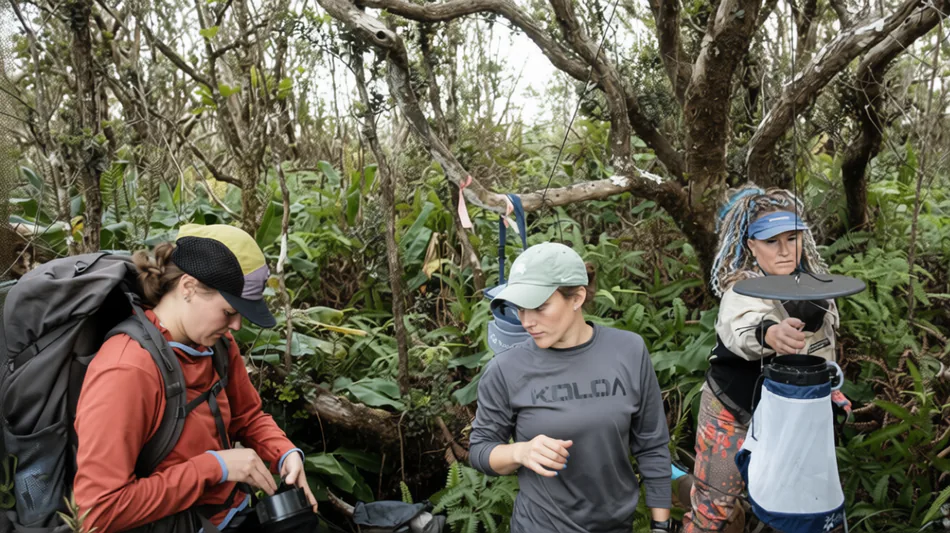
With eradication across the entire forest deemed impossible due to time and resource constraints, conservationists have shifted their strategy to emergency translocation. Crampton described the effort as pulling birds out of a burning house. Her team is now focusing on locating honeycreepers and transporting them via helicopter to secure facilities operated by the Honolulu Zoo and San Diego Zoo Wildlife Alliance on O‘ahu and Hawai‘i Island.
Currently, these partners hold 19 ‘anianiau, 30 ‘akikiki, and three ‘akekeke in captivity. These birds are protected from pathogens and integrated into breeding programs designed to rebuild their populations. However, the long-term survival of these species on Kaua‘i remains uncertain.
Scientists have discovered that ‘amakihi species on O‘ahu and Hawai‘i Island have developed genetic resistance to avian malaria. Loren Sackett of the University of Louisiana recently led research identifying a gene responsible for this resistance. Her team found that each island’s ‘amakihi evolved different genetic pathways to achieve immunity. Isolating these genes could offer insights into helping Kaua‘i’s ‘amakihi develop resistance, though CRISPR gene-editing tools are currently considered too risky for wild populations.
The discovery of genetic differences has opened discussions about hybridization between Kaua‘i and O‘ahu ‘amakihi populations. However, this approach faces legal and ethical challenges under the Endangered Species Act, which lacks overarching guidelines for hybridization and handles such cases individually.
Despite these potential scientific solutions, Hite stated that his team lacks the time and resources to pursue them. The captive population of Kaua‘i ‘amakihi consists of only a handful of related females, making successful cross-breeding unlikely. Consequently, conservationists are prioritizing the translocation of the ‘anianiau to forests on Hawai‘i Island, where higher elevations have kept mosquitoes at bay for now.
The ‘anianiau were selected because they are among the most abundant of Kaua‘i’s endemic honeycreepers and have the highest chance of thriving in a new environment. Crampton’s team has begun capturing adult birds, with hopes to start the translocation process this fall.
This “assisted migration” carries its own risks. Introducing a species to an unfamiliar habitat can disrupt local ecosystems, and there is no certainty that the ‘anianiau will adapt successfully. Hite emphasized that leaving the birds on Kaua‘i is no longer an option. “More than three thousand ‘anianiau died in the last three years, and now there’s just a handful left,” he said.
Conservationists acknowledge that translocation is only a temporary solution. As temperatures continue to rise, mosquitoes are expected to invade high-elevation forests across the entire Hawaiian archipelago. Eventually, even Hawai‘i Island’s forests may face the same fate as Kaua‘i. However, Crampton hopes that moving the birds will buy enough time for mosquito eradication efforts on Kaua‘i to succeed, allowing for a future return of the ‘anianiau to their native home.
C.M.Harper--TFWP