Sea levels to rise in California as coastal wave surges up west coast / Photo: © AFP

Sea levels in California are set to rise by as much as a foot (30 centimeters) in the coming days as an enormous wave washes up the US West Coast.
The huge surge of energy, known as a "coastal trapped wave" or a "Kelvin wave," is part of El Nino, a months-long phenomenon in the Pacific Ocean that scientists say could generate powerful storms and floods in some parts of the world, while leaving others in drought.
The Kelvin wave is not anything like a tsunami; nor does it crash on beaches. Rather it is a sustained bulge of excess water up to 30 kilometers (18 miles) wide that will hug the coastline as it travels all the way up to Alaska.
Dillon Amaya, an oceanographer at North Carolina State University, said the elevated sea levels could collide with other natural phenomena to create problems for coastal communities.
"What this wave is doing is it's raising sea states, and then when... you combine this wave with things like storm surge from passing weather, large swells, or things like astronomically high tide....(you) elevate your risk for things like flooding and also beach erosion," Amaya told AFP by telephone.
"The general rule of thumb is that every two to four inches (5-10 centimeters) of sea level rise that we see in that background state essentially doubles your flood risk.
"So it doesn't sound like a lot, but because it's over a huge volume of water, and it's combined with these other factors, you start to get the flood risk."
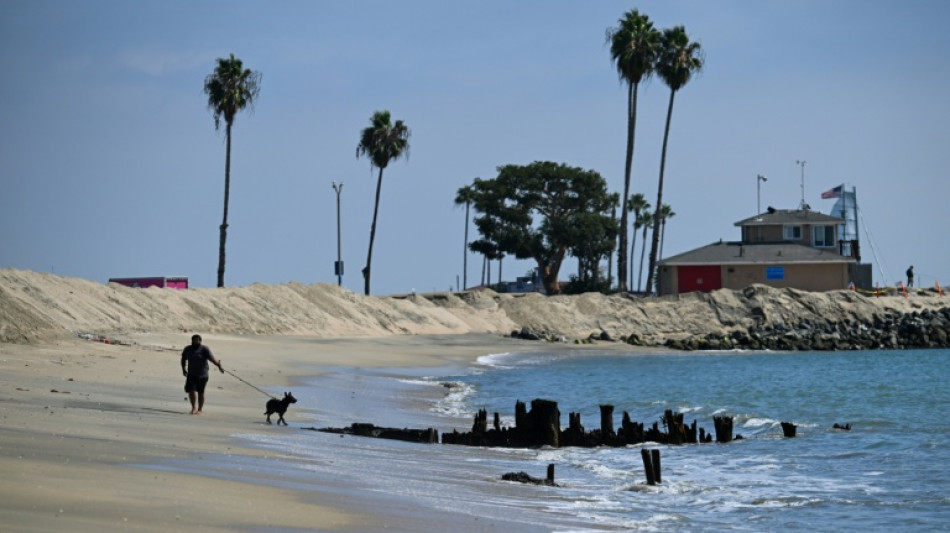
In recent weeks parts of Southern California have been hit by storm surges that have eaten away at beaches or damaged properties.
In Dana Point and Laguna Beach, south of Los Angeles, several houses have been left uninhabitable, and at least one has completely collapsed.
In Malibu, an enormous sink hole emerged in the driveway of a home belonging to Hollywood actor Nicolas Cage when pounding waves from a nearby hurricane eroded the coastline.
- El Nino -
The Kelvin wave is essentially both a cause and a symptom of El Nino, said Amaya, and originates in waters near Indonesia when trade winds die down.
"Those trade winds hold up a ton of really warm water in the Western Equatorial Pacific because they're pushing on the surface waters as they blow.
"If they weaken for too long... water is then able to effectively slosh back along the equatorial strip from Indonesia all the way to South America."
As this wave makes it way over the Pacific, it suppresses the cold water that usually comes up from the deep ocean, making the surface temperature higher.
It is this ocean warming that we call El Nino.
"So these Kelvin waves are, in many ways, the driving force of El Nino. They help El Nino grow and mature over the course of several months," said Amaya.
As the equatorial Kelvin wave hits South America, the energy converts into a coastal Kelvin wave, and heads both north and south along the continents.
The wave going towards the US is currently somewhere north of Cabo, Mexico, and travelling around six miles (10 kilometers) an hour, said Amaya, who expects it to reach San Diego within the next week.
While Kelvin waves are common -- there are five or six during every El Nino -- this one arrives at a delicate time, said Amaya, with sea temperatures already elevated.
"When it gets really warm, that water expands... which causes sea levels to rise just because the water is warm, so you get an additional additive increase in sea level," he said.
"Southern California... just got battered by offshore tropical cyclones, which led to flooding events already and beach erosion, so there's lots of anxiety about extra flood risk coming from El Nino and these waves."
C.Dean--TFWP