Pacdora Data: 65% of New Online Packaging Designs Are Now Created as 3D Mockups

Based on 1.58 million projects: the first platform-level dataset on how online packaging designs split between 3D mockup and 2D dieline workflows.
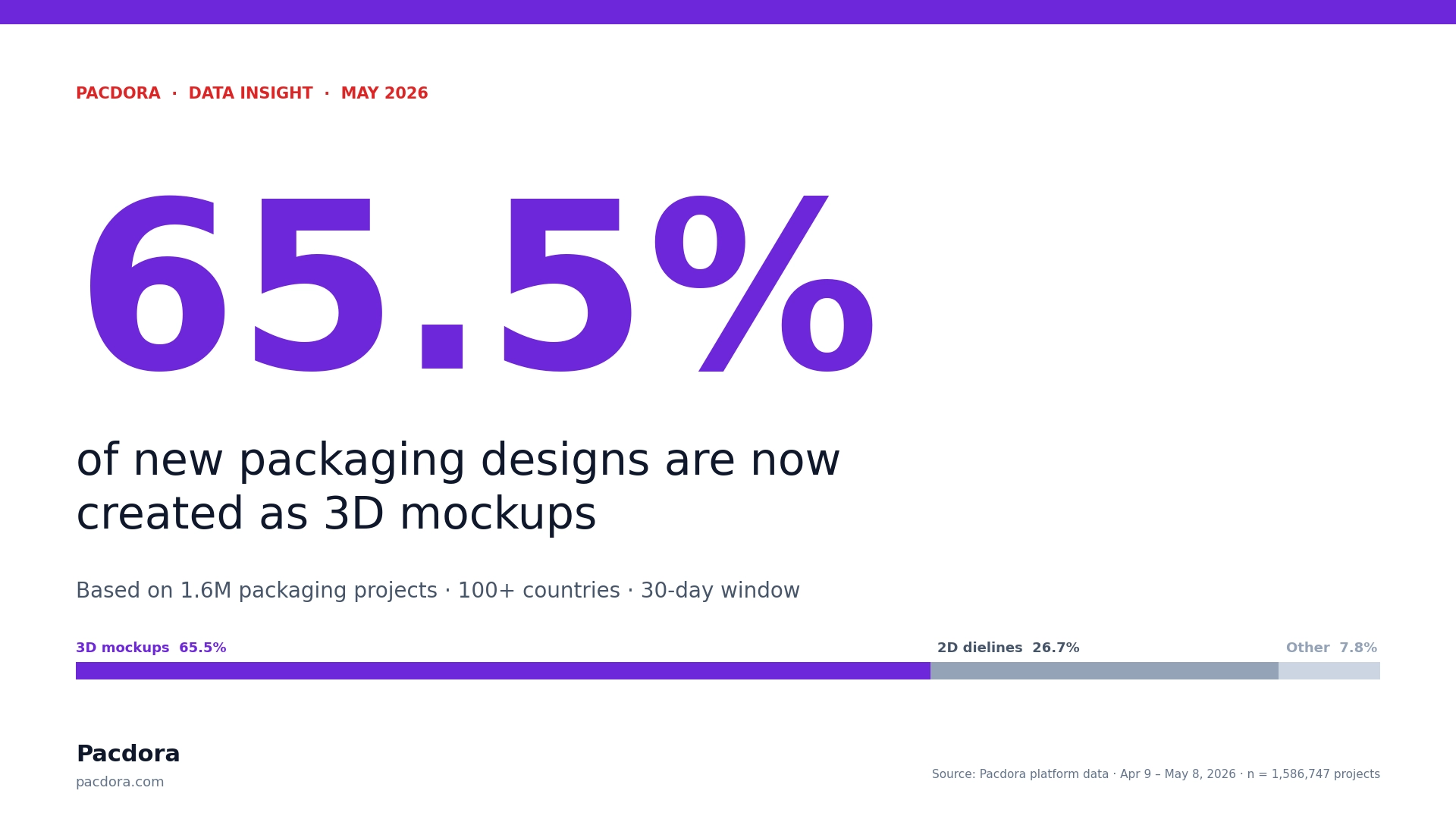
SINGAPORE, SG / ACCESS Newswire / May 19, 2026 / Pacdora, a browser-based packaging design platform with 4.5 million registered users, reported today that 65.5% of the 1.58 million projects created on its platform between April 9 and May 8, 2026 began as 3D mockups rather than flat 2D dielines. The pattern held across regions and product categories, the company said, indicating that 3D mockup has replaced the dieline as the default starting point for new packaging work on browser-native platforms.
Browser-based tools have made 3D rendering accessible to in-house designers and freelance studios that previously relied on specialist agencies.
Of those projects, 1.04 million (65.5%) were created as 3D mockups and 423,000 (26.7%) as 2D dielines, according to Pacdora. Among projects that explicitly chose a format, 71% began in 3D. Two decades ago, such workflows required dedicated rendering software and specialist training.
When Designers Choose 3D - And When They Don't
Adoption differs widely across product categories, the data showed. Designers tend to pick 3D when evaluating consumer-facing visuals, and 2D when working on production output.
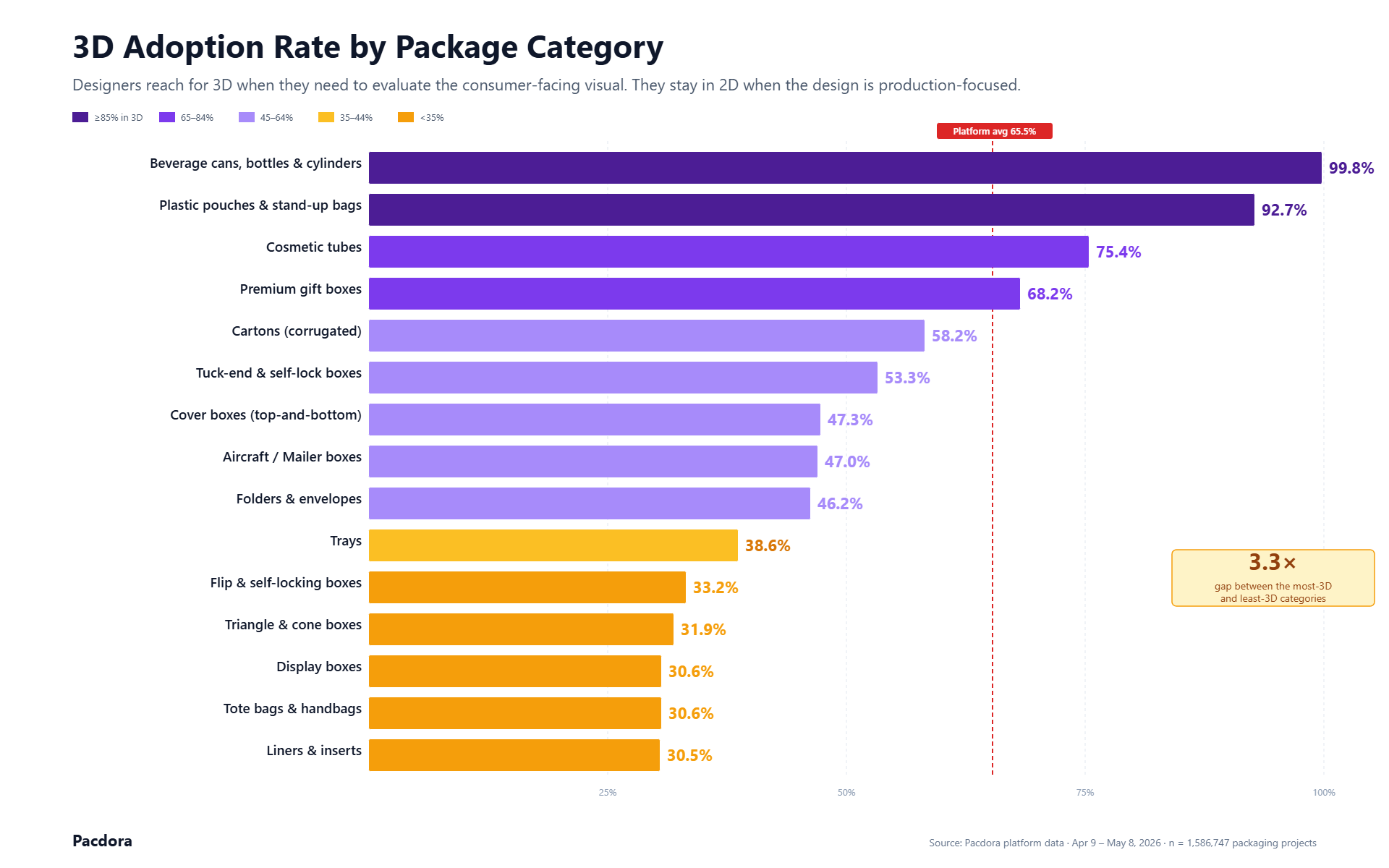
High 3D adoption (evaluation-driven categories) - designers need to see how the package will look to a consumer:
Beverage cans, bottles, and cylindrical containers: 99.8% in 3D
Plastic pouches and stand-up bags: 92.7% in 3D
Cosmetic tubes: 75.4% in 3D
Premium gift boxes: 68.2% in 3D
Low 3D adoption (operation-driven categories) - designers need accurate flat layouts for printing and production:
Tote bags and handbags: 30.6% in 3D
Display boxes: 30.6% in 3D
Liners and inserts: 30.5% in 3D
Triangle and cone boxes: 31.9% in 3D
Flip and self-locking boxes: 33.2% in 3D
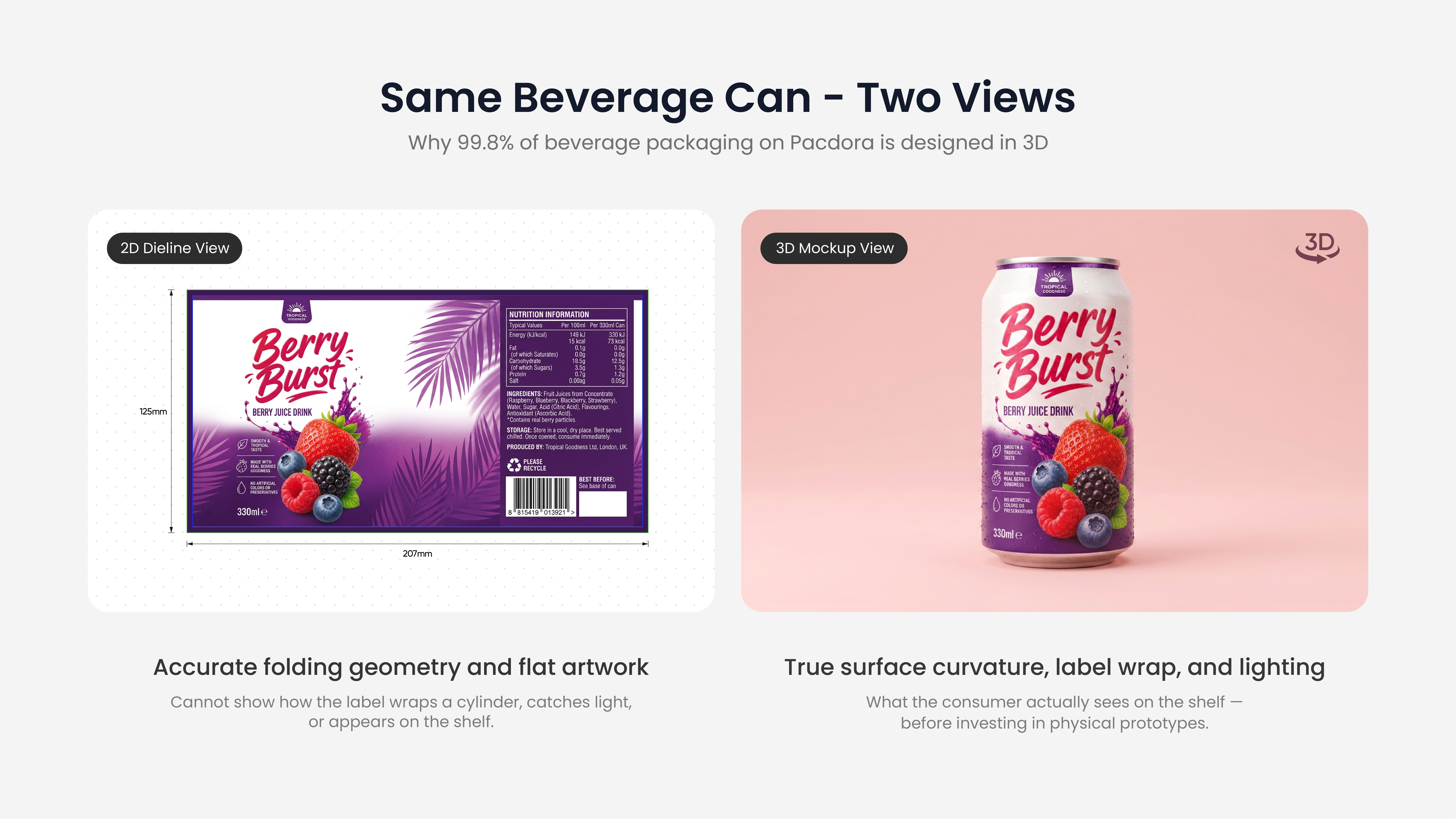
A 3D mockup is the only way to judge how a label wraps a curved bottle or whether artwork distorts on a stuffed pouch. For categories where fold accuracy or print dimensions are the main concern, designers can stay in 2D. The 3.3x gap between top and bottom categories follows that split.
"The category split surprised me more than the headline," said Raymond Wang, CEO of Pacdora. "We knew drink cans would lead. But three times the rate of tote bags? That comes down to whether designers can judge the work without seeing it rendered." Wang added that the cross-country data was the another surprise: "Indonesia and the U.S. tied at 82% - we didn't expect that."
Global Adoption Crosses Borders
3D adoption was not concentrated in a single market. Among countries with at least 10,000 projects, the Philippines led at 88.2%, followed by France (85.2%), South Korea (84.9%), the United Kingdom (84.5%), and Canada (83.3%), all above the 77.6% cross-country average. The three largest markets by volume-Indonesia, the United States, and India-sat within a few points of one another. Pacdora said the spread no longer correlates with market maturity.
Industry Implications
For brand teams and packaging buyers, the trend means faster feedback cycles. A category manager reviewing six SKU variants can compare them on screen during the design meeting rather than waiting for printed comps. For suppliers, the gap between concept and approved dieline narrows. The practical question for in-house designers in 2026 has shifted from whether to render a mockup to which categories still let them skip one.
Pacdora will continue tracking how packaging design workflows evolve across categories, regions, and brand types, with additional insights planned later in 2026.
About Pacdora
Pacdora is the browser-based packaging design platform used by more than 4.5 million registered users across 100+ countries**.** The platform provides integrated dieline structures, 3D mockup visualization, brand-guided design tools, and production-ready output, helping teams move from concept to production in a single workflow. Learn more at https://www.pacdora.com.
Media Contact
Pacdora Press Office: [email protected]
Website: www.pacdora.com
SOURCE: PACDORA PTE. LTD.
View the original press release on ACCESS Newswire
S.Rocha--TFWP