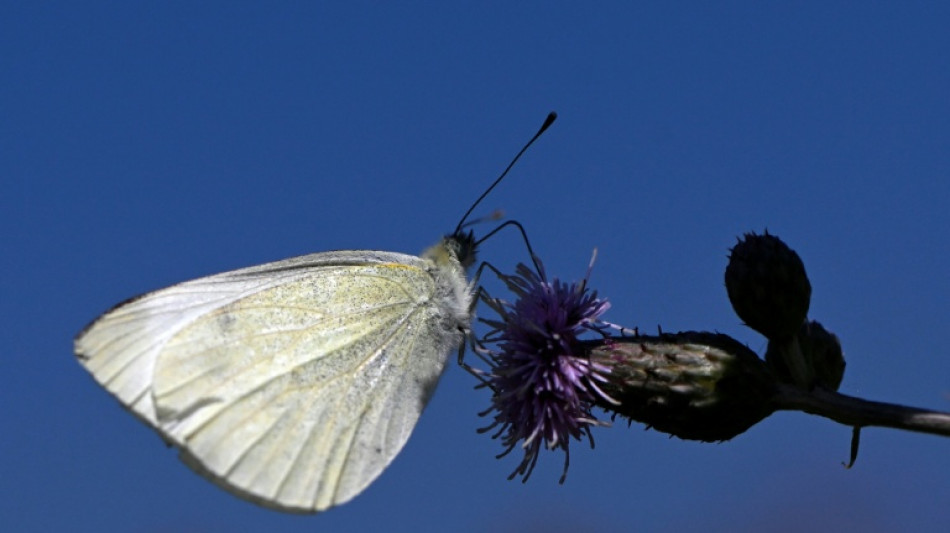
Butterflies seek new habitats as climate changes: study / Photo: © AFP

Climate change is driving shifts in where butterflies are found globally, a major study said Wednesday, with many species moving into new areas while others are retreating from traditional habitats.
The study in Nature Ecology & Evolution is one of the most comprehensive to date on how butterfly distributions are changing, assessing more than 1,700 species across 105 countries and territories.
Researchers found that nearly 80 percent of the reported shifts in the geographic ranges where butterflies were associated with climate change and extreme weather events.
Other factors were also driven by human activity: changes in land use, intensive agriculture, urbanisation, habitat fragmentation and the introduction of invasive species.
Butterflies are considered important indicators of ecosystem health because they are highly sensitive to temperature changes, have short life cycles and depend on specific host plants.
As the planet warms -- primarily because of the burning of coal, oil and gas -- some butterfly species are relocating northwards or seeking out higher elevations in search of cooler conditions.
However, just 22 percent of species showed a shift in elevation.
Overall, 80 percent of species expanded their range while 27 percent experienced range contractions, with some showing different patterns in different regions, underscoring the complexity of responses to climate change.
"This is rather good news as it proves that butterfly species are capable of migrating and shifting their range to adapt to changes," study co-author Jonathan Lenoir, an ecologist from France's national scientific research centre (CNRS), told AFP.
- 'Trapped' -
Lenoir cautioned that range expansions were easier to detect than contractions because it was simpler to confirm a species has colonised a new area than prove it has vanished entirely from another.
Many observations, including those made by citizen scientists, were concentrated in lowland areas and near urban centres, potentially skewing the findings.
But butterflies could only adapt so far, Lenoir said.
It was possible that beyond a certain warming threshold more butterflies would contract their range, causing "much more rapid and sudden upheavals" among certain species and "potential extinctions".
A 2024 study in Global Ecology and Biogeography found that 84 per cent of roughly 270 butterfly species studied in Europe would reduce their range by 2080 if global temperatures keep rising.
"Some butterfly species will not necessarily be able to migrate further north in latitude, or higher up in the mountains, in response to the global rise in temperatures," said Lenoir.
Species endemic to mountain regions on islands could become "trapped" as their habitat is reduced "to almost nothing" with limited options to shift elsewhere, he added.
The authors advocated for stronger conservation policies, the protection and restoration of butterfly habitats, ecological corridors and micro-climatic refuges, and improving biodiversity monitoring particularly through citizen science.
Underlining it all, they emphasised the urgent need to limit global warming to lower levels.
Knowledge gaps, too, must be addressed: just one in 10 butterfly species has documented data on how its range is changing and tropical regions remain largely understudied, the authors added.
M.Cunningham--TFWP