US announces 'guardrails' for controversial carbon markets / Photo: © AFP

President Joe Biden's administration announced new "guardrails" to help ensure carbon offset markets are actually effective, in a big boost for the controversy-dogged schemes intended to reduce planet-warming emissions.
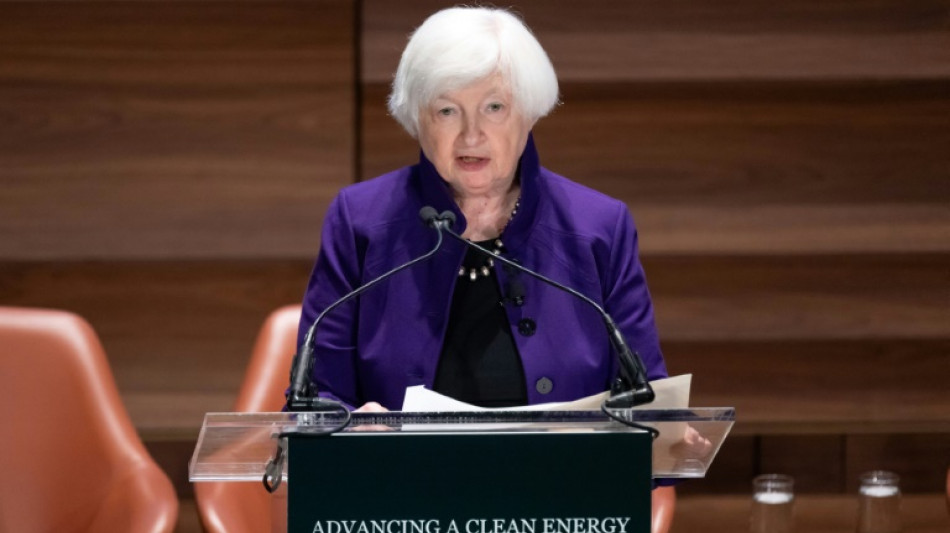
Cabinet officials including Treasury Secretary Janet Yellen laid out the government's first broad guidelines for "high-integrity" carbon markets, aimed at dispelling distrust in a system panned by critics as greenwashing.
"It's about building the confidence to be able to use this tool more effectively at scale," White House national climate adviser Ali Zaidi told AFP.
"Four years into the decisive decade for climate action, we're not in a position to sideline any set of tools that will help us move faster."
Carbon credits enable corporations and countries to offset their greenhouse gas emissions, with each credit representing the reduction or removal of one tonne of CO2, often in developing countries through projects combating deforestation.
Other examples of carbon projects include replacing cookstoves, and directly capturing carbon dioxide from the air.
The carbon offsets market is currently worth around $2 billion per year. But recent research has raised concerns that claims of reduced emissions under the schemes are often grossly exaggerated, or in some cases, entirely unfounded.
Yellen outlined principles emphasizing integrity in three key areas: supply-side credits tied to genuine emissions reductions or removals; demand-side corporate accountability that prioritizes emission reduction; and market integrity through greater transparency and reduced complexity.
- US imprimatur -
The release of the guidelines, detailed in a 12-page policy statement, is an important signal the US government is throwing its weight behind carbon markets, Nat Keohane, of the Center for Climate and Energy Solutions, told AFP.
"Right now, the problem we have is not that all credits are bad -- some are really, really good, and some are bad, and it's hard to tell the difference," he said.
That's where the administration's guidelines come in, he added, "creating convergence and alignment about what good looks like."
Accountability, he said, would be market-driven and come from companies seeking high-quality carbon credits to avoid a public backlash.
While the Biden administration doesn't explicitly endorse emerging sets of standards developed by the two most prominent industry-led bodies -- the Integrity Council for the Voluntary Carbon Market (ICVCM) and Voluntary Carbon Markets Integrity Initiative (VCMI) -- it says these play "an essential role."
Prominent advocates of carbon markets, including former US climate envoy John Kerry, argue that government funding alone is insufficient to meet the Paris accord's goal of limiting warming to 1.5 degrees Celsius.
Kenya's President William Ruto has hailed Africa's carbon sinks as an "unparalleled economic goldmine" with the potential to generate billions annually.
- 'Walk the talk' -
But Gilles Dufrasne of Carbon Market Watch told AFP that the US government must "walk the talk" and ensure transparency and integrity in its promises.
"There is currently no public data to transparently measure how much finance is flowing to climate action through carbon credits, and how much is staying in the pockets of global north intermediaries and consultants," he added.
Barbara Haya of UC Berkeley noted that while the published guidelines are "excellent," they bear a strong resemblance to existing rules already in place at major offset registries, which have failed to yield satisfactory results.
"I don't think we should be advocating for the use of offsets until we see that quality can be reasonably assured," Haya, a researcher with two decades of experience studying offset markets, told AFP.
Environmentalists are also concerned about a provision in the guidelines that appears to endorse offsetting pollution from businesses' value chains.
The United Nations COP28 climate talks held in Dubai last year failed to agree on a unified set of global rules governing carbon markets, leaving countries to come up with their own bilateral and regional guidelines -- a situation ripe for greenwashing, according to critics.
J.P.Cortez--TFWP