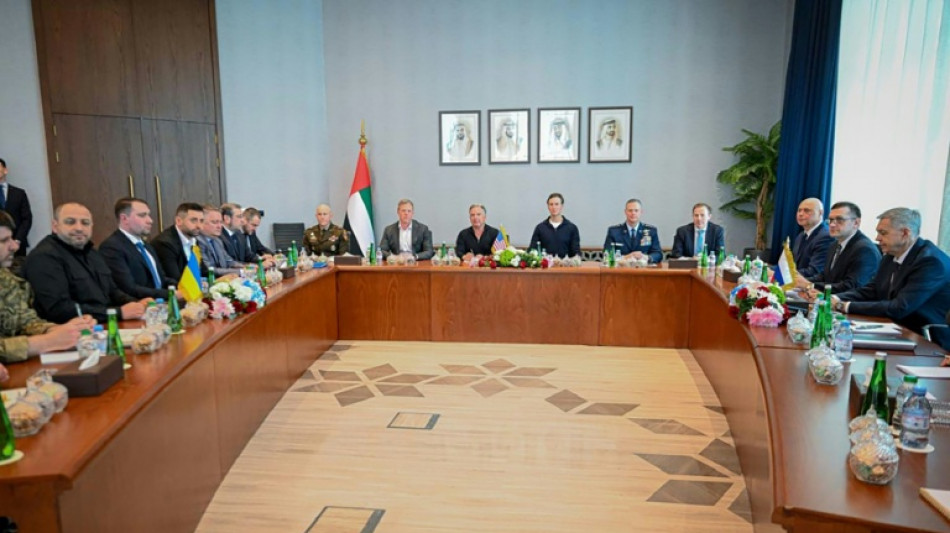
Russia, US agree to resume military contacts at Ukraine talks / Photo: © MOFA QATAR/AFP

Russia and the United States have agreed to resume high-level military contacts at two-day Ukraine talks in Abu Dhabi on Thursday, in a major step of rapprochement between the world's top nuclear powers.
Moscow and Washington suspended senior military dialogue shortly before Russia invaded Ukraine in 2022, with then US President Joe Biden severing almost all contact with Russia.
But US President Donald Trump has restored communications with Moscow since he returned to the White House last year, holding several talks and a summit with Russian leader Vladimir Putin.
The agreement to restore military contacts came after two days of talks between US, Russian and Ukrainian delegates in Abu Dhabi, searching for a deal to end the war in Ukraine.
Those negotiations resulted in the first prisoner exchange in four months, but Ukrainian President Volodymyr Zelensky called the discussions complicated and urged faster progress.
It was also announced hours after the New START treaty -- the last nuclear agreement between Moscow and Washington -- expired, triggering fears of a global arms race.
"The U.S. and Russian Federation agreed today in Abu Dhabi to reestablish high level military-to-military dialogue," the US military's European Command said in a statement, adding that "the parties continue to work towards a lasting peace."
"Maintaining dialogue between militaries is an important factor in global stability and peace, which can only be achieved through strength, and provides a means for increased transparency and de-escalation," it added.
Moscow had not commented on the announcement.
- 'Not easy' -
Moscow and Kyiv agreed to swap more than 300 prisoners at the talks in Abu Dhabi, but there were no immediate signs of progress on the thornier issue of territory.
"It is certainly not easy, but Ukraine has been and will remain as constructive as possible," Zelensky said of the talks.
"We want faster results," he told a press conference in Kyiv, speaking alongside Polish Prime Minister Donald Tusk.
US mediator Steve Witkoff conceded that "significant" work still lay ahead in the quest for a broader deal to end the war, dimming hopes for a quick breakthrough.
The negotiations are the latest bid in diplomatic efforts to halt the fighting -- Europe's deadliest conflict since World War II, with hundreds of thousands killed, millions forced to flee their homes and much of eastern and southern Ukraine left decimated.
As talks were underway, large swathes of the Ukrainian capital were still without heating in sub-zero temperatures, after successive Russian strikes knocked out energy supplies to hundreds of apartment blocks.
Kyiv's mayor Vitali Klitschko warned that more than 1,000 apartment blocks could be without heating for two months after a Russian strike earlier this week destroyed a critical power station.
- Territory deadlock -
The main sticking point in the negotiations is the long-term fate of territory in eastern Ukraine.
Moscow is demanding that Kyiv pull its troops out of swathes of the Donbas, including heavily fortified cities atop vast natural resources, before any deal.
It also wants international recognition that land seized in the invasion belongs to Russia.
Kyiv has said the conflict should be frozen along the current front line and has rejected a pull-back of forces.
Trump has been pushing both sides to negotiate an end to the war since he returned to office, boasting he could strike a deal in hours.
Zelensky said the US president's role was crucial, telling French television in an interview broadcast Wednesday that "Putin is only scared of Trump".
In a rare official admission of battlefield losses, Zelensky said Wednesday that at least 55,000 of his country's troops had been killed since Russia invaded in February 2022 -- a figure lower than many independent estimates.
Russia has not disclosed how many of its soldiers have been killed. Tracking of obituaries and family announcements by the BBC and independent Mediazona outlet has found the names of more than 160,000 Russian soldiers killed in the conflict.
Russia occupies around 20 percent of Ukraine. It claims the Donetsk, Lugansk, Kherson and Zaporizhzhia regions as its own, and holds pockets of territory in at least three other Ukrainian regions in the east.
Kyiv still controls around one-fifth of the Donetsk region that Moscow demands it withdraws from. Ukraine has warned that ceding ground will embolden Moscow, and that it will not sign a deal that fails to deter Russia from invading again.
burs-asy/oc/jc/yad
S.Jordan--TFWP