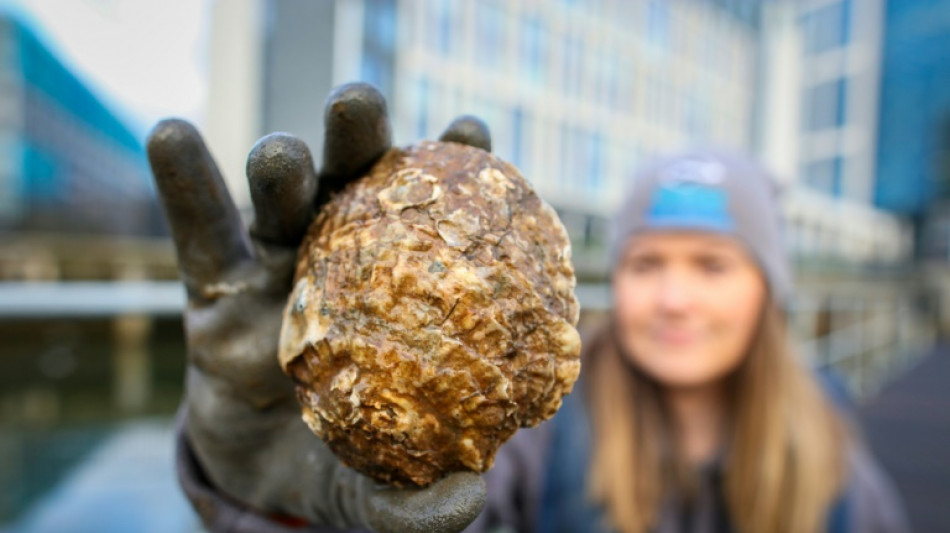
Native oysters return to Belfast after a century's absence / Photo: © AFP

Long gone from Belfast's famed harbour where the Titanic was built, oysters are making a comeback thanks to a nursery installation project aimed at boosting marine life and water quality.
Until the early 1900s, the narrow Belfast Lough channel was home to large oyster reefs but overfishing, disease and pollution gradually decimated the population, according to the Ulster Wildlife group.
"We're bringing back a lost habitat," the group's marine conservation manager David Smyth told AFP on a harbour quay in the shadow of a noisy downtown highway and towering commercial buildings.
Extensive native oyster beds were abundant in European seas, and humans have been harvesting them since the Stone Age.
But the group estimates that oyster populations have declined by 95 percent since the 19th century, with native oyster reefs now one of the most threatened habitats in Europe.
- 'Coral reef' -
Last month a nursery comprising some 700 of the molluscs -- brought from Scotland by van, and measured and screened for disease -- were lowered into Belfast Lough in over a dozen cages fitted with shelves.
It should eventually create a local "equivalent of a coral reef", said Smyth during a check of the oysters' health with a team of researchers tracking their progress.
After hoisting the metal oyster homes from the water, the team carefully removed each animal and placed them on the pier for measurement and weighing.
Pairs of oysters already conjoined are the early stages of forming a reef, said Smyth holding two aloft.
"Imagine 100,000 of these all stuck together, this is what we are after, from them millions of larvae will settle around the shore and on the seabed," he told AFP with a satisfied smile.
Among the ecological benefits of a restored habitat are boosted marine biodiversity and better water quality, according to Ulster Wildlife.
"Just as with a coral reef, once these animals start forming their beds then small fish and crustaceans like mussels, barnacles, worms, snails, and algae will come to live and feed there," said Smyth.
Oysters are also "supreme water filters" he noted, with just one animal able to filter over 200 litres of seawater a day.
- Encouraging signs -
With cargo ships and passenger ferries manoeuvering in and out of docks not far away, pollutants in the waterway make habitat rehabilitation a challenge.
Shipbuilding was one of Belfast's largest industries for much of the 19th and 20th centuries, with the yellow gantry cranes of the shipyard that built the Titanic still defining Belfast's skyline beside a new museum celebrating the doomed liner.
A coalyard and tannin works also contributed to long decades of environmental degradation.
"It's very difficult for oysters' larvae to settle and become adults if they are exposed to the sort of pollutants present in an industrial shipping lane," said Smyth.
But the resilient nursery animals have "performed impressively" so far with just two mortalities from the 700 oysters installed, with many more planned to be installed in the coming years, he added.
Similar projects have got under way recently around Europe but the Belfast nursery aims at replicating a successful effort in New York, begun a decade ago with the goal of restoring millions of oysters to replicate conditions there in the 1800s.
"New York's the shining example of how well these animals can do in an industrial area," said Smyth.
"There were dolphins swimming around the Statue of Liberty for the first time in years recently, we don't know if we will ever have dolphins swimming in Belfast but you never know," he laughed, before letting a cage drop back below the water.
L.Davila--TFWP