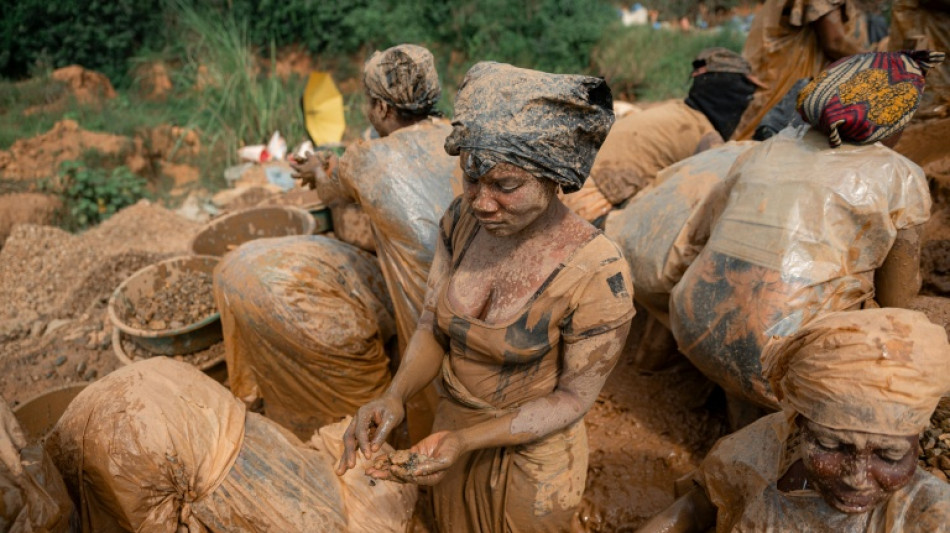
Necessity drives gold miners in DR Congo's Ebola epicentre / Photo: © AFP

In the mines of Mongbwalu, the epicentre of an Ebola outbreak in the northeastern Democratic Republic Congo, gold prospectors have no choice but to overcome their fear of the virus and carry on their backbreaking work.
"Ebola is real and it scares us. But if I stay at home, what are my children going to eat?" Justin Okaume, an artisanal digger, asked.
The DRC's 17th Ebola outbreak was declared on May 15 after several unexplained deaths in Mongbwalu in the mineral-rich but volatile Ituri province.
It has claimed more than 250 lives with 1,000 cases in the vast central African nation but the real extent of the crisis is difficult to assess.
In total, 209 people have been infected in Mongbwalu, 89 of whom have died, according to official figures.
Several miners were among the victims, Richard Lokudu, the head of the local hospital, told AFP.
"They talk to us about preventive measures but it's hard to follow them because our work forces us to be in contact with each other," Justin Uketi, another miner, said.
Behind him, greasy, sticky earth stretched as far as the eye could see.
The ochre landscape was pockmarked with holes that dozens of artisanal miners tirelessly dug through.
Men and women caked in mud broke up rocks that were then crushed to free the gold particles.
They spend hours side by side, sweating and wearing themselves out in dire health and safety conditions.
Some come from other provinces or neighbouring countries such as Uganda, hoping to earn a few hundred dollars a week, at best.
Such large population movements have also dangerously contributed to the spread of the highly contagious virus, which is passed on by close contact and infected bodily fluids.
- 'We don't know who's infected' -
Jeannette Akelo, a mother of seven and day labourer at the open-pit site, said that the diggers had no choice: they must continue to work "to survive".
The current outbreak is caused by the Bundibugyo strain for which there is no vaccine or specific treatment.
Existing Ebola vaccines, developed between 2018 and 2019, are only effective against the Zaire strain, which has caused previous major outbreaks.
In the hills of the rural commune, Red Cross workers in full protective suits have regularly intervened over the past few weeks to wrap bodies and prevent post-mortem transmission of the virus.
The first diggers at the mining site started at dawn, before the equatorial heat became stifling.
In the DRC, most gold production comes from artisanal mining.
After long hours, some stopped to eat a plate of rice with a gravy made from leaves.
Others preferred not to waste time. With their bare hands, they mixed mercury into the brownish material extracted from the ground.
The small greyish, heavy, shiny lump that formed will, once heated, turn into raw gold.
"We don't know who is infected or not, and after work everyone goes home," Jean-Baptiste Liwawi said.
The digger said he took ginger and some concoctions to ward off infection.
Since the start of the outbreak, many patients have preferred to consult traditional healers rather than go to hospitals.
Public mistrust runs deep in a region that has for years been ravaged by violence waged by various armed groups, which regularly carry out massacres.
In Ituri, almost all gold deposits are controlled by community-based militias, who derive substantial income particularly through the imposition of taxes, according to UN experts.
Most of the illegally mined gold is smuggled to Uganda, the experts said in a report on the DRC at the end of 2025.
Landslides, asphyxiation or gun battles between armed groups fighting for control of the resources regularly claim lives.
Mining accidents are also common.
In the town centre, meanwhile, gold washers haggled with traders as usual with the record high prices the precious metal now commands failing to slow business in Mongbwalu's trading houses.
D.Ford--TFWP