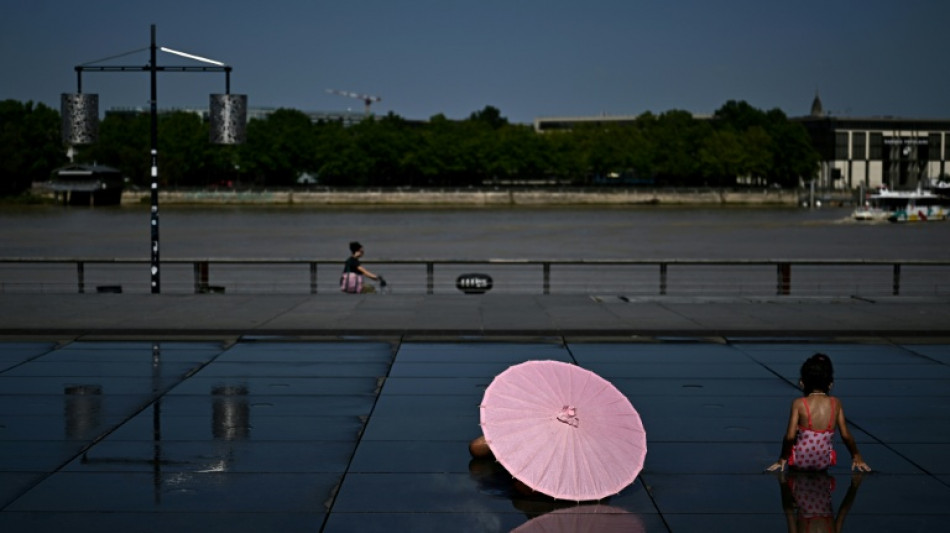
What is driving Europe's heatwave? / Photo: © AFP

Europe is baking under a scorching heatwave, with health warnings in place across western and central parts of the continent as temperatures climb to record-breaking highs.
Among the factors driving these extremes are atmospheric and circulation patterns that keep hot air trapped in place for days, causing the mercury to slowly rise.
Scientists say these weather patterns are nothing new, but heatwaves are made more intense in a world hotter because of burning fossil fuels.
- 'Omega block' -
A circulation pattern over Europe is creating "the equivalent of a traffic jam in the atmosphere which locks in heat", Samantha Burgess from the European Centre for Medium-Range Weather Forecasts, told AFP.
A ridge of high pressure drawing hot air from North Africa is wedged between two areas of low pressure, one in central Europe and the other off the coast of Portugal.
This is known as an "omega block".
The pattern gets its name because the jet stream -- a current in the atmosphere that moves air and weather systems from west to east -- bends into a shape resembling the Greek letter.
- Vacuum cleaner -
The area of high pressure gets stuck "because of the pressure on either side", said Burgess, a climate scientist and strategic lead for climate at ECMWF.
"The jet stream gets stuck in a loop and it forces other weather systems to go around it," she said.
With little energy available to disrupt it, the omega pattern can persist for days -- or weeks -- allowing heat to stew and temperatures to intensify beneath it.
"So hence blocking -- it means that once this meteorological set-up gets going, it can just keep reinforcing itself for some time," said Will Lang, chief meteorologist at the UK's Met Office.
Sebastien Leas, a forecaster at France's weather service, likened it to a "vacuum cleaner, drawing in heat and masses of hot air rising from North Africa" and blasting it northward in a violent torrent.
- Heat dome -
If this pattern is very stable, the high pressure system can evolve into a "heat dome".
This acts like an atmospheric lid on a boiling pot, trapping heat beneath. Air sinking beneath the pressure warms as it is compressed, while heat near the surface cannot escape.
These conditions suppress cloud formation and favour still weather with little wind. Clearer skies allow more sunshine to cook Earth's surface, creating a heat feedback loop.
"Under the right conditions -- and you do need the right conditions -- it just gets hotter and hotter," said Lang.
- Hotter world -
Heat domes and omega patterns are nothing new and can form separately from each other, experts said.
A heatwave in late May across Europe was tied to a heat dome, while a horseshoe-shaped omega pattern was identified as a key driver of a major hot spell over France in June 2025.
They are also not unique to Europe but occur in both hemispheres across the world's middle latitudes. "They can occur over the Pacific, over Europe, over North America," said Burgess.
Scientists say there has been an increase in high pressure systems in Europe in recent decades but whether this is a consequence of climate change remains a subject of debate.
Burgess said when heat domes do occur "the subsequent heatwave is more intense than it otherwise would have been without climate change".
S.Palmer--TFWP