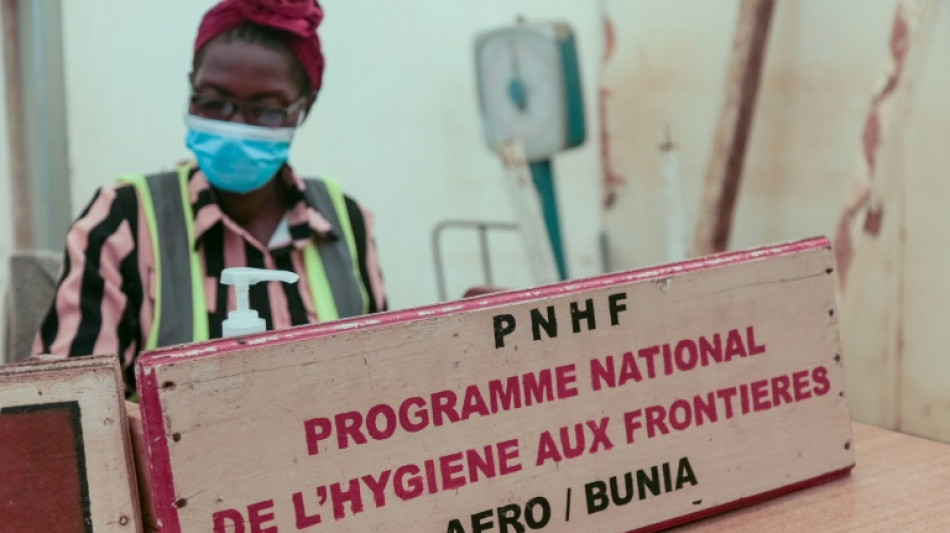
'People thought it was witchcraft': DR Congo's Ebola outbreak / Photo: © AFP

The Ebola virus was circulating in the Democratic Republic of Congo for several weeks before the outbreak was identified and declared, during which time affected communities believed it to be a "mystical illness".
The World Health Organization (WHO) declared the Ebola outbreak -- the 17th in the huge, impoverished country of more than 100 million people -- an international health emergency on Sunday.
But, according to witnesses, the first suspected cases of the highly contagious haemorrhagic fever appeared from mid-April in the mining locality of Mongbwalu, in gold-rich Ituri province.
Insecurity is rife and access is difficult in the northeastern region, where different armed groups have roamed for years and massacres are regularly reported.
"Unfortunately, the alert spread slowly within the community," as people believed they were suffering from a "mystical illness", Congolese Health Minister Samuel Roger Kamba said Tuesday.
After a body was repatriated to Mongbwalu from Bunia, the Ituri provincial capital, "members of the family decided to change coffins", and then the first one "was burned by young people", John Vatsosi, a resident of Mongbwalu, told AFP.
But, he said, some local traditional chiefs wanted "to hold ceremonies before incinerating the coffin".
"After that, there were repeated deaths, sometimes between three and five people a day," he said.
"People then began to speculate, saying that the traditional leaders had cast a curse that was causing these deaths," he added.
- 'Witchcraft' -
"An old dad was suspected of being a sorcerer who caused people's deaths," Timothee Bedidjo, who also lives in Mongbwalu, said.
"Someone would be taken to hospital and a few minutes later the person would die, but the medical staff couldn't identify any kind of illness. Sometimes they spoke of a fever, sometimes of an as-yet unidentified outbreak," he added.
Some patients "decided to seek treatment from traditional healers, while others turned to servants of God for prayers," Vatsosi said.
In the days that followed, the virus spread in neighbouring areas, in a mining and commercial region where people are constantly on the move.
"In the beginning, there was chaos. There were cases of death and people thought it was witchcraft," said a hospital official in Rwampara, a locality near Bunia that quickly became one of the epicentres of the new Ebola outbreak.
"They brought us patients and we handled them as ordinary hospital admissions. There were no concrete signs that would allow us to associate the illness with Ebola," he said.
Health infrastructure in the DRC is largely lacking in human and financial resources.
It is often reliant on international organisations, whose funding to provide aid has been slashed recently particularly by the United States since President Donald Trump's return to the White House.
"We face technical limitations when it comes to detecting outbreaks such as Ebola. Some healthcare workers were even infected because they lacked appropriate protective equipment," the hospital official said.
He said the patients who make it to the hospital died within 24 hours.
But in isolated areas, infected people "die at home and their bodies are handled by their family members", said Isaac Nyakulinda, a civil society official in Rwampara health area.
"We, the population, did not really know if it was an epidemic," he said.
"We regret that the government intervened late," he added emotionally.
- Too few tests -
In Bunia, tests were not available to identify the Bundibugyo strain, which is responsible for the new outbreak.
Health Minister Samuel Roger Kamba told reporters on Tuesday that testing equipment had been ready for the Zaire strain of the virus, which has been behind previous big Ebola outbreaks in the DRC.
"Samples had to leave the Bunia laboratory and be sent to the central laboratory" in the capital Kinshasa, delaying identification of the virus, the minister said.
The WHO has said it was alerted to the emergence of a highly lethal disease on May 5.
"This false rumour about the fetishist nature of the illness gradually began to disappear," Vatsosi said.
However at that point, 246 suspected cases including 65 deaths had already been recorded.
The outbreak's origins have yet to be clearly established.
Bats are known to be carriers of the Ebola virus and are sometimes eaten by local residents in the DRC.
Over the years "Congolese people have been venturing ever deeper into the forests and coming into contact with the virus reservoir," Jean-Jacques Muyembe, head of the National Institute of Biomedical Research (INRB) and co-discoverer of Ebola in 1976, told reporters this week.
"Another factor is bush meat," he said, adding it was a main protein source for people living in rural areas.
A.Nunez--TFWP