Maoist landmine legacy haunts India / Photo: © AFP

India's blood-soaked six-decade Maoist insurgency may be over, but a lethal legacy remains: hundreds of crude landmines planted by the rebels along forest tracks.
For decades, Maoist fighters seeded vast stretches of central India's forests with pressure-operated improvised explosive devices (IEDs), often buried just beneath dirt roads or hidden along jungle footpaths.
Rudimentary in design -- gelatin, ball bearings and metal fragments packed into a steel lunch box -- they were nonetheless devastatingly effective, say those who fought the insurgency.
The Maoists controlled nearly a third of the country at the rebellion's peak in the mid-2000s, saying they were fighting for the rights of marginalised indigenous people in forest regions.
But India stepped up its campaign against the last remnants of the rebellion in recent years, and declared last month that the country was free of the Maoist insurgency.
"You ask a soldier what he is afraid of the most -- it is not bullets, but these pressure IEDs, because you never knew when you step on one," said 23-year-old Kishan Hapka of the District Reserve Guards, the police's main strike force against the Maoists.
"Every step you take in the jungle, you have to be mindful."
Hapka's left leg was torn off in 2024 when he stepped on a mine.
"I would still say I was lucky," he said. "Three other soldiers were killed in that same operation."
Hapka now walks with a prosthetic leg, restricted to administrative work.
- 'Ears went numb' -
IEDs have killed nearly 500 soldiers in the last 25 years in the former Maoist stronghold of Bastar in Chhattisgarh state, according to police data. They have injured a thousand more.
The pressure mines were designed to target security forces.
But they also killed and maimed the local tribal residents whom the Maoists claimed to have been fighting for, killing more than 150 of them and hurting more than 250 others.
Tama Jogi is one of them.
The 65-year-old was foraging in the forest last summer, when she stepped on one.
Her right leg was shattered.
"My ears went numb and I lost consciousness," she told AFP. "The next thing I remember is I was in the hospital and they were cleaning my wounds."
Doctors had to amputate her other leg too to save her life, leaving her entirely immobile.
The government only pays for medical care for soldiers who are hurt in the line of duty.
Police arrested her son days later, saying he was a Maoist insurgent -- a charge she denies.
He is still in prison.
"I don't know who to blame anymore," said Jogi, who must now crawl to the bathroom.
- 'Big problem' -
Officials in Chhattisgarh state say stray landmines are everywhere -- and continue to be a "big problem".
"The IED can be buried beside a pond, beside a road, beside a river – anywhere it could be," said Vijay Sharma, deputy chief minister of the state.
"Every day, dozens are being recovered."
In the remote forest village of Lankapalli, where a waterfall cascaded even in the dry heat of Bastar, 35-year-old Raju Modiyam found out the hard way.
In January, he had gone looking for fish, taking a popular mountainous path, believing the Maoists would not plant a landmine on a track frequented by the local villagers.
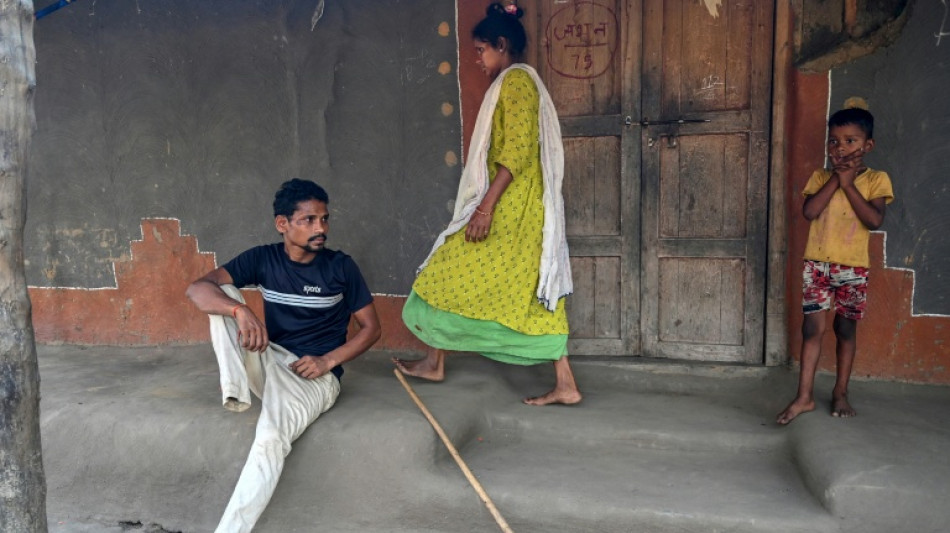
"I stepped on a mine, and as soon as I stepped on it, my leg blew up," he told AFP from his mud-tiled house's courtyard, shaded by bottle gourd creepers over a bamboo frame.
"When I saw my leg, it was completely blown apart, everything was torn open," said Modiyam, walking restlessly on one leg, leaning on a stick.
"There was blood everywhere."
Modiyam, as he feared while waiting for help to arrive, lost his leg.
The family, dependent on the forest for their livelihood, cannot afford a prosthetic limb, said his wife Jayamma, 21, who is pregnant with their third child.
"A duplicate leg will take money which we don't have," she said.
The police say they recovered nearly 900 IEDs from the forests of Bastar last year, and another 300 in just the first three months of 2026.
"We are not in a position to declare the area is 100 percent IED-free yet," said local police chief Sundarraj P.
The problem, he said, arose from Bastar's "entangled" geography -- unlike other conflict-addled places like Sri Lanka, where the army could sweep a defined territory after the Tamil civil year ended.
"There was never a clear demarcation in terms of the areas they controlled and what we controlled," he said, but adding that "98 percent of the job has been done".
But that is little consolation for Bastar's tribal residents.
"There is a lot of fear," said Modiyam. "We don't go into the jungle anymore. What if we step on an IED and it explodes?"
A.Williams--TFWP