The Fort Worth Press - Lost in space: Sperm struggles to navigate during weightless sex

USD -
AED 3.672504
AFN 63.000368
ALL 81.850403
AMD 368.180403
ANG 1.79046
AOA 918.000367
ARS 1411.841886
AUD 1.388696
AWG 1.8
AZN 1.70397
BAM 1.679981
BBD 2.014233
BDT 122.76083
BGN 1.66992
BHD 0.377275
BIF 2976
BMD 1
BND 1.278067
BOB 6.910443
BRL 5.037104
BSD 1.000073
BTN 94.959542
BWP 13.418887
BYN 2.740298
BYR 19600
BZD 2.011459
CAD 1.38005
CDF 2272.000362
CHF 0.781119
CLF 0.022615
CLP 890.050396
CNY 6.76635
CNH 6.764365
COP 3693.14
CRC 452.064266
CUC 1
CUP 26.5
CVE 94.87504
CZK 20.824204
DJF 177.720393
DKK 6.41042
DOP 58.340393
DZD 132.780279
EGP 52.325831
ERN 15
ETB 158.000358
EUR 0.857704
FJD 2.221804
FKP 0.742087
GBP 0.743356
GEL 2.670391
GGP 0.742087
GHS 11.74039
GIP 0.742087
GMD 72.503851
GNF 8780.000355
GTQ 7.628513
GYD 209.220224
HKD 7.83695
HNL 26.570388
HRK 6.460604
HTG 130.96772
HUF 303.492504
IDR 17823.65
ILS 2.80215
IMP 0.742087
INR 95.010504
IQD 1310
IRR 1351050.000352
ISK 122.960386
JEP 0.742087
JMD 157.513861
JOD 0.70904
JPY 159.30904
KES 129.410385
KGS 87.450384
KHR 4010.00035
KMF 422.00035
KPW 899.855249
KRW 1507.420383
KWD 0.30944
KYD 0.833462
KZT 487.321548
LAK 21952.503779
LBP 89550.000349
LKR 330.034874
LRD 183.125039
LSL 16.240381
LTL 2.95274
LVL 0.60489
LYD 6.350381
MAD 9.18375
MDL 17.306602
MGA 4190.000347
MKD 52.848875
MMK 2100.044704
MNT 3580.365831
MOP 8.070537
MRU 40.000346
MUR 47.370378
MVR 15.403739
MWK 1737.000345
MXN 17.354804
MYR 3.970504
MZN 63.905039
NAD 16.240377
NGN 1371.703725
NIO 36.570377
NOK 9.253504
NPR 151.935268
NZD 1.671822
OMR 0.385278
PAB 1.000103
PEN 3.399504
PGK 4.355039
PHP 61.474038
PKR 278.550374
PLN 3.62895
PYG 6017.110756
QAR 3.641038
RON 4.504104
RSD 100.681038
RUB 71.146838
RWF 1462.5
SAR 3.772303
SBD 8.03246
SCR 13.563987
SDG 600.503676
SEK 9.255045
SGD 1.276804
SHP 0.746601
SLE 24.603667
SLL 20969.502105
SOS 571.503662
SRD 37.170504
STD 20697.981008
STN 21.4
SVC 8.751074
SYP 110.532098
SZL 16.240369
THB 32.575038
TJS 9.231047
TMT 3.5
TND 2.894038
TOP 2.40776
TRY 45.852504
TTD 6.793623
TWD 31.426804
TZS 2629.583038
UAH 44.293077
UGX 3769.922222
UYU 40.112866
UZS 12022.503617
VES 548.68505
VND 26312.5
VUV 118.055972
WST 2.715197
XAF 563.44981
XAG 0.013284
XAU 0.00022
XCD 2.70255
XCG 1.802416
XDR 0.699507
XOF 562.503593
XPF 102.603591
YER 238.603589
ZAR 16.29669
ZMK 9001.203584
ZMW 18.382896
ZWL 321.999592
  • CMSC

    -0.1000

    22.74

    -0.44%

  • CMSD

    0.0400

    22.93

    +0.17%

  • JRI

    0.0600

    12.92

    +0.46%

  • RELX

    -0.3100

    32.79

    -0.95%

  • RBGPF

    -0.0100

    63.54

    -0.02%

  • RIO

    -0.0800

    106.39

    -0.08%

  • BCE

    0.2000

    25.11

    +0.8%

  • NGG

    -1.1562

    81.53

    -1.42%

  • BTI

    -1.1300

    61.79

    -1.83%

  • AZN

    0.3400

    185.67

    +0.18%

  • BP

    0.2800

    41.87

    +0.67%

  • GSK

    -0.7000

    50.54

    -1.39%

  • BCC

    -0.6300

    69.72

    -0.9%

  • VOD

    0.0300

    14.96

    +0.2%

  • RYCEF

    0.7000

    18

    +3.89%

Lost in space: Sperm struggles to navigate during weightless sex
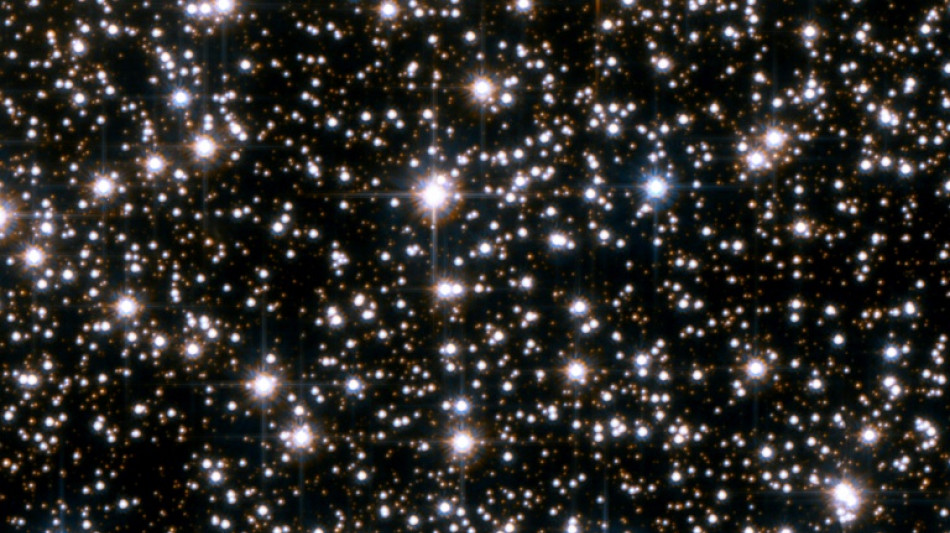
Lost in space: Sperm struggles to navigate during weightless sex / Photo: © ESA/AFP/File

Lost in space: Sperm struggles to navigate during weightless sex

Scientists have used a tiny plastic "obstacle course" to test how much sperm would struggle to navigate during sex in the weightlessness of space.

Text size:

Some particularly resilient sperm still made it through the course, suggesting that conceiving children in space will still be possible, according to research published on Thursday.

However a bigger problem could be that the development of embryos after fertilisation was harmed by a lack of gravity, the Australian team of researchers found.

With humanity setting its eyes on colonising space -- next week NASA hopes to launch its first crewed mission around the Moon in half a century -- scientists have been studying how difficult it will be to procreate on spaceships or other worlds.

One of the biggest challenges is that sperm will no longer be pulled downwards by Earth's gravity.

"Sperm need to actively find their way to an egg, and this study is the first to put that ability to the test under space-like conditions," Nicole McPherson, a researcher at Adelaide University in Australia, told AFP.

The scientists used a plastic chamber that resembles the female reproductive tract to act as a "miniature obstacle course", the senior author of the new study said.

"Think of it as a tiny race track... sperm are introduced at one end and have to swim their way through to the other."

- Filtering out weak runners -

Both human and mice sperm were sent down the course, which was inside a device that uses constant rotation to simulate the microgravity of space.

The sperm was about 50 percent worse at navigating through the course compared to how they perform under Earth's gravity.

This worked out to be roughly a 30-percent drop in successful fertilisation, according to the study in the journal Communications Biology.

However the sperm that did make it through seemed to produce better-quality embryos, which could turn out to be "beneficial", McPherson said.

It appeared that the stress of microgravity acted as a "filter" that effectively cleared the field, "leaving only the most capable sperm in the running," she explained.

A bigger problem came in the first 24 hours after sperm had fertilised the eggs.

"The results reversed sharply, with fewer embryos formed, and those that did were of poorer quality," McPherson said.

This suggests that microgravity "may not be the deal-breaker we feared, but protecting the embryo from weightlessness in those critical first hours will likely be essential for reproduction in space," she added.

Some including billionaire SpaceX founder Elon Musk have ambitious plans to make humans an interplanetary species by establishing settlements on the Moon then Mars.

There has also been speculation that the first baby conceived outside the bounds of Earth could be the result of a couple having sex on a flight launched by the booming space tourism industry.

McPherson emphasised that much more research is needed to understand how reproduction works in space, adding that fertilisation is "only one small piece of a very long and complex puzzle".

"We are still a long way from seeing the first space baby."

J.P.Cortez--TFWP