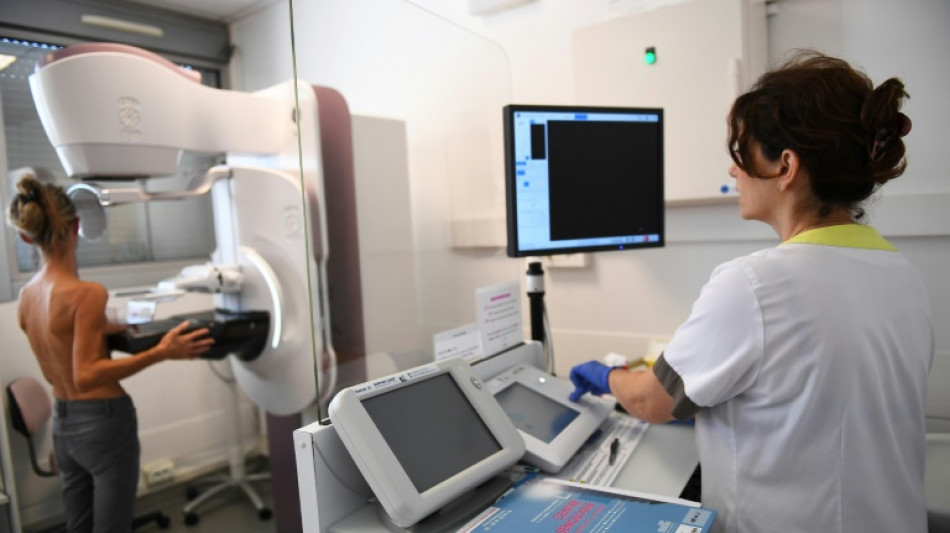
AI helps doctors spot breast cancer in scans: world-first trial / Photo: © AFP

Artificial intelligence helps doctors spot more cases of breast cancer when reading routine scans, a world-first trial found Friday.
The results suggest countries should roll out programmes taking advantage of AI's scanning power to ease the workload of short-staffed radiologists, the Swedish lead researchers said.
Well before the release of ChatGPT in 2022 raised global awareness about AI, scientists had been testing out the technology's capacity to read medical scans.
But the new study published in The Lancet medical journal marks the first completed randomised controlled trial -- the gold standard for this kind of research -- looking at AI-supported breast cancer screening.
The trial involved more than 100,000 women who received routine breast cancer scans across Sweden in 2021 and 2022.
They were randomly sorted into two groups. In one, a single radiologist was assisted by an AI system to check the scans.
The other followed the standard European method, which requires two radiologists to read the scans.
Nine percent more cancer cases were spotted in the AI group compared to the control group.
Over the following two years, those in the AI group also had a 12 percent lower rate of being diagnosed with cancer between routine scans, which are known as interval cancers and can be particularly dangerous.
The improvement was consistent across different ages and levels of breast density, which can be risk factors. The rate of false positives was similar in both groups.
Senior study author Kristina Lang of Sweden's Lund University said that "widely rolling out AI-supported mammography in breast cancer screening programmes could help reduce workload pressures amongst radiologists, as well as helping to detect more cancers at an early stage".
But this must be done "cautiously" and with "continuous monitoring", she said in a statement.
- 'The radiologist's eye' -
Jean-Philippe Masson, head of the French National Federation of Radiologists, told AFP that "the radiologist's eye and experience must correct the AI's diagnosis".
Sometimes the "AI tool will have seen a change in breast tissue that is not actually cancer," he added.
The use of AI by radiologists is still in its "infancy" in France because these systems are expensive -- and prone to overdiagnosis, Masson warned.
Stephen Duffy, emeritus professor of cancer screening at Queen Mary University of London who was not involved in the study, said it provided further evidence that AI-assisted cancer screening is safe.
But he warned that the "reduction in interval cancers following screening in the AI group is not significant".
He urged another follow-up of the trial's participants to see if the control group "catches up".
Interim results from the trial, published in 2023, showed that AI nearly halved the time radiologists spent reading scans.
The AI model Transpara was trained on more than 200,000 previous examinations taken in 10 countries.
More than 2.3 million women were diagnosed with breast cancer and 670,000 died from the disease in 2022, according to the World Health Organization.
D.Johnson--TFWP