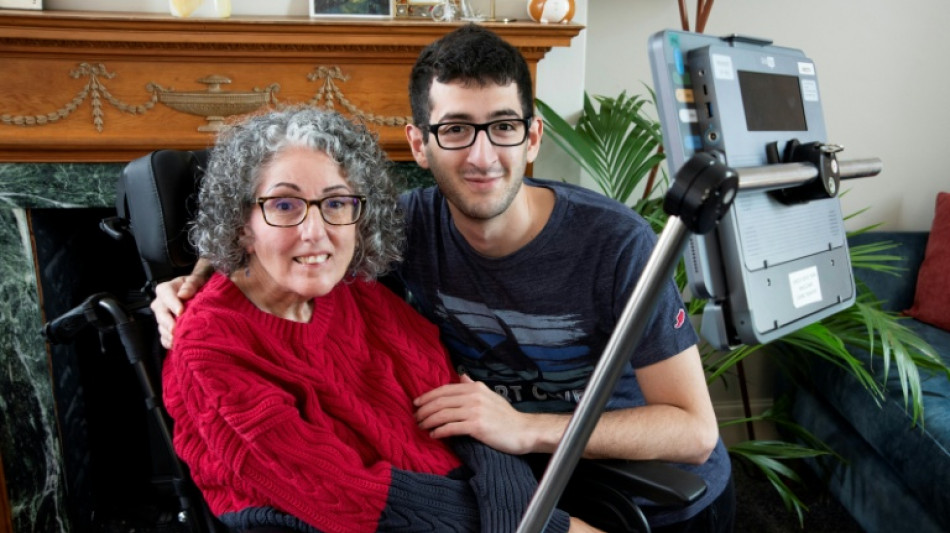
AI helps UK woman rediscover lost voice after 25 years / Photo: © Smartbox Assistive Technology/AFP

A British woman suffering from motor neurone disease who lost her ability to speak is once again talking in her own voice thanks to artificial intelligence and a barely audible eight-second clip from an old home video.
Sarah Ezekiel, an artist, was left without the use of her voice after she was diagnosed at the age of 34 with MND while pregnant with her second child 25 years ago.
The condition, which progressively damages parts of the nervous system, can cause weakness of the tongue, mouth and throat muscles, leading some sufferers to lose their speech completely.
In the years after her diagnosis Ezekiel, from north London, was able to use a computer and voice generating technology to help her communicate, albeit in a voice that sounded nothing like her own.
She was also able to continue her career as an artist using a computer cursor to create her images.
But her two children, Aviva and Eric, grew up never knowing how their mother had once spoken.
In recent years, experts have increasingly been able to use technology to create computerised versions of a person's original voice.
But the technique has generally required long and good quality recordings, and even then tended to produce voices that while sounding something like the sufferer were "very flat and monotone", said Simon Poole of the UK medical communication company Smartbox.
Poole told AFP the firm had originally asked Ezekiel for an hour's worth of audio.
People who are expected to lose their ability to speak due to conditions like MND are currently encouraged to record their voice as soon as possible as a way of preserving their "identity" alongside their ability to communicate.
But in the pre-smartphone era, having suitable recordings to draw upon was far less common.
When Ezekiel could locate only one very short and poor quality clip, Poole said his "heart sank".
- 'Nearly cried' -
The clip from a 1990s home video was just eight seconds long, muffled and with background noise from a television.
Poole turned to technology developed by New York-based AI voice experts ElevenLabs that can produce not only a voice based on very little but can also make it sound more like a real human being.
He used one AI tool to isolate a voice sample from the clip and a second tool -- trained on real voices to fill the gaps -- to produce the final sound.
The result, to Ezekiel's delight, was very close to her original, complete with her London accent and the slight lisp that she had once hated.
"I sent samples to her and she wrote an email back to me saying she nearly cried when she heard it," Poole said.
"She said she played it to a friend who knew her from before she lost her voice and it was like having her own voice back," he added.
According to the UK's Motor Neurone Disease Association, eight in 10 sufferers endure voice difficulties after diagnosis.
But the timing, pitch and tone of current computer generated voices "may be quite robotic".
"The real advance with this new AI technology is the voices are really human and expressive, and they just really bring that humanity back into the voice that previously sounded a bit computerised," Poole said.
Personalising a voice was a way of preserving someone's "identity"," he added.
"Particularly if you acquire a condition later in life, and you lost your voice, being able to speak using your original voice is really quite important, rather than using some off the shelf voice," he said.
F.Garcia--TFWP