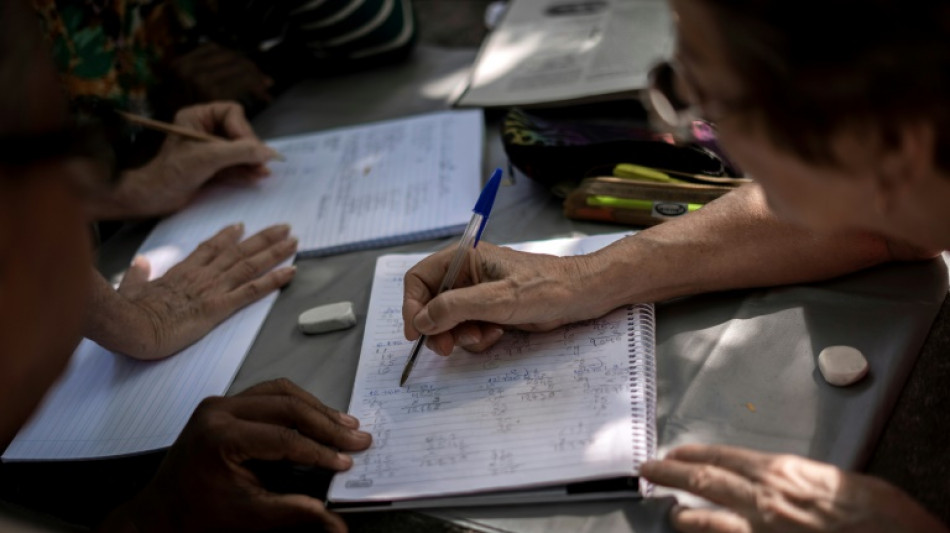
The Fort Worth Press - Shock study: Mild electric stimulation boosts math ability

USD -
AED 3.672498
AFN 63.000153
ALL 83.141978
AMD 376.485471
ANG 1.790083
AOA 917.000319
ARS 1368.006
AUD 1.45314
AWG 1.8025
AZN 1.700487
BAM 1.694558
BBD 2.010968
BDT 122.511751
BGN 1.709309
BHD 0.377004
BIF 2965.773868
BMD 1
BND 1.283101
BOB 6.914956
BRL 5.276697
BSD 0.998423
BTN 94.09624
BWP 13.729041
BYN 2.998376
BYR 19600
BZD 2.008109
CAD 1.38685
CDF 2285.499887
CHF 0.79772
CLF 0.023589
CLP 931.560016
CNY 6.91145
CNH 6.921963
COP 3689.46
CRC 462.899991
CUC 1
CUP 26.5
CVE 95.540739
CZK 21.33335
DJF 177.799726
DKK 6.495865
DOP 60.195193
DZD 133.15778
EGP 52.800598
ERN 15
ETB 154.307745
EUR 0.86936
FJD 2.257403
FKP 0.749063
GBP 0.753115
GEL 2.694963
GGP 0.749063
GHS 10.916401
GIP 0.749063
GMD 73.495771
GNF 8752.907745
GTQ 7.638886
GYD 208.893799
HKD 7.833495
HNL 26.511932
HRK 6.546603
HTG 130.753836
HUF 339.36101
IDR 16982
ILS 3.153401
IMP 0.749063
INR 94.77175
IQD 1307.999879
IRR 1313299.999846
ISK 124.660495
JEP 0.749063
JMD 156.917785
JOD 0.708972
JPY 159.849027
KES 129.907037
KGS 87.450232
KHR 3998.336553
KMF 427.000249
KPW 900.088302
KRW 1511.930155
KWD 0.30794
KYD 0.832088
KZT 480.998402
LAK 21565.798992
LBP 89410.383591
LKR 314.008846
LRD 183.234482
LSL 17.08101
LTL 2.95274
LVL 0.60489
LYD 6.375734
MAD 9.322411
MDL 17.537157
MGA 4161.215702
MKD 53.550332
MMK 2102.538494
MNT 3579.989157
MOP 8.045798
MRU 39.8269
MUR 46.770519
MVR 15.460236
MWK 1731.28406
MXN 18.05755
MYR 4.013006
MZN 63.909775
NAD 17.080862
NGN 1383.230512
NIO 36.742473
NOK 9.714203
NPR 150.534765
NZD 1.738295
OMR 0.384496
PAB 0.998471
PEN 3.455542
PGK 4.314509
PHP 60.534019
PKR 278.731944
PLN 3.72784
PYG 6536.015664
QAR 3.640948
RON 4.432101
RSD 102.102971
RUB 81.673918
RWF 1458.028296
SAR 3.752552
SBD 8.041975
SCR 13.467171
SDG 600.999975
SEK 9.449904
SGD 1.28793
SHP 0.750259
SLE 24.550303
SLL 20969.510825
SOS 570.594376
SRD 37.561976
STD 20697.981008
STN 21.225996
SVC 8.73675
SYP 110.526284
SZL 17.078983
THB 32.929501
TJS 9.556146
TMT 3.51
TND 2.938146
TOP 2.40776
TRY 44.458798
TTD 6.776842
TWD 31.972497
TZS 2576.486977
UAH 43.811372
UGX 3714.470144
UYU 40.481936
UZS 12161.933849
VES 466.018145
VND 26337.5
VUV 119.707184
WST 2.754834
XAF 568.30701
XAG 0.014772
XAU 0.000226
XCD 2.70255
XCG 1.799507
XDR 0.706792
XOF 568.311934
XPF 103.329218
YER 238.650219
ZAR 17.21025
ZMK 9001.196166
ZMW 18.745993
ZWL 321.999592
  • RELX

    -0.3350

    31.73

    -1.06%

  • BCC

    -0.1300

    74.19

    -0.18%

  • NGG

    -0.3600

    82.05

    -0.44%

  • JRI

    0.0050

    12.075

    +0.04%

  • CMSC

    0.0350

    22.88

    +0.15%

  • RIO

    0.1400

    85.91

    +0.16%

  • RYCEF

    -0.8200

    15.24

    -5.38%

  • CMSD

    -0.2600

    22.58

    -1.15%

  • RBGPF

    -13.5000

    69

    -19.57%

  • GSK

    0.6700

    54.66

    +1.23%

  • BCE

    -0.0100

    25.45

    -0.04%

  • AZN

    9.1400

    192.54

    +4.75%

  • VOD

    0.1100

    14.74

    +0.75%

  • BTI

    0.0549

    57.5

    +0.1%

  • BP

    0.0900

    46.28

    +0.19%

Shock study: Mild electric stimulation boosts math ability
Shock study: Mild electric stimulation boosts math ability / Photo: © AFP/File

Shock study: Mild electric stimulation boosts math ability

Struggle with math? A gentle jolt to the brain might help.

Text size:

A new study published Tuesday in PLOS Biology suggests that mild electrical stimulation can boost arithmetic performance -- and offers fresh insight into the brain mechanisms behind mathematical ability, along with a potential way to optimize learning.

The findings could eventually help narrow cognitive gaps and help build a more intellectually equitable society, the authors argue.

"Different people have different brains, and their brains control a lot in their life," said Roi Cohen Kadosh, a neuroscientist at the University of Surrey who led the research.

"We think about the environment -- if you go to the right school, if you have the right teacher -- but it's also our biology."

Cohen Kadosh and colleagues recruited 72 University of Oxford students, scanning their brains to measure connectivity between three key regions.

Participants then tackled math problems that required either calculating answers or recalling memorized solutions.

They found that stronger connections between the dorsolateral prefrontal cortex, which governs executive function, and the posterior parietal cortex, involved in memory, predicted better calculation performance.

When the researchers applied a painless form of brain stimulation using electrode-fitted caps -- a technique known as transcranial random noise stimulation -- the low performers saw their scores jump by 25–29 percent.

The team believes the stimulation works by enhancing the excitability of neurons and interacting with GABA, a brain chemical that inhibits excessive activity -- effectively compensating for weak neural connectivity in some participants.

In fact, the stimulation helped underperformers reach or even surpass the scores of peers with naturally stronger brain wiring. But those who already performed well saw no benefit.

"Some people struggle with things, and if we can help their brain to fulfill their potential, we open them a lot of opportunities that otherwise would be closed," said Cohen Kadosh, calling it an "exciting time" for the field of brain stimulation research.

Still, he flagged a key ethical concern: the risk that such technologies could become more available to those with financial means, widening -- rather than closing -- access gaps.

He also urged the public not to try this at home. "Some people struggle with learning, and if our research proves successful beyond the lab, we could help them fulfil their ambitions and unlock opportunities that might otherwise remain out of reach."

G.Dominguez--TFWP