The Fort Worth Press - Bird flu mutated inside US patient, raising concern

USD -
AED 3.672497
AFN 66.498609
ALL 80.653395
AMD 365.190533
AOA 917.000054
ARS 1498.989302
AUD 1.414597
AWG 1.80125
AZN 1.703622
BAM 1.692154
BBD 2.008721
BDT 123.455081
BHD 0.3761
BIF 2985.970817
BMD 1
BND 1.277984
BOB 11.853211
BRL 5.084798
BSD 0.997309
BTN 94.901089
BWP 13.461555
BYN 2.969692
BYR 19600
BZD 2.005779
CAD 1.394115
CDF 2262.49471
CHF 0.808065
CLF 0.023198
CLP 913.000248
CNY 6.747599
CNH 6.74377
COP 3157.29
CRC 453.361712
CUC 1
CUP 26.5
CVE 95.398565
CZK 20.98875
DJF 177.598394
DKK 6.465797
DOP 58.218911
DZD 132.934044
EGP 49.93801
ERN 15
ETB 160.971007
EUR 0.86491
FJD 2.20855
FKP 0.741752
GBP 0.740515
GEL 2.610163
GGP 0.741752
GHS 11.701051
GIP 0.741752
GMD 73.495368
GNF 8759.111457
GTQ 7.609218
GYD 208.606894
HKD 7.845385
HNL 26.731037
HRK 6.516695
HTG 130.40262
HUF 314.446499
IDR 17763
ILS 2.998355
IMP 0.741752
INR 95.268197
IQD 1306.448752
IRR 1375550.000034
ISK 123.330248
JEP 0.741752
JMD 158.382433
JOD 0.708993
JPY 158.679498
KES 129.360358
KGS 87.449758
KHR 4050.85633
KMF 426.000327
KRW 1418.630255
KWD 0.30887
KYD 0.831109
KZT 467.406398
LAK 22517.541811
LBP 89309.055987
LKR 334.518649
LRD 180.013843
LSL 16.202317
LTL 2.95274
LVL 0.60489
LYD 6.343603
MAD 9.294994
MDL 17.342816
MGA 4255.889809
MKD 53.263787
MMK 2099.549591
MNT 3594.253507
MOP 8.059058
MRU 40.09223
MUR 46.999786
MVR 15.449707
MWK 1729.34998
MXN 17.13935
MYR 4.093046
MZN 63.904995
NAD 16.202107
NGN 1361.210173
NIO 36.701693
NOK 9.513955
NPR 151.845026
NZD 1.695995
OMR 0.3845
PAB 0.997314
PEN 3.377444
PGK 4.407375
PHP 60.743997
PKR 276.877947
PLN 3.722105
PYG 5930.040405
QAR 3.64559
RON 4.529397
RSD 101.489003
RUB 82.645927
RWF 1466.50401
SAR 3.744756
SBD 8.065696
SCR 14.717724
SDG 600.497862
SEK 9.47955
SGD 1.27922
SLE 24.600752
SOS 569.989877
SRD 37.866496
STD 20697.981008
STN 21.197622
SVC 8.726386
SZL 16.199029
THB 32.981035
TJS 9.200175
TMT 3.51
TND 2.92983
TRY 47.717785
TTD 6.759762
TWD 32.242052
TZS 2647.503041
UAH 44.66703
UGX 3714.372216
UYU 40.144833
UZS 11927.514351
VES 755.762395
VND 26167
VUV 119.366412
WST 2.733717
XAF 567.53013
XAG 0.015566
XAU 0.00023
XCD 2.70255
XCG 1.797449
XDR 0.705825
XOF 567.53013
XPF 103.182603
YER 238.398776
ZAR 16.178103
ZMK 9001.203851
ZMW 18.824028
ZWL 321.999592
  • CMSC

    0.0240

    21.744

    +0.11%

  • CMSD

    -0.1600

    21.82

    -0.73%

  • BTI

    0.6000

    59.33

    +1.01%

  • BP

    -0.6000

    41.63

    -1.44%

  • BCE

    -0.0200

    22.75

    -0.09%

  • BCC

    2.3400

    86.6

    +2.7%

  • AZN

    1.4100

    161.42

    +0.87%

  • RIO

    1.4500

    101.1

    +1.43%

  • GSK

    0.7900

    52.96

    +1.49%

  • RBGPF

    0.7600

    70.5

    +1.08%

  • NGG

    0.4700

    80.88

    +0.58%

  • JRI

    0.1500

    12.81

    +1.17%

  • VOD

    0.1900

    16.19

    +1.17%

  • RELX

    0.0485

    35.52

    +0.14%

  • RYCEF

    0.2300

    20.85

    +1.1%

Bird flu mutated inside US patient, raising concern
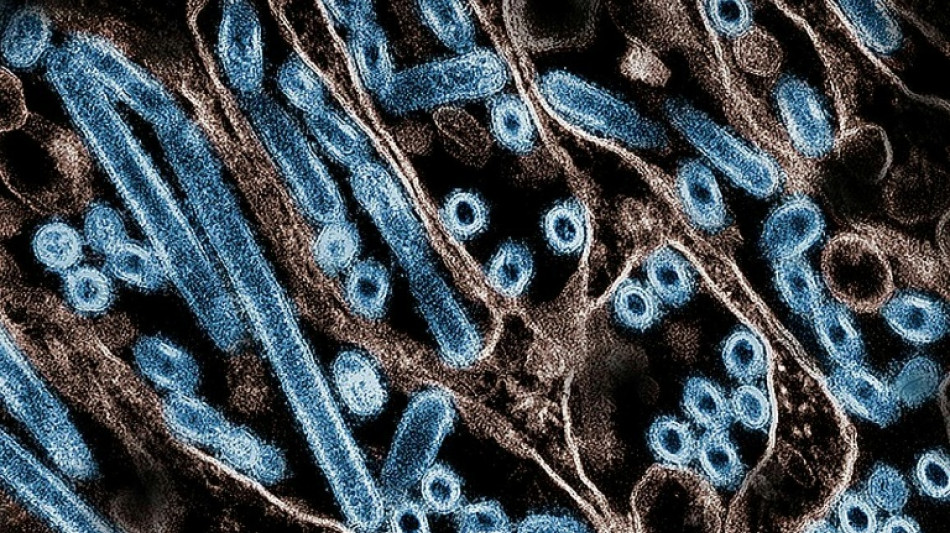
Bird flu mutated inside US patient, raising concern / Photo: © National Institute of Allergy and Infectious Diseases/AFP/File

Bird flu mutated inside US patient, raising concern

The bird flu virus found in a severely ill patient hospitalized in the United States has mutated to become better adapted to human airways, though there is no evidence it has spread beyond the individual, authorities said.

Text size:

Earlier this month, officials announced an elderly Louisiana patient was in "critical condition" with a severe H5N1 infection.

An analysis posted by the Centers for Disease Control and Prevention (CDC) on its website Thursday found that a small percentage of the virus detected in the patient's throat had genetic changes that may lead to "increased virus binding" to certain "cell receptors found in the upper respiratory tract of humans."

Importantly, these changes have not been found in birds, including in the backyard poultry flock thought to have infected the Louisiana patient initially.

Instead, the CDC stated that the mutations were "likely generated by replication of this virus in the patient with advanced disease," adding that no transmission of the mutated virus to other humans has been identified.

Experts contacted by AFP said it was too early to determine whether these changes would make the virus spread more easily or cause more severe disease in humans.

The particular mutation "is one step that is needed to make a more efficiently transmissible virus," said Angela Rasmussen, a virologist at the University of Saskatchewan in Canada. "But I do want to point out that it's not the only step."

She explained that while the mutation might mean the virus can more easily enter cells, this would need to be confirmed through further testing on animals. Moreover, similar mutations have been found in severely ill patients in the past without triggering wider spread among humans.

"It's good to know that we should be looking out for this," she said, "but it doesn't actually tell us, 'Oh, we're this much closer to a pandemic now.'"

Another expert, Thijs Kuiken of Erasmus University Medical Center in the Netherlands, agreed with Rasmussen.

"Efficient attachment to human upper respiratory tract cells is necessary, but not sufficient, for more efficient transmissibility between people," he said, "because the attachment process is but one of several steps in the virus replication cycle in a human cell."

Rasmussen expressed greater concern about the overall level of bird flu currently circulating rather than this specific case.

The CDC has reported 65 confirmed human cases of bird flu in the United States in 2024, with more likely going undetected among dairy and poultry workers.

This, Rasmussen explained, increases the chances of bird flu "reassortment" with seasonal flu, which could lead to "rapid evolutionary leaps in a short period of time," similar to the processes that caused the 1918 and 2009 pandemics.

S.Palmer--TFWP