The Fort Worth Press - Drug-resistant superbugs projected to kill 39 million by 2050

USD -
AED 3.672499
AFN 66.265317
ALL 82.40468
AMD 381.537936
ANG 1.790403
AOA 917.000395
ARS 1449.250041
AUD 1.512185
AWG 1.8025
AZN 1.701917
BAM 1.670125
BBD 2.014261
BDT 122.309039
BGN 1.670125
BHD 0.377012
BIF 2957.004398
BMD 1
BND 1.292857
BOB 6.910892
BRL 5.541298
BSD 1.000043
BTN 89.607617
BWP 14.066863
BYN 2.939243
BYR 19600
BZD 2.011357
CAD 1.379195
CDF 2558.501249
CHF 0.795195
CLF 0.023213
CLP 910.640111
CNY 7.04095
CNH 7.03416
COP 3860.210922
CRC 499.466291
CUC 1
CUP 26.5
CVE 94.159088
CZK 20.77025
DJF 178.088041
DKK 6.376535
DOP 62.644635
DZD 130.069596
EGP 47.690961
ERN 15
ETB 155.362794
EUR 0.853703
FJD 2.283697
FKP 0.747408
GBP 0.74712
GEL 2.685003
GGP 0.747408
GHS 11.486273
GIP 0.747408
GMD 72.999948
GNF 8741.72751
GTQ 7.663208
GYD 209.231032
HKD 7.781017
HNL 26.346441
HRK 6.432802
HTG 131.121643
HUF 330.045497
IDR 16697
ILS 3.20705
IMP 0.747408
INR 89.577497
IQD 1310.106315
IRR 42099.999884
ISK 125.629729
JEP 0.747408
JMD 160.018787
JOD 0.709015
JPY 157.5835
KES 128.909953
KGS 87.450384
KHR 4013.492165
KMF 419.999986
KPW 899.999767
KRW 1475.719978
KWD 0.30723
KYD 0.83344
KZT 517.535545
LAK 21660.048674
LBP 89556.722599
LKR 309.636651
LRD 177.012083
LSL 16.776824
LTL 2.95274
LVL 0.60489
LYD 5.420776
MAD 9.166901
MDL 16.930959
MGA 4548.055164
MKD 52.559669
MMK 2100.286841
MNT 3551.115855
MOP 8.015542
MRU 40.023056
MUR 46.149683
MVR 15.449418
MWK 1734.170189
MXN 18.022785
MYR 4.077022
MZN 63.894334
NAD 16.776824
NGN 1460.159533
NIO 36.804577
NOK 10.13072
NPR 143.372187
NZD 1.736935
OMR 0.385423
PAB 1.000043
PEN 3.367832
PGK 4.254302
PHP 58.570975
PKR 280.195978
PLN 3.590096
PYG 6709.363392
QAR 3.645959
RON 4.335397
RSD 100.234832
RUB 80.459966
RWF 1456.129115
SAR 3.750995
SBD 8.146749
SCR 15.161607
SDG 601.498945
SEK 9.267885
SGD 1.292865
SHP 0.750259
SLE 24.04961
SLL 20969.503664
SOS 570.513642
SRD 38.441497
STD 20697.981008
STN 20.921395
SVC 8.750267
SYP 11058.461434
SZL 16.774689
THB 31.425042
TJS 9.215661
TMT 3.5
TND 2.927287
TOP 2.40776
TRY 42.814755
TTD 6.787925
TWD 31.518899
TZS 2495.196618
UAH 42.285385
UGX 3577.131634
UYU 39.263908
UZS 12022.543871
VES 282.15965
VND 26312.5
VUV 121.02974
WST 2.787828
XAF 560.144315
XAG 0.014815
XAU 0.000229
XCD 2.70255
XCG 1.8024
XDR 0.69664
XOF 560.144315
XPF 101.840229
YER 238.398055
ZAR 16.765585
ZMK 9001.200765
ZMW 22.626703
ZWL 321.999592
  • SCS

    0.0200

    16.14

    +0.12%

  • CMSC

    -0.1200

    23.17

    -0.52%

  • CMSD

    -0.0300

    23.25

    -0.13%

  • NGG

    -0.2800

    76.11

    -0.37%

  • AZN

    0.7500

    91.36

    +0.82%

  • RBGPF

    0.0000

    80.22

    0%

  • GSK

    0.3200

    48.61

    +0.66%

  • RIO

    0.6900

    78.32

    +0.88%

  • BTI

    -0.5900

    56.45

    -1.05%

  • BCE

    -0.0100

    22.84

    -0.04%

  • BP

    0.6300

    33.94

    +1.86%

  • RELX

    0.0800

    40.73

    +0.2%

  • JRI

    -0.0500

    13.38

    -0.37%

  • VOD

    0.0400

    12.84

    +0.31%

  • BCC

    -2.9300

    74.77

    -3.92%

  • RYCEF

    0.2800

    15.68

    +1.79%

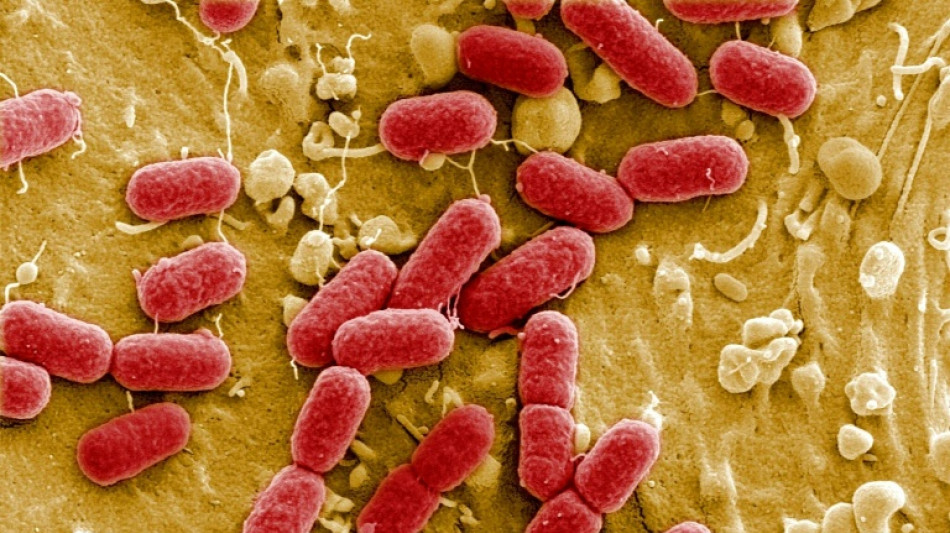
Drug-resistant superbugs projected to kill 39 million by 2050
Drug-resistant superbugs projected to kill 39 million by 2050 / Photo: © Helmholtz-Zentrum für Infektions/AFP

Drug-resistant superbugs projected to kill 39 million by 2050

Infections of drug-resistant superbugs are projected to kill nearly 40 million people over the next 25 years, a global analysis predicted on Monday, as the researchers called for action to avoid this grim scenario.

Text size:

Superbugs -- strains of bacteria or pathogens that have become resistant to antibiotics, making them much harder to treat -- have been recognised as a rising threat to global health.

The analysis has been billed as the first research to track the global impact of superbugs over time, and estimate what could happen next.

More than a million people died from the superbugs -- also called antimicrobial resistance (AMR) -- a year across the world between 1990 and 2021, according to the study in The Lancet journal.

Deaths among children under five from superbugs actually fell by more than 50 percent over the last three decades, the study said, due to improving measures to prevent and control infections for infants.

However when children now catch superbugs, the infections are much harder to treat.

And deaths of over-70s have surged by more than 80 percent over the same period, as an ageing population became more vulnerable to infection.

Deaths from infections of MRSA, a type of staph bacteria that has become resistant to many antibiotics, doubled to 130,000 in 2021 from three decades earlier, the study said.

- 'This threat is growing' -

The researchers used modelling to estimate that -- based on current trends -- the number of direct deaths from AMR would rise by 67 percent to reach nearly two million a year by 2050.

It will also play a role in a further 8.2 million annual deaths, a jump of nearly 75 percent, according to the modelling.

Under this scenario, AMR will have directly killed 39 million people over the next quarter century, and contributed to a total of 169 million deaths, it added.

But less dire scenarios are also possible.

If the world works to improve care for severe infections and access to antimicrobial drugs, it could save the lives of 92 million people by 2050, the modelling suggested.

"These findings highlight that AMR has been a significant global health threat for decades and that this threat is growing," study co-author Mohsen Naghavi of the US-based Institute of Health Metrics said in a statement.

The researchers looked at 22 pathogens, 84 combinations of drugs and pathogens, and 11 infectious syndromes such as meningitis. The study involved data from 520 million individual records across 204 countries and territories.

It was released ahead of a high-level AMR meeting at the United Nations scheduled for September 26.

Antimicrobial resistance is a natural phenomenon, but the overuse and misuse of antibiotics in humans, animals and plants has made the problem worse.

A.Williams--TFWP