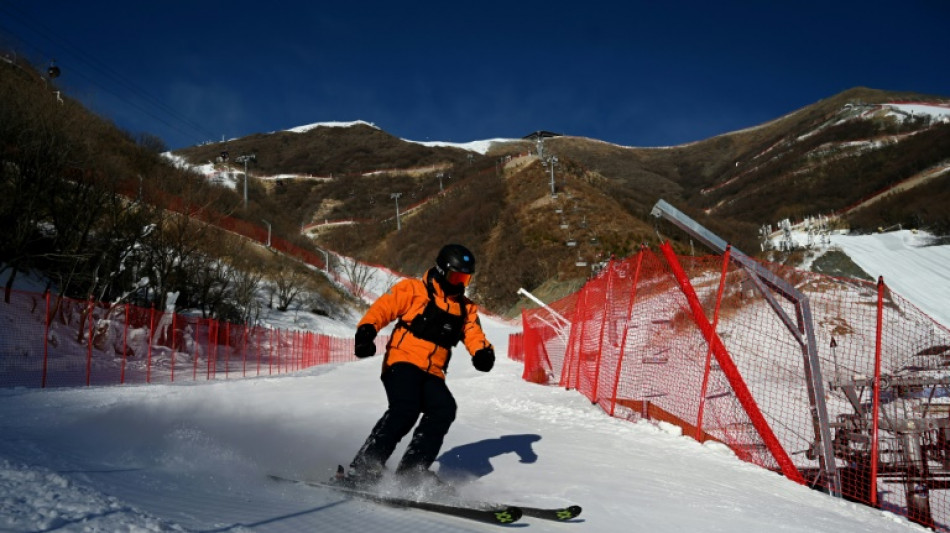
Chinese trauma doctors perfect ski skills for Olympics

Undeterred by the heavy medical bags on their backs, a group of Chinese doctors zipped down a steep ski slope, part of a crack medical team tasked with racing to any injured athletes during the Winter Olympics.
Dressed in bright orange jackets with white crosses, the medics are the first group of people in China to be specifically trained for emergency ski rescues.
And until recently, most were little more than amateur skiers in a country with a nascent winter sports scene.
"The training was not easy," recalled Li Qiyi, a 49-year-old orthopaedic surgeon usually stationed at Xiehe Hospital, one of Beijing's top medical facilities.
"It sometimes dropped to -20 or -30 degrees, with an even lower windchill factor. Some of us had frostbite on our feet or face," he told AFP.
The world's finest skiers will start competing in the slalom, downhill and Super-G competitions in early February.
Li was among a group of medics AFP interviewed who were putting in last minute practice at Yanqing, one of two sites north of China's capital that will host mountain-based events.
The doctors are expected to get to any athlete who needs them within four minutes of an accident.
If someone suffers a catastrophic injury, those first few minutes can be vital for saving a life.
- Extreme cold -
Back in 2018, authorities put a call out to a dozen regional hospitals looking for volunteer doctors for the Games.
There was one key demand: those applying needed to have at least some experience of skiing.
Ahead of the Olympics, the government has been keen to promote winter sports, with mass construction of snow resorts leading to millions of fresh devotees.
But finding world class medical professionals who could handle themselves on all slopes in all conditions was no easy task.
Li Qiujun, a 39-year-old anaesthesiologist at Beijing's Jishuitan Hospital, jumped at the opportunity to volunteer as he considered himself an accomplished skier.
"I was going down black slopes, so I thought I was good, but when the training started, I realised that I was still far from the required level," he said smiling.
"We are all doctors, so we are used to doing emergency rescues in our hospitals. But on a competitive ski track, with the extreme cold, the slope, the environment, it's very different."
The three doctors AFP spoke to all had the family name Li but were unrelated.
Li Dong, a 51-year-old doctor from the Changping traditional Chinese medicine hospital, said the learning curve was a steep one.
"Learning to put on and take off the skis on the snow, it was difficult," she recalled.
"If you fall, you would tumble all the way down because the track is super steep and slippery."
Overall the team of more than 40 doctors has trained some four to five weeks a year over the last four years to get to where they now are.
They were taught multiple advanced techniques, such as how to safely descend steep edges on the sides of their skis and use crampons for icy sections.
- 'Proud to be a part' -
Much like military medics, the main focus is on speed.
"If a skier gets hurt, we have to be able to get to him in four minutes," said Li Qiyi.
"We must assess the severity of the injury and then perform first aid so that he can be evacuated quickly to a place where he can receive better care."
While some athletes have been killed preparing for the Winter Olympics or during a training session, no one has yet died during competition at the Games.
But the dangers are clear to anyone who takes part in, or watches, winter sports.
Downhill skiers can travel up to 140 kilometres per hour (87 miles per hour) and spectacular wipeouts do happen.
"We stand by for orders at the most dangerous parts of the competition track, and prepare for when an emergency happens," explained Li Qiujun.
The skiing doctors are equipped with 5G walkie-talkies as well as medical rucksacks filled with trauma essentials, including intubation equipment, tourniquets, splints, syringes, oxygen and defibrillators.
They must also be able to communicate with foreign athletes.
"If the injured remains conscious, we communicate with them in English. We had a lot of English lessons during our training," explained Li Qiyi.
Li Dong recalled her elderly parents were initially concerned about her training to be a ski doctor.
"At the beginning, they said 'Don’t go, it's very dangerous' but after they saw that I was full of emotions, they became very supportive," she recalled.
"We are proud to be a part of it."
A.Maldonado--TFWP