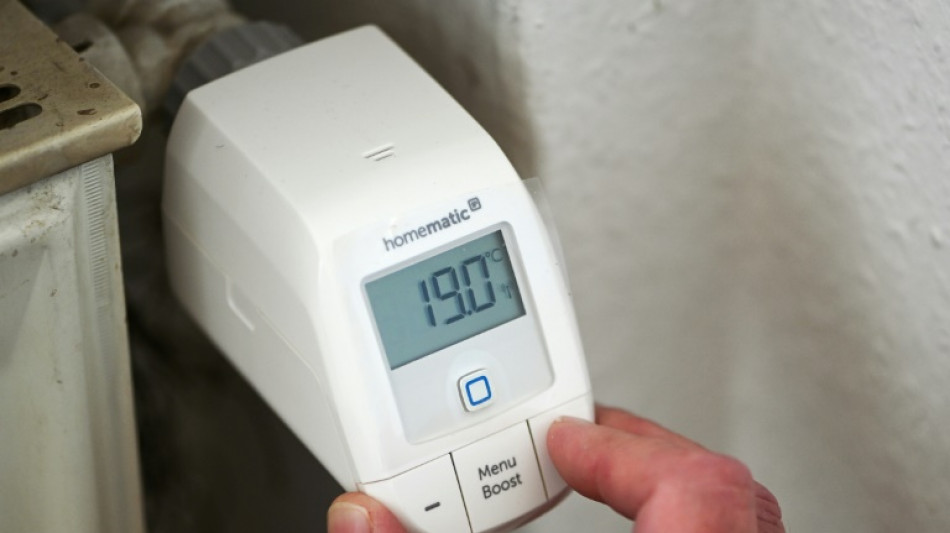
Heat will stay on in Europe this winter, but after? / Photo: © AFP/File

Europe is likely to scrape through this winter without cutting off gas customers despite reduced Russian supplies, but even adjusting to colder homes and paying more may not be enough in coming years, analysts say.
"I like a hot house, I have to admit... I really used a lot of gas," said Sofie de Rous, who until this year kept her home on the Belgian coast at a toasty 21 degrees Celsius (70F).
But like millions of other Europeans, the 41-year-old employee at an architectural firm has had to turn down the thermostat after energy prices surged following Russia's invasion of Ukraine in February.
Russia's progressive reduction of gas supplies to Europe via pipeline triggered a bidding war for liquefied natural gas (LNG), sending prices sharply higher.
If certain countries like France and Spain froze prices for consumers, others like Belgium let suppliers more or less pass along the higher costs.
"I was a little panicked in the beginning," said de Rous, who saw the gas bill to heat her 90-square-metre (970-square-foot) house in Oostduinkerke jump from 120 euros ($126) per month to 330 euros.
She has lowered her thermostat to 18 degrees and is looking into installing double-pane windows and a solar panel.
Like de Rous, the lack of concern about energy consumption of a whole generation of Europeans ended abruptly in 2022, and everyone is mindful of where their thermostat is set.
If previously natural gas was cheap and plentiful, it is now scarce and expensive.
The European wholesale reference price used to fluctuate little, hovering around 20 euros per megawatt hour. This year, it shot as high as 300 euros before dropping back to around 100 euros.
"It's the most chaotic time I've witnessed in all of those years," Graham Freedman, a European gas analyst at energy consultancy Wood Mackenzie, told AFP.
- Big drops in consumption –
Sky-high energy prices have caused numerous factories, particularly in Germany's chemicals sector which was highly dependent upon cheap Russian gas, to halt operations.
But European nations were able to fill their gas reservoirs and no one has been cut off yet.
"Until February, the very idea of Europe without Russian energy was seen as impossible," said Simone Tagliapietra, a senior fellow at the Bruegel think tank in Brussels.
"What was impossible became possible."
A warm autumn that allowed many consumers to put off turning on their heating also helped put Europe in better position for the winter.
Overall, the reduction in EU gas consumption by consumers and industry was around 25 percent in October compared to the 2019-2021 average for the month, according to calculations by Bruegel.
In Germany, where half the households use gas for heat, data shows consumption down by 20 to 35 percent depending on the week.
"That's much more than anyone expected," said Lion Hirth, a professor of energy policy at the Hertie School in Berlin.
"And that's completely contradictory to the talk that we've been hearing from doomsday talkers saying, people just don't respond. People just keep heating. People don't change their behaviour. People don't respond to prices."
In the space of several months Russia has lost its top gas customer, Europe, with purchases passing from 191 billion cubic metres in 2019 to 90 billion this year.
Wood Mackenzie forecasts deliveries will fall to 38 billion cubic metres next year.
The EU has been able to import large quantities of LNG, but only by outbidding South Asian nations like Pakistan and India.
This has pushed these nations to increase their dependence on coal -- negatively impacting global efforts to curb climate change.
- In 2023? –
Europe's ability to import LNG has been limited by a lack of infrastructure.
While France and Spain each had several terminals to unload LNG from tankers and convert it back into gas at the start of the Ukraine conflict, Germany didn't have one.
And while construction of more LNG terminals is under way, in 2023, unlike at the beginning of this year, Europe will mostly have to do without Russian gas to fill its reservoirs.
This could set up an even fiercer bidding war between European and Asian nations for supplies.
"The key factor is most certainly going to be: what is the weather going to be like this winter," said Laura Page, a gas analyst at commodity data firm Kpler.
"If we have a cold winter in Asia, and we have a cold winter in Europe... this fight will intensify."
The problem is that LNG supplies are limited.
"There isn't enough gas in the world at the moment to actually cope with that loss of supply from Russia," said Wood Mackenzie's Freedman.
New LNG projects to boost supply won't be able to come on line before 2025, meaning Europeans will have to get used to living with homes heated to just 18 degrees.
J.M.Ellis--TFWP