'Another arrow to the quiver': World Bank posts record private capital mobilization / Photo: © AFP

The World Bank announced Thursday that it had mobilized a record $112 billion in private capital for developing countries last financial year, with its chief lauding the approach as "adding another arrow to the quiver" of the world's largest development lender.
Private capital mobilization increased by more than 60 percent from the year before and was almost level with the World Bank Group's own lending, according to official data.
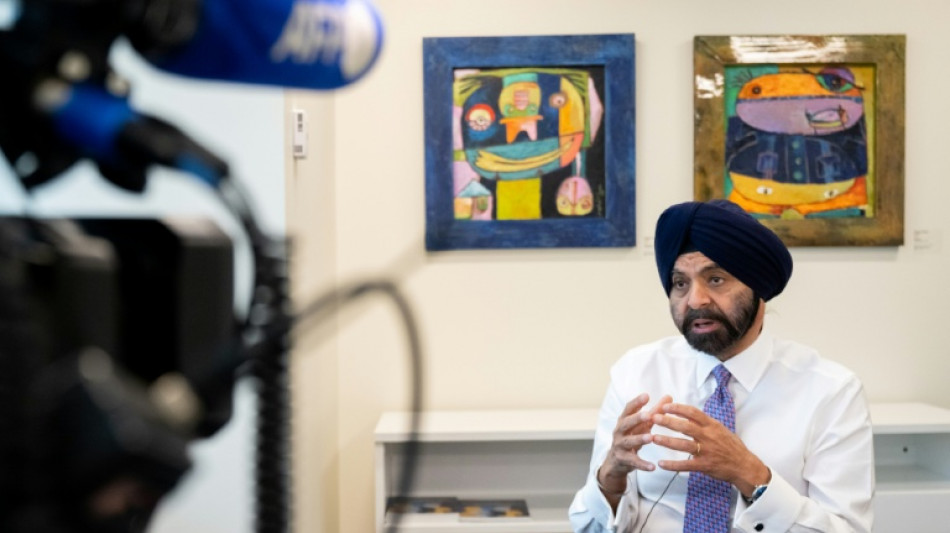
Speaking to AFP at the World Bank's headquarters in Washington, Group President Ajay Banga said the focus on private capital mobilization reflected a stark reality: donors did not have the funds to meet the world's development needs.
"We can't be lending $200 billion a year. We don't have it," he said, adding that private capital was "augmenting" the Bank's work, not replacing it.
The only way to increase the Bank's own lending, he said, would be to ask countries to increase their contributions -- but in a world with debt-to-GDP levels at sky-high levels, that is unlikely.
"Governments don't have that kind of fiscal headroom today," he said.
-'Can't force countries' -
The World Bank normally offers low-interest loans and some grants to member countries through a combination of two of its arms, the International Bank for Reconstruction and Development (IBRD) and the International Development Association (IDA).
Banga argued that IBRD and IDA lending simply "cannot grow adequately."
Still, the Bank's private capital mobilization strategy is not indiscriminate, and funds and projects are offered in combinations that suit member states.
"These things are not either/or, and they're also not mutually exclusive," he said. "One size doesn't fit all."
Critics of the use of private capital by multilateral development lenders argue that it can shift commercial risks from investors onto public finances, and that those finances in turn can subsidize private profits.
For Banga, however, the private capital is necessary to address the sheer scale of development financing needs.
"You got to remember that private capital will not go unless there is a proper return and proper demand," he said. "You can't force countries to take private capital. It's going to have to be a mutually acceptable system."
According to the World Bank, more than half of its lending and private capital mobilization goes to five job-creating sectors: infrastructure and energy, agribusiness, health, tourism, and value-added manufacturing.
Another common criticism of relying on private capital for development needs is that it can leave behind low-income or conflict-affected states -- the ones that often need the most help.
World Bank data showed that private capital mobilization for low-income countries stayed steady at about $3 billion over the last four years, while nearly tripling for lower-middle-income states.
- 'Wet paint' -
The Bank has increased its private sector mobilization using a variety of levers, including prioritizing providing investors more regulatory certainty in emerging markets, and taking on some risk through guarantees and seed money in larger funds.
"The role of private capital mobilization is to bridge the gap between what you need versus what you can generate from public financials, and try and see if there's a way to de-risk that investment, to incentivize that investment, to make it more predictable," said Banga.
One of the most innovative approaches is to create an emerging markets asset class to attract large institutional investors.
The goal is to attract such investors to a bundle of projects that they may not otherwise have the expertise or risk appetite to evaluate on their own.
"I'm not going to invest in one water project in Kenya and one in Vietnam, but if you give me 10 packaged together every year worth $2 billion, and I get a Standard & Poors or Fitch or Moody's rating for them," then they become attractive, he said.
An example of the new approach is how the International Finance Corporation (IFC) -- an arm of the WBG -- approached a transaction with Banco Industrial of Guatemala to support small and medium businesses.
The IFC offered a $850 million financing package that included $750 million generated through international capital markets -- markets the Guatemalan bank was unlikely to be able to access without the IFC's backing.
For Banga, the work done in the last four years was just the start.
"This is wet paint, and as the paint dries, you get a little more result," he said. "And I think that's what you're beginning to see."
M.Cunningham--TFWP