The Fort Worth Press - South Africa coal delay could cause 32,000 deaths, report says

USD -
AED 3.67315
AFN 63.492461
ALL 81.288631
AMD 372.380045
ANG 1.789884
AOA 918.000357
ARS 1377.492202
AUD 1.396794
AWG 1.8
AZN 1.699161
BAM 1.665113
BBD 2.01512
BDT 122.759818
BGN 1.668102
BHD 0.377228
BIF 2975.105995
BMD 1
BND 1.273476
BOB 6.913109
BRL 4.982597
BSD 1.000451
BTN 93.790972
BWP 13.451617
BYN 2.814964
BYR 19600
BZD 2.012209
CAD 1.36645
CDF 2310.999924
CHF 0.78322
CLF 0.022658
CLP 891.79611
CNY 6.824802
CNH 6.829475
COP 3580.41
CRC 455.822507
CUC 1
CUP 26.5
CVE 94.400773
CZK 20.77525
DJF 178.157299
DKK 6.37653
DOP 59.650359
DZD 132.44793
EGP 52.055309
ERN 15
ETB 157.484803
EUR 0.853197
FJD 2.194501
FKP 0.740159
GBP 0.74065
GEL 2.689995
GGP 0.740159
GHS 11.080075
GIP 0.740159
GMD 72.999962
GNF 8777.498711
GTQ 7.646989
GYD 209.3344
HKD 7.832805
HNL 26.580678
HRK 6.427014
HTG 130.965962
HUF 311.019651
IDR 17221.55
ILS 2.99945
IMP 0.740159
INR 93.759249
IQD 1310.596128
IRR 1320999.999847
ISK 122.689681
JEP 0.740159
JMD 158.492044
JOD 0.70899
JPY 159.394496
KES 129.150005
KGS 87.427401
KHR 4004.835771
KMF 419.999744
KPW 899.990254
KRW 1479.359879
KWD 0.30828
KYD 0.833745
KZT 463.595498
LAK 22073.421989
LBP 89593.471709
LKR 317.917894
LRD 184.091335
LSL 16.446219
LTL 2.95274
LVL 0.60489
LYD 6.326571
MAD 9.238104
MDL 17.138041
MGA 4149.568356
MKD 52.55037
MMK 2099.66818
MNT 3578.517246
MOP 8.0708
MRU 39.939723
MUR 46.520139
MVR 15.460376
MWK 1734.492329
MXN 17.322498
MYR 3.9525
MZN 63.902114
NAD 16.446219
NGN 1348.940277
NIO 36.821672
NOK 9.296902
NPR 150.065555
NZD 1.692345
OMR 0.384481
PAB 1.000528
PEN 3.43825
PGK 4.400759
PHP 60.190414
PKR 278.910249
PLN 3.621599
PYG 6293.366934
QAR 3.647718
RON 4.345799
RSD 100.126033
RUB 75.100047
RWF 1461.969385
SAR 3.750618
SBD 8.038772
SCR 14.015284
SDG 599.999861
SEK 9.191805
SGD 1.274725
SHP 0.746601
SLE 24.603506
SLL 20969.496166
SOS 571.778849
SRD 37.457983
STD 20697.981008
STN 20.858697
SVC 8.754693
SYP 110.631499
SZL 16.439919
THB 32.259886
TJS 9.419537
TMT 3.505
TND 2.90915
TOP 2.40776
TRY 44.925199
TTD 6.78285
TWD 31.4855
TZS 2605.000213
UAH 43.897001
UGX 3706.888478
UYU 39.776259
UZS 12134.653533
VES 481.046775
VND 26322.5
VUV 117.946979
WST 2.711482
XAF 558.460897
XAG 0.01282
XAU 0.000211
XCD 2.70255
XCG 1.803113
XDR 0.694162
XOF 558.465651
XPF 101.534165
YER 238.624974
ZAR 16.459602
ZMK 9001.197767
ZMW 19.034038
ZWL 321.999592
  • BCC

    -0.3850

    82.065

    -0.47%

  • BCE

    -0.0500

    23.85

    -0.21%

  • RIO

    2.5100

    100.23

    +2.5%

  • NGG

    1.5800

    85.85

    +1.84%

  • JRI

    0.0100

    13.06

    +0.08%

  • GSK

    -0.1980

    55.922

    -0.35%

  • BTI

    1.1400

    55.97

    +2.04%

  • CMSC

    0.1000

    22.76

    +0.44%

  • CMSD

    0.0300

    23.07

    +0.13%

  • AZN

    0.0000

    195.78

    0%

  • RBGPF

    -13.5000

    69

    -19.57%

  • RYCEF

    -1.3100

    15.85

    -8.26%

  • RELX

    -0.1050

    36.965

    -0.28%

  • BP

    0.4600

    46.37

    +0.99%

  • VOD

    0.1350

    15.325

    +0.88%

South Africa coal delay could cause 32,000 deaths, report says
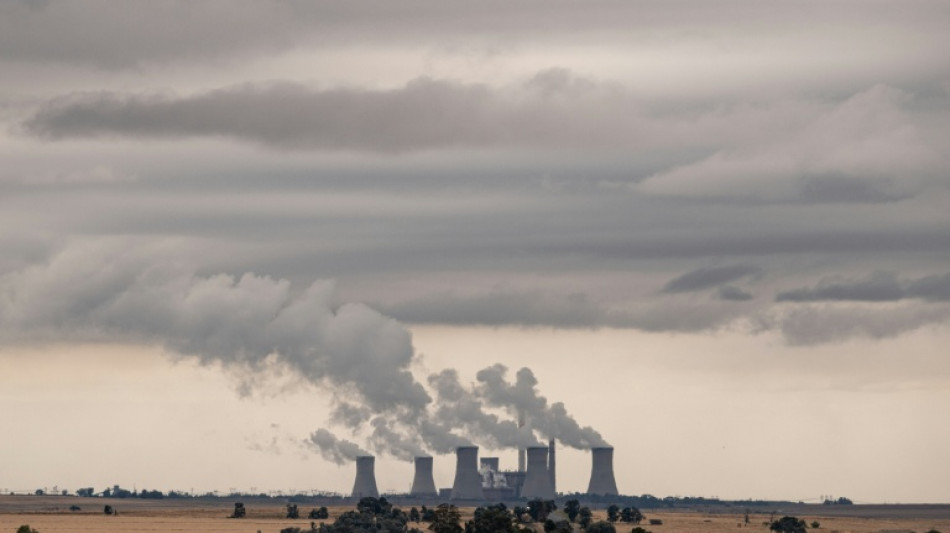
South Africa coal delay could cause 32,000 deaths, report says / Photo: © AFP/File

South Africa coal delay could cause 32,000 deaths, report says

South Africa risks thousands of premature deaths if the phase-out of coal plants is delayed due to the government's updated decommissioning dates, climate rights groups said in a report Wednesday.

Text size:

Coal provides 80 percent of South Africa's power, according to the OECD, and the country ranks among the world's largest greenhouse gas emitters.

It is also a cornerstone of the country's economy, employing more than 90,000 people, making decommissioning plans a divisive issue.

Last year, the government approved the extension of operating dates for its 14 coal-fired power plants across the country, with two set to continue operating until 2050.

The new report by Greenpeace, the Centre for Research on Energy and Clean Air and the South Africa-based climate NGO GroundWork said continued delays could cause up to "32,000 preventable deaths" between 2026 and 2050.

Gauteng province -- home to the capital Pretoria and financial hub Johannesburg -- and with no state-owned coal plants, is projected to bear the largest burden from the extension, with 15,000 deaths forecast over the same period.

In January, authorities attributed elevated sulphur pollution levels in Gauteng to transboundary pollution from neighbouring Mpumalanga, South Africa's most polluted industrial zone.

"Pollution does not stay where it is made, it travels," said Cynthia Moyo, a climate campaigner at Greenpeace.

The delay will also place a heavy burden on children's health, resulting in 41,000 pre-term births, 17,000 new cases of childhood asthma, and 370 deaths among children under five, the report said.

"Coal's true cost is being hidden in hospitals and in early graves," Moyo told AFP in a phone interview, dismissing the government's argument that the delay is for economic reasons.

- 'A pandemic' -

Residents of Middelburg, in Mpumalanga, present at the report's launch, recounted the effects of air pollution they have experienced, including early-onset asthma in children, skin diseases, and other respiratory flare-ups.

"It is a pandemic for us," said 30-year-old mother Sharon Mbonani, who was forced to separate from her one-year-old son and send him to another province after doctors linked his respiratory problems to environmental factors.

The report estimates the cost of the delay to the South African economy at 721 billion rand ($38 billion), including lost working days and increased pressure on the public healthcare system.

Coal-rich but energy-starved South Africa -- the continent's most industrialised nation -- became the first country in the world to sign a Just Energy Transition Partnership (JETP) deal with wealthy nations in 2021, worth $8.5 billion, to shift away from coal-fired power generation.

But last year the United States withdrew its multi-million dollar deal with Pretoria as part of the Trump administration's pullback from global climate commitments.

The transition to green energy has been mired with infighting among the government, which has a long history of support from labour unions representing mine workers.

N.Patterson--TFWP