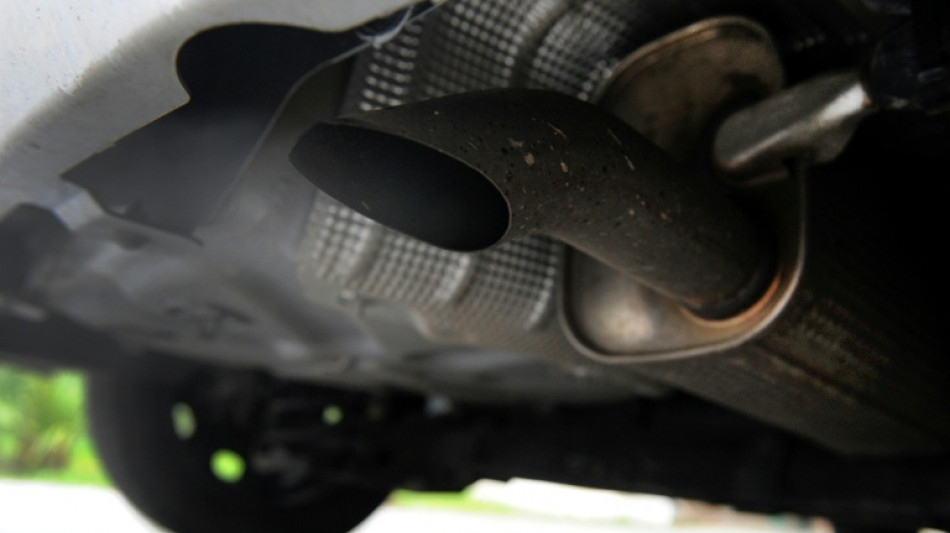
EU eases 2035 combustion-engine ban to boost car industry / Photo: © AFP

The EU on Tuesday walked back a 2035 ban on new petrol and diesel cars seen as a milestone in the fight against climate change, as the bloc pivots to bolstering its crisis-hit auto sector.
Under proposals decried by environmental groups, carmakers will now have to cut exhaust emissions from new vehicles by 90 percent from 2021 levels -- down from an envisaged 100 percent -- with the remainder "compensated" in various ways.
The EU's industry chief, Stephane Sejourne, insisted the bloc's green ambitions stood intact as he put forward a plan billed as a "lifeline" for Europe's auto industry.
"The European Commission has chosen an approach that is both pragmatic and consistent with its climate objectives," he told AFP.
The combustion-engine ban was hailed as a major win in climate fight when adopted in 2023.
But carmakers and their backers have lobbied hard over the past year for Brussels to relax it, in the face of fierce competition from China and a slower-than-expected shift to electric vehicles (EVs).
Weakening the ban is the most striking result yet of a pro-business push that has seen the EU pare back a slew of environmental laws this year -- on the grounds they risk weighing on growth.
In practice, automakers will still be able to sell a limited number of polluting vehicles -- from plug-in hybrids to diesel cars -- past 2035.
To do so, they will have to compensate for the planet-warning emissions these cars spew into the atmosphere through two types of carbon credits.
The first will be generated by the use of made-in-Europe, low-carbon steel in car manufacturing.
The second will be outside carmakers' hands and tied to the amount of e-fuels and biofuels that energy companies put on the market every year.
- Condemned to 'decline' -
Beset by announcements of job cuts and factory closures over the past year, Europe's auto industry -- which employs almost 14 million people and accounts for about seven percent of Europe's GDP -- had maintained that the 2035 goal was no longer realistic.
High upfront costs and the lack of adequate charging infrastructure in parts of the 27-nation union mean consumers have been slow to warm to EVs, producers say.
Just over 16 percent of new vehicles sold in the first nine months of 2025 run on batteries, according to industry figures.
Manfred Weber, the conservative head of the EU parliament's largest group, welcomed the new target, saying that "forbidding technologies" would be a gift to far-right populists.
Critics, including Spain, France and the Nordic countries, had warned that ditching the ban risked slowing the shift to electric, undermining the EU's green agenda and deterring investments in electrification.
"To claim that tomorrow's jobs and innovations still lie in diesel or petrol engines, when the rest of the world has embarked on an industrial race towards batteries and electric vehicles, is to condemn the French and European automotive industry to decline," said Neil Makaroff, director at Strategic Perspectives, a think tank.
- Green fleets -
The commission also unveiled a slew of additional measures to support the auto sector as part of a package that needs approval from the EU parliament and member states.
In the run-up to 2035, carmakers will benefit from "super credits" for small "affordable" electric cars made in the EU, in an accounting trick that would make reaching emission targets easier.
This would mean that sales of electric cars under 4.2 metres in length will be counted 1.3 times, thus artificially boosting the share of zero-emission cars in an automakers fleet.
The commission also proposed reducing the interim 2030 emission target for vans from 50 to 40 percent and allowing truck manufacturers more time to meet their own 2030 target, in line with a previous concession to automakers.
To boost EV sales, medium and large firms will be required to green their fleets, which currently account for about 60 percent of new car sales in Europe.
At least 30 percent of new vehicles bought by companies will need to be zero- or low-emission, under targets that will differ from country to country, with the bar set higher for richer nations.
Finally, the EU will provide 1.5 billion euros to support European battery producers through interest-free loans.
Road transport accounts for about 20 percent of total planet-warming emissions in Europe, and 61 percent of those come from cars' exhaust pipes, according to the EU.
W.Knight--TFWP