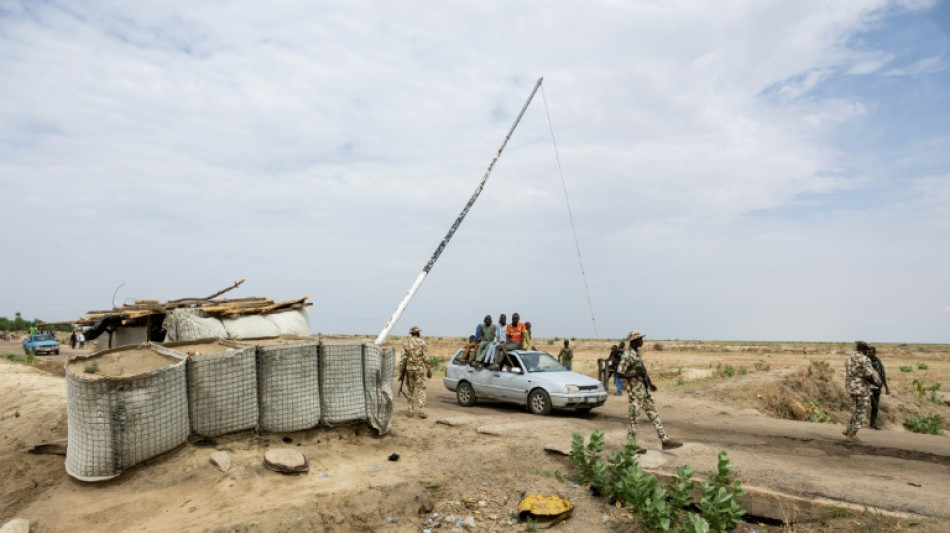
Deadly roads block mothers from care in jihadist-hit Nigeria / Photo: © AFP/File

When Lawan Mustafa's wife, nine months pregnant, woke up bleeding in the middle of the night, she looked at her husband and warned him: don't go to the hospital.
Despite a base full of troops stationed on the outskirts of the northeastern Nigerian town where they live, Magumeri is known to crawl with jihadists at night -- as well as anti-jihadist vigilantes who might view Mustafa as a suspect.
Nigeria is the world's most dangerous country to give birth in, with a maternal mortality rate of 993 per 100,000 births, according to the World Health Organization.
Corruption is endemic and doctors are constantly on strike, demanding backpay and upgrades to aging facilities.
But in the northeast, in the throes of a 16-year-old insurgency, an untold number of women never make it to the hospital -- hemmed in by roads too dangerous to travel on, or military checkpoints and curfews.
"Before you know it, everywhere was stained with blood," Mustafa, a 35-year-old father of five, told AFP. "I was reassuring her, because there was no way we could go out."
He finally left around 4:30 am, when there would be safety in numbers as fellow Muslim faithful started stirring for the first morning prayers.
His wife, Ummanim, eventually made it to the hospital, but it was too late: she and the baby both died.
Even as its maternal mortality rate has been steadily ticking down over the past decade, the nation's 75,000 maternal deaths per year account for a quarter of all such fatalities worldwide.
The causes are myriad, experts say: despite the country's vast oil wealth, millions live in poverty. Cultural mores can limit women's access to contraceptives, as well as their ability to travel outside their village, especially in the conservative north.
Children aren't spared: Nigeria ranks only behind neighbouring Niger when it comes to deaths of children under five, according to the World Bank.
- Abductions, checkpoints -
The country's jihadist insurgency, which was kicked off by Boko Haram's 2009 uprising, only adds to the crisis.
"You want (a patient) to come to a facility that is far -- she might be thinking, what if I get abducted along this road?" said Ekeh Chizoba, a health outreach officer with International Rescue Committee (IRC), an NGO, noting an increase in reports of kidnapping this year.
Medical workers can also be high-value kidnapping targets, her colleague, Saidu Liman told AFP, adding to the already difficult task of recruiting specialists to rural locales.
Violence in the northeast has receded since its peak a decade ago, and major cities such as Maiduguri -- the capital of Borno state -- are no longer the site of suicide bombings or gun battles.
But swathes of countryside remain outside government control and analysts have warned of an uptick in jihadist attacks this year.
The military closes the 50-kilometre (30-mile) road from Maiduguri to Magumeri each day around 5:00 pm -- blocking the movement of doctors, patients and medicines from the better-equipped capital.
Even when the road is open, it's no guarantee there won't be attacks.
"They'll mount a checkpoint and tell me I have to stay back while the military clear the road," said Mohammed Bakura, an ambulance driver contracted by IRC who often drives between the two cities.
Such delays are preferable to the times when jihadists have attempted to steal his car while attacking the Magumeri clinic, he said.
In a village on Magumeri's outskirts, surrounded by sprawling fields of sorghum and beans, Falmata Kawu was seated at a small clinic where she took her daughter Aisa last year.
The two-year-old was referred to a hospital in Maiduguri for complications from malnutrition.
The road was open and she was able to go right away, but Aisa died at the hospital.
Kawu, 30, wondered what would have happened if there were less conflict and more money for health care -- if she could have treated Aisa in the village.
"The child could have lived longer," she said.
S.Palmer--TFWP