German industry sounds alarm as government cuts growth forecast / Photo: © AFP

The German government on Wednesday slashed its growth forecasts for 2025 as industry leaders sent dire warnings over the country's economic health and staged nationwide protests to urge reforms.
Output by Europe's largest economy was now expected to increase by just 0.3 percent this year, the economy ministry said.
The figure was significantly lower than the government's previous estimate of 1.1 percent growth made in October last year.
"Germany is stuck in stagnation," Economy Minister Robert Habeck told a press conference in Berlin. Another 12 months of near-zero growth would follow two straight years in which the economy has been in recession.
The downward revision could be traced back to domestic political instability, Habeck said, with Germany headed for an early election on February 23 after the collapse of the government last year.
The return of Donald Trump to the White House and his threat to levy tariffs on key trading partners is also a risk for Germany's export-oriented economy, Habeck said.
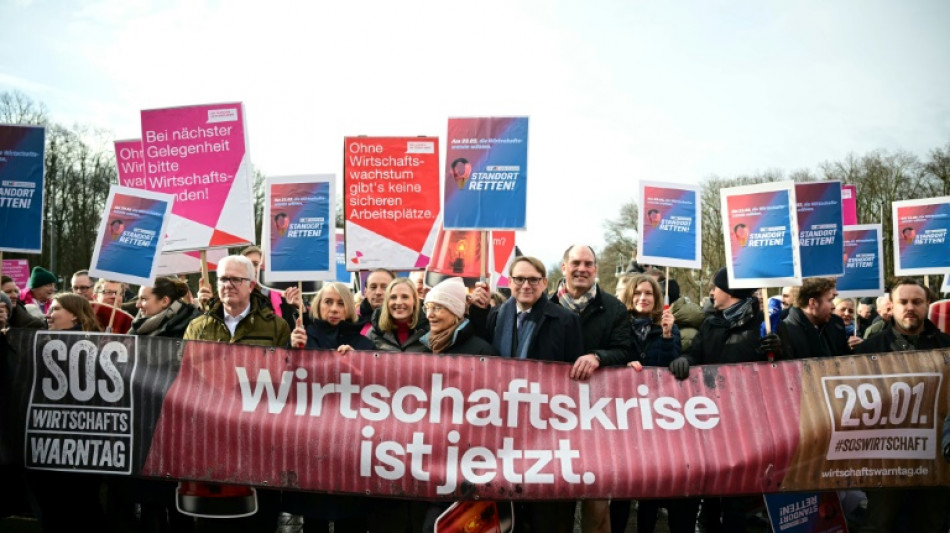
Amid the bad economic news, Germany's leading industry associations organised demonstrations in several cities across the country to send a "distress signal" to officials.
A few hundred noisy protestors gathered in front of the Brandenburg Gate in the centre of Berlin's government district.
"When will there be real growth again?" read one sign held by protestors, who blew whistles and sounded horns in front of the monument.
- 'Delaying the recovery' -
The cut to this year's forecasts was "mainly due" to the collapse of Chancellor Olaf Scholz's government in November, the ministry's report said.
The disintegration of the coalition between Scholz's Social Democrats, the Greens and the liberal Free Democrats (FDP) meant that a planned economic stimulus programme could not be fully implemented.
The whole package would have boosted growth in 2025 by 0.5 percentage points, Habeck said.
The lack of clarity over the shape of the next government and the country's economic policy were discouraging investments and "delaying the recovery", he said.
The minister, who is leading the Greens into the election, also made an appeal to Trump to avoid the planned tariff increases.
"This is a danger for an export nation like Germany, but it is also to the overall detriment of the people in both economies," Habeck said.
At the same time, it is increasingly clear that Germany has "structural problems", Habeck said, pointing to a shortage of skilled workers and excessive bureaucracy.
Likewise, Germany was "systematically underinvesting in relation to its GDP", he said.
The government's fiscal policy over the past three years of Scholz's coalition with Habeck as minister had had a "braking effect" on the economy, he said.
- 'Suffocating' -
Asked whether Germany's economic struggles were feeding support for political extremes, Habeck said that failure to match economic success in autocracies means "the attraction of these political models will probably become ever stronger".
"If we want to keep our constitution and democracy... then we must overcome this weakness in growth," he said.
At the industry protest by the Brandenburg Gate, real estate business owner Urs Moeller pinned the blame on Habeck for the economic situation.
"The issue of costs and bureaucracy is increasingly suffocating us," Moeller told AFP.
The industry associations behind the protests said it was "time to act" after years of warning about the issues facing business.
The election of Trump was a "turning point" and a challenge to Europe where businesses needed to be more competitive, the heads of the BDA, BDI, DIHK and ZDH groups said in a joint statement.
Economic issues needed to be "at the top of the agenda of the next federal government", they said, calling for cuts to red tape and taxes as well as affordable energy prices and more skilled labour.
"Short-term crisis management will not help Germany... We need fundamental structural changes in economic and social policy," they said.
S.Palmer--TFWP