The Fort Worth Press - Medieval Europe and Africa collide in Sao Tome traditional theatre

USD -
AED 3.672504
AFN 65.503991
ALL 79.318504
AMD 362.947984
ANG 1.789783
AOA 918.000367
ARS 1507.906983
AUD 1.390241
AWG 1.8
AZN 1.70397
BAM 1.682915
BBD 2.014026
BDT 122.892914
BGN 1.696366
BHD 0.376974
BIF 2990.405714
BMD 1
BND 1.267134
BOB 12.374478
BRL 5.126204
BSD 0.999957
BTN 94.431872
BWP 13.388977
BYN 3.080411
BYR 19600
BZD 2.011186
CAD 1.38375
CDF 2280.000362
CHF 0.805696
CLF 0.023647
CLP 931.050209
CNY 6.711304
CNH 6.707805
COP 3141.849159
CRC 453.555909
CUC 1
CUP 26.5
CVE 94.880179
CZK 20.83504
DJF 178.066515
DKK 6.436104
DOP 59.192015
DZD 133.23104
EGP 50.946694
ERN 15
ETB 162.350127
EUR 0.860604
FJD 2.19495
FKP 0.739564
GBP 0.735862
GEL 2.60504
GGP 0.739564
GHS 11.369445
GIP 0.739564
GMD 74.000355
GNF 8789.743148
GTQ 7.634126
GYD 209.207073
HKD 7.84035
HNL 26.844211
HRK 6.487804
HTG 130.774857
HUF 311.860388
IDR 17630.8
ILS 3.012395
IMP 0.739564
INR 94.490504
IQD 1309.985802
IRR 1374600.000352
ISK 121.240386
JEP 0.739564
JMD 158.507938
JOD 0.70904
JPY 156.25504
KES 129.544379
KGS 87.449104
KHR 4046.809792
KMF 424.00035
KPW 900.000294
KRW 1346.090383
KWD 0.30899
KYD 0.833369
KZT 455.431743
LAK 22423.095125
LBP 89547.734802
LKR 328.133201
LRD 174.994622
LSL 15.976165
LTL 2.95274
LVL 0.60489
LYD 6.345136
MAD 9.374607
MDL 17.224971
MGA 4290.323969
MKD 52.94067
MMK 2099.630759
MNT 3599.09303
MOP 8.075205
MRU 40.228886
MUR 46.830378
MVR 15.460378
MWK 1733.941402
MXN 16.887204
MYR 4.044304
MZN 63.903729
NAD 15.976165
NGN 1323.210377
NIO 36.802478
NOK 9.307904
NPR 151.090651
NZD 1.694485
OMR 0.384504
PAB 0.999957
PEN 3.353784
PGK 4.508024
PHP 62.720375
PKR 277.307146
PLN 3.71225
PYG 5982.876565
QAR 3.65495
RON 4.522038
RSD 100.976638
RUB 86.537882
RWF 1471.927032
SAR 3.752831
SBD 8.000512
SCR 13.778038
SDG 601.503676
SEK 9.572704
SGD 1.268804
SHP 0.740866
SLE 24.650371
SLL 20969.499227
SOS 571.526911
SRD 37.730504
STD 20697.981008
STN 21.081616
SVC 8.750161
SYP 13001.999906
SZL 15.979004
THB 32.920369
TJS 9.219722
TMT 3.5
TND 2.918556
TOP 2.40776
TRY 48.421304
TTD 6.76935
TWD 31.685804
TZS 2647.420729
UAH 44.542959
UGX 3774.89997
UYU 40.252979
UZS 11794.51878
VES 806.377104
VND 26060
VUV 118.065332
WST 2.718087
XAF 564.434023
XAG 0.015104
XAU 0.000226
XCD 2.70255
XCG 1.802177
XDR 0.707052
XOF 564.434023
XPF 102.620144
YER 237.000331
ZAR 15.96895
ZMK 9001.203584
ZMW 19.124898
ZWL 321.999592
  • CMSC

    -0.1100

    20.81

    -0.53%

  • BTI

    -0.6200

    55.35

    -1.12%

  • RELX

    -1.1400

    35.51

    -3.21%

  • AZN

    -2.0700

    162.7

    -1.27%

  • RBGPF

    0.0000

    70

    0%

  • RIO

    0.4300

    103.27

    +0.42%

  • RYCEF

    0.1400

    19.92

    +0.7%

  • BP

    0.2300

    43.81

    +0.52%

  • GSK

    -0.9800

    49.89

    -1.96%

  • NGG

    -0.0500

    78.12

    -0.06%

  • CMSD

    -0.0700

    20.69

    -0.34%

  • BCC

    2.0900

    79.21

    +2.64%

  • JRI

    -0.0700

    12.14

    -0.58%

  • BCE

    -0.1400

    23.67

    -0.59%

  • VOD

    0.3200

    16.9

    +1.89%

Medieval Europe and Africa collide in Sao Tome traditional theatre
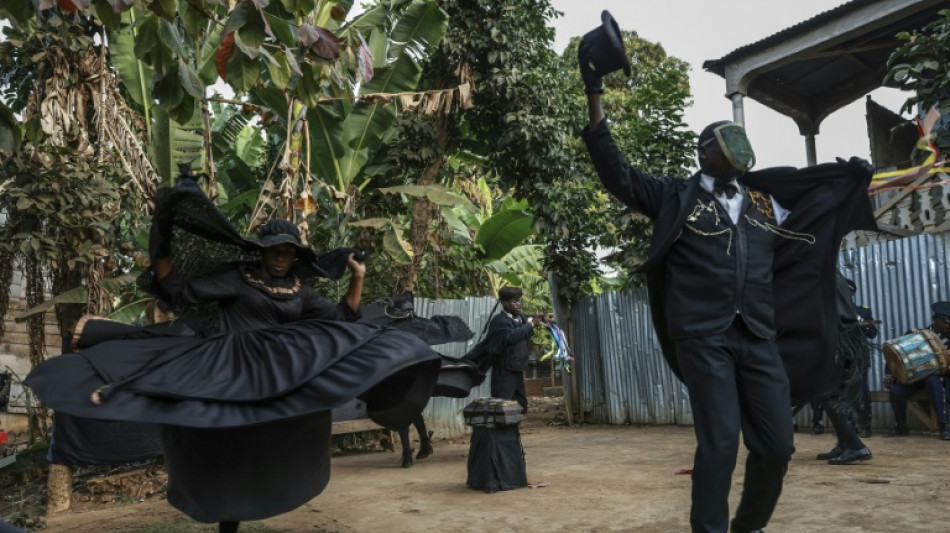
Medieval Europe and Africa collide in Sao Tome traditional theatre / Photo: © AFP

Medieval Europe and Africa collide in Sao Tome traditional theatre

A carved bamboo flute trills before the percussion picks up the pace as the performers on Sao Tome bring a medieval European tragedy to life on the island off Africa's west coast.

Text size:

Brought to the Gulf of Guinea archipelago nation more than 500 years ago by Portuguese colonialists, the UNESCO-listed tradition of open-air Tchiloli theatre continues to conquer the Sao Tome and Principe public to this day.

"People love this culture because it speaks to something very real: justice," said Marco Carvalho, who plays the traditional Pitu flute for the Formiguinha da Boa Morte troupe, among the most venerable Tchiloli acts around.

"Justice makes no distinction between the rich and the poor," said Carvalho, who at 61 years old has spent more than three of his decades alive in Tchiloli theatre.

Sporting a flamboyant array of outfits accessorised with beards, wigs and top hats, the troupe spend several hours dancing to the orchestra's rhythm in a courtyard surrounded by homes, to the delight of the spectators.

But the play's script is in Old Portuguese; its inspiration comes from the legends tied to the Carolingian dynasty, which ruled over much of western Europe from the eighth to the 10th centuries AD.

At the story's heart lies a crime: the Emperor Charlemagne's heir, Charles the Younger, kills a knight during a hunting meet.

So the knight's uncle, the Marquis of Mantua, demands that the emperor bring his own son to trial, which sees Charles the Younger convicted in public.

- 'Unifying art' -

"It spreads a very important message," said 19-year-old spectator Maribel Borja. "Everything must be just. Who sows evil reaps evil."

For the central African archipelago nation's culture ministry, Tchiloli theatre is a "unifying art" that must be protected.

"It reaffirms the primacy of law, the rule of law, the virtues of dialogue, and promotes living together and peaceful coexistence," the ministry said.

Since the Portuguese brought Tchiloli's ancestor to the islands as early as the 16th century, the tradition "maintained itself in the archipelago across many years by taking the form it has today and by integrating (the archipelago's) cultural values", it added.

Carvalho, the veteran Pitu flute player, agreed that "Tchiloli in itself did not originate from the island".

"It is an art adapted from European culture," he said.

His 35-year-old colleague, Jardel Moniz Fernandes, has spent a year fulfilling his childhood dream by taking on the character of Ganelon in the Formiguinha da Boa Morte troupe.

In the tales, Ganelon betrays Charlemagne to the Saracens at the Battle of Roncevaux Pass,

"I love it all, really all of it: the dancing, the sound of the flute, the drum," Fernandes said.

"I've two children, and soon enough I will start to prepare my eldest to act," he added.

As with many before him, the centuries-old tradition will then pass down to the generation to come.

C.Rojas--TFWP