From misfits to MAGA: Nicki Minaj's political whiplash
/ Photo: © AFP/File

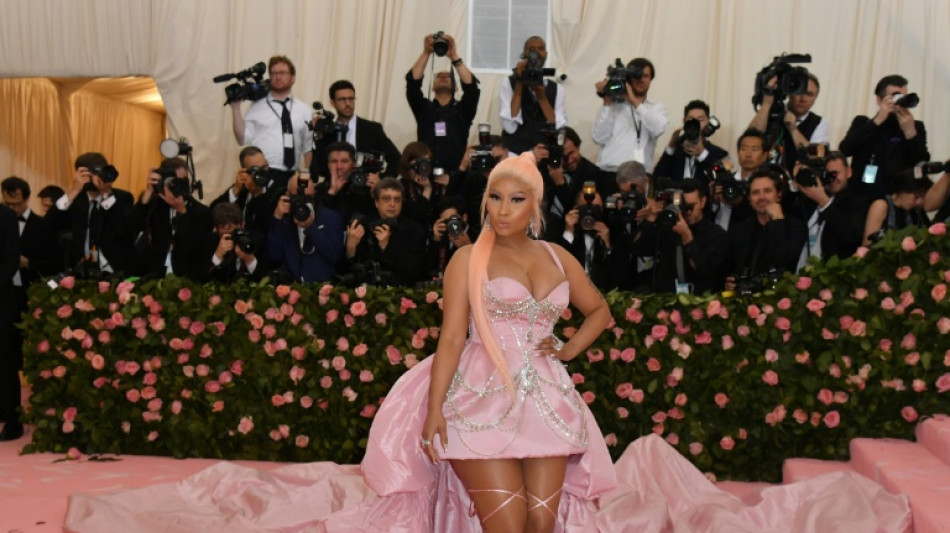
Nicki Minaj long reigned as pop's unruliest shape-shifter -- a hyper-sexual, neon-bright provocateur whose latex-clad persona, explicit lyrics and affinity with outsiders made her a global icon.
Today, she commands a different spotlight -- conservatively dressed, warmly received by Republican activists and increasingly fluent in the language of Donald Trump's "Make America Great Again" (MAGA) movement.
In just a few years, Minaj, 43, has moved from condemning the US president's immigration policies to praising his leadership, trading memes with his vice president and appearing under US government auspices at the United Nations.
She has mocked Democratic officials, echoed Republican messaging on transgender youth, and emerged as an unlikely darling of the MAGA right -- a turn that has jolted fans, particularly within the LGBTQ community.
The shift has recast Minaj as a lightning rod -- particularly over rhetoric viewed as dismissive or hostile toward trans people -- while making her an improbable guest at political events few would have linked to the artist behind "Super Freaky Girl" and "Trollz."
"Nicki Minaj has always been about dominance, independence and answering to no one," celebrity branding expert Jeetendr Sehdev told AFP.
"Aligning with the energy around Donald Trump isn't about policy -- it's about freedom of expression, resisting cancellation and asserting autonomy."
Minaj's transformation was on full display at Turning Point USA's weekend conference in Arizona, where she shared the stage with Erika Kirk -- the widow of the group's slain founder, Charlie Kirk -- and hailed Trump as a "role model."
She mocked California Governor Gavin Newsom, using nicknames popularized by Trump.
The contrast is jarring -- not only politically, but culturally. Hip-hop, though never monolithic, has largely leaned progressive.
Stars like Cardi B, Megan Thee Stallion and Lizzo have backed Democratic candidates, while a smaller cohort -- including Lil Wayne and Kodak Black -- stand out as Trump-friendly exceptions.
- 'Childish' -
Gone was the shock-and-awe star in latex and wigs when she sat down in Phoenix. In her place sat a composed figure steeped in conservative grievance and moral certainty.
Her remarks drew fierce backlash for comments on transgender youth that critics say mirror Republican framing of gender-affirming care as a threat to children.
"For boys: boys, be boys... There's nothing wrong with being a boy," she told the crowd, urging a return to traditional gender norms.
It was a sharp departure from the artist who once celebrated fluid identities and cultivated one of pop's most queer-friendly fan bases.
Her evolution did not happen overnight. Minaj has long resisted tidy labels, cloaking herself in alter egos and irony.
She once rapped about voting Republican, then brushed it off as sarcasm. She called Trump "childish," even as she admitted finding him entertaining.
During Trump's first term, she condemned family separations at the US–Mexico border -- invoking her own arrival in the United States as an undocumented child from Trinidad and Tobago -- and later celebrated Joe Biden's election victory.
But the shift towards MAGA gathered pace during the Covid-19 pandemic, when she questioned vaccine safety in ways that echoed conservative skepticism and drew public rebukes from health officials.
- 'The cool kids' -
From there, her rhetoric hardened and Minaj has increasingly aligned with administration messaging -- reposting White House videos set to her music and appearing alongside senior officials.
She has also appeared under US diplomatic auspices at the United Nations, speaking about violence against Christians in Nigeria -- an issue experts say is more complex than often portrayed.
The aesthetic shift rivals the political one -- the artist who once weaponized excess now favoring restraint, sitting comfortably among Republican operatives and conservative influencers.
At the Arizona conference, she joked that she and her allies were "the cool kids."
Supporters say Minaj is simply exercising independence, refusing to be boxed in by expectations tied to her gender, race or fan base.
Critics counter that independence does not excuse language that marginalizes vulnerable groups -- especially from an artist whose career was built on challenging norms, not reinforcing them.
"She will polarize people, but that won't weaken a brand like hers -- it will likely amplify it," Sehdev, the Hollywood branding expert, told AFP.
"It filters out passive fans and deepens loyalty among those who admire strength over approval."
T.Mason--TFWP