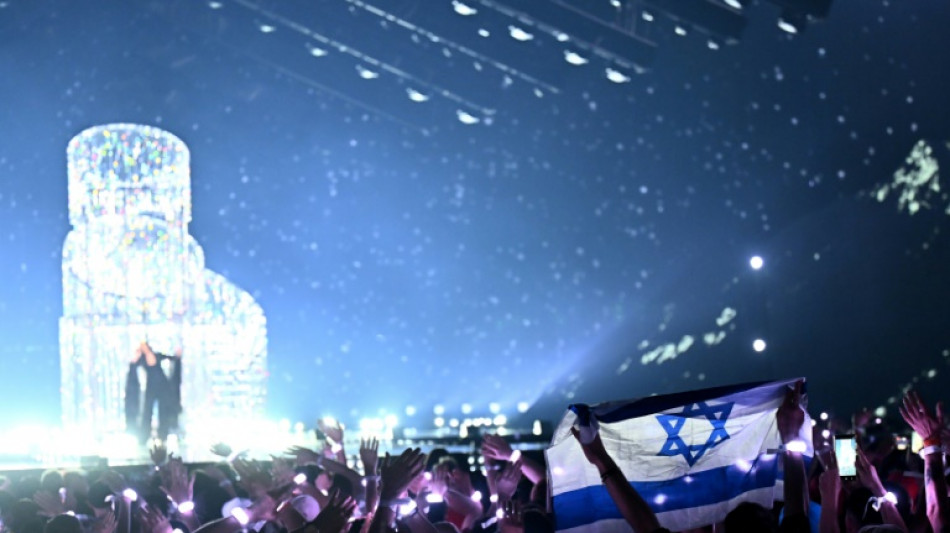
Eurovision facing fractious 2026 as unity unravels / Photo: © AFP

The Eurovision Song Contest heads into its 70th anniversary edition next year mired in its biggest-ever political boycott, with five countries staying away over Israel's participation.
Eurovision organisers announced Monday that 35 countries would take part in the world's biggest live televised music event in May -- the fewest since entry was expanded in 2004.
The number would have been even lower, but for Bulgaria, Romania and Moldova rejoining the glitzy annual extravaganza.
Once the lights go up in Vienna, Eurovision 2026 may look very much like a regular edition.
However, the boycott will cast a shadow over proceedings -- and may remain the biggest talking point.
For William Lee Adams, founder of the independent Eurovision website Wiwibloggs, the atmosphere will be very different, with many die-hard fans sensing bad vibes and sitting this one out.
"This is not going to be the festival of rainbows and kisses as it was in the past," he told AFP. "There's great unease colouring everything."
- 'Serious crisis' -
Eurovision is run by the European Broadcasting Union (EBU), the world's biggest alliance of public service media.
While countries have had Eurovision grievances over the years and dipped in and out -- sometimes citing the voting system, their chances of winning, the quality of the show, or the standard of their own entries -- this time feels different.
Matters came to a head over widespread concerns about the conduct of Israel's two-year war in Gaza.
There were suspicions too that the televoting system was being manipulated to boost Israel after it comfortably topped the public voting in Basel at Eurovision 2025, with extraordinary sequences of maximum points from other countries.
Some broadcasters also raised concerns about EBU values and media freedom, with Israel preventing their journalists from accessing Gaza, while targeting and killing Palestinian journalists in the territory.
Public broadcasters in Iceland, Ireland, the Netherlands, Slovenia and Spain have all announced they are boycotting.
Eurovision "tells us about European politics: it's a political barometer that reflects the zeitgeist," Dean Vuletic, the author of "Postwar Europe and the Eurovision Song Contest", told AFP.
"This is the first time we've seen broadcasters grouping in a political boycott over the participation of another country. So it is a serious crisis for the contest," he said.
- Risk of contagion -
The boycott could potentially spread further, if performers themselves decide to pull out.
"They've confirmed 35 countries but I'm not yet convinced we will see 35," Adams said.
"In the past, Eurovision was a great honour for so many artists," but now, "it might feel like a poisoned chalice to some".
"Artists ultimately are thinking about their careers -- and their calculus will be different."
Most of the contenders in Portugal's domestic selection competition have vowed not to attend Eurovision if they win.
"Some of these selections play a big part in national musical life. You will see artists under pressure to take positions," Catherine Baker of the University of Hull, who has researched the cultural politics of Eurovision, told AFP.
She said contenders would be figuring out how to approach their engagement with Eurovision if selected.
Some would have signed up in expectation that Israel would not be taking part, she added.
- A question of trust -
Vuletic said the seven-decade history of Eurovision was one of ongoing adaptation: "changes to the rules, trying to address emerging problems... and not being able to anticipate future ones".
EBU members have adopted measures aimed at improving the voting system, enhancing fraud detection and curbing government-backed promotional campaigns.
How those changes play out at Vienna 2026 will have an impact on the contest's future -- including whether the boycotting broadcasters come back, and if waverers who stayed on board will keep faith.
"What happens over the next 12 months is going to play a big role in restoring trust on the part of those broadcasters," said Baker. "There is a lot of regret that it's come to the current situation."
"If, after the results in 2026, broadcasters are feeling happier that these reforms have actually worked, then you might see some of them potentially returning."
Ewan Spence, the co-founder and editor of the ESC Insight online platform, said one of the first gauges of the public mood would be when tickets go on sale on January 13.
"I do not think there is a way the EBU can avoid coverage around this issue," he told AFP.
"Vienna will have all the glitz, the glamour, and the heart in the middle of the Eurovision logo -- but many will be asking if the heart of the show is still there."
K.Ibarra--TFWP