The Fort Worth Press - Climate-boosted drought in western US worst in 1,200 years

USD -
AED 3.672504
AFN 62.503991
ALL 82.650403
AMD 368.540403
ANG 1.79046
AOA 918.000367
ARS 1450.190811
AUD 1.415629
AWG 1.8025
AZN 1.70397
BAM 1.680659
BBD 2.014781
BDT 122.77973
BGN 1.66992
BHD 0.377125
BIF 2983
BMD 1
BND 1.283376
BOB 6.911427
BRL 5.172104
BSD 1.000301
BTN 94.924401
BWP 13.438973
BYN 2.805998
BYR 19600
BZD 2.011764
CAD 1.39345
CDF 2300.000362
CHF 0.796223
CLF 0.023233
CLP 914.390396
CNY 6.76565
CNH 6.790525
COP 3603.13
CRC 460.103983
CUC 1
CUP 26.5
CVE 96.150394
CZK 21.001904
DJF 177.720393
DKK 6.486804
DOP 58.250393
DZD 134.609744
EGP 52.109853
ERN 15
ETB 158.803874
EUR 0.867804
FJD 2.219304
FKP 0.748554
GBP 0.749457
GEL 2.660391
GGP 0.748554
GHS 11.81504
GIP 0.748554
GMD 73.000355
GNF 8777.503848
GTQ 7.624752
GYD 209.211097
HKD 7.83425
HNL 26.670388
HRK 6.538904
HTG 130.795342
HUF 308.550388
IDR 18095.7
ILS 2.93015
IMP 0.748554
INR 94.950504
IQD 1310
IRR 1375125.000352
ISK 124.640386
JEP 0.748554
JMD 158.149367
JOD 0.70904
JPY 160.295504
KES 129.360385
KGS 87.450384
KHR 4012.503796
KMF 428.00035
KPW 899.855249
KRW 1559.360383
KWD 0.30932
KYD 0.833545
KZT 486.735702
LAK 22000.000349
LBP 90311.324071
LKR 336.595887
LRD 182.525039
LSL 16.550381
LTL 2.95274
LVL 0.60489
LYD 6.355039
MAD 9.261039
MDL 17.344602
MGA 4200.000347
MKD 53.481713
MMK 2098.995154
MNT 3580.562942
MOP 8.070774
MRU 40.035039
MUR 47.570378
MVR 15.450378
MWK 1737.000345
MXN 17.472904
MYR 4.029504
MZN 63.910377
NAD 16.550377
NGN 1360.303725
NIO 36.610377
NOK 9.564635
NPR 151.885876
NZD 1.726073
OMR 0.387019
PAB 1.000254
PEN 3.47125
PGK 4.360375
PHP 61.798504
PKR 278.503701
PLN 3.68295
PYG 6114.066219
QAR 3.637504
RON 4.544704
RSD 101.171038
RUB 73.673999
RWF 1463
SAR 3.758217
SBD 8.048583
SCR 13.810372
SDG 600.503676
SEK 9.391625
SGD 1.291038
SHP 0.746601
SLE 24.603667
SLL 20969.502105
SOS 571.000338
SRD 37.311504
STD 20697.981008
STN 21.5
SVC 8.752181
SYP 110.532098
SZL 16.550369
THB 32.728038
TJS 9.332606
TMT 3.5
TND 2.917504
TOP 2.40776
TRY 46.062504
TTD 6.776952
TWD 31.577604
TZS 2627.498038
UAH 44.369817
UGX 3768.980244
UYU 40.388069
UZS 11967.503617
VES 562.585085
VND 26330
VUV 118.752346
WST 2.727023
XAF 563.670111
XAG 0.014742
XAU 0.000231
XCD 2.70255
XCG 1.802862
XDR 0.707883
XOF 564.503593
XPF 103.875037
YER 238.625037
ZAR 16.56803
ZMK 9001.203584
ZMW 17.585213
ZWL 321.999592
  • CMSC

    -0.1384

    22.47

    -0.62%

  • CMSD

    -0.1300

    22.52

    -0.58%

  • BCC

    -0.4000

    68.08

    -0.59%

  • BCE

    0.3300

    24.41

    +1.35%

  • GSK

    0.2500

    51.52

    +0.49%

  • RBGPF

    0.5500

    60.56

    +0.91%

  • BP

    -1.0700

    42.97

    -2.49%

  • NGG

    0.4800

    81.86

    +0.59%

  • RIO

    -4.7100

    100.69

    -4.68%

  • VOD

    -0.4000

    14.7

    -2.72%

  • BTI

    1.8700

    59.72

    +3.13%

  • RYCEF

    -0.4400

    16.7

    -2.63%

  • JRI

    -0.2100

    12.6

    -1.67%

  • AZN

    4.1500

    185.95

    +2.23%

  • RELX

    0.6900

    35.15

    +1.96%

Climate-boosted drought in western US worst in 1,200 years


Climate-boosted drought in western US worst in 1,200 years

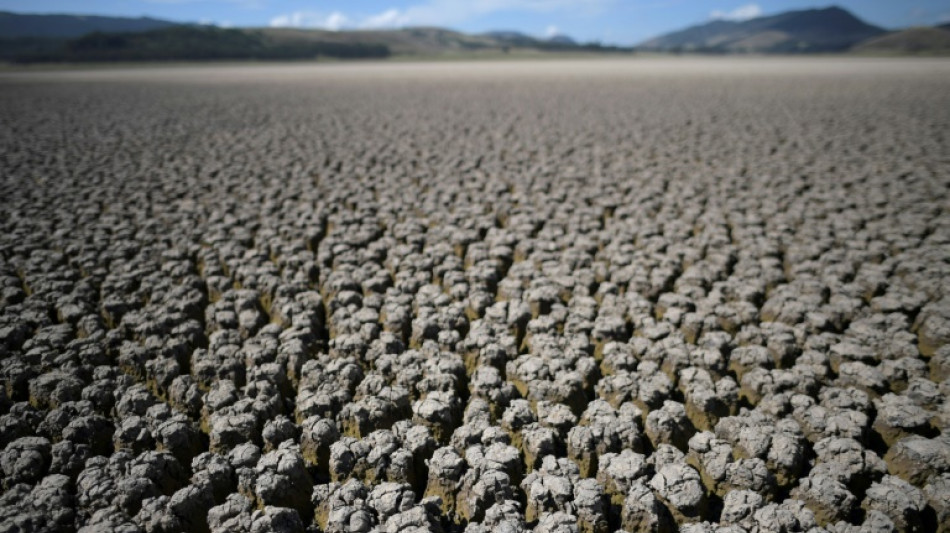
The megadrought that has parched southwestern United States and parts of Mexico over the last two decades is the worst to hit the region in at least 1,200 years, researchers said Monday.

Text size:

Human-caused global heating accounts for more than 40 percent of the dry spell's intensity, they reported in the journal Nature Climate Change.

"The turn-of-the-21st-century drought would not be on a megadrought trajectory without anthropogenic climate change," lead author Park Williams, an associate professor at the University of California in Los Angeles, and colleagues wrote.

Over the last decade, California and other western states have experienced severe water shortages, triggering periodic restrictions on water usage and forcing some communities to import bottled water for drinking.

Occasional heavy snow or rainfall have not been enough to compensate.

2021 was especially dry. As of February 10, 95 percent of western US had drought conditions, according to the US government's Drought Monitor.

Last summer, two of North America's largest reservoirs -- Lake Mead and Lake Powell -- reached their lowest recorded level in more than a century.

The odds are high that the current dry spell will continue for at least a couple of years, probably longer, according to the findings.

Running simulations based on soil moisture records stretching back 1,200 years, the researchers calculated a 94 percent chance that the drought would extend through 2022.

There's a three-in-four chance it will run until the end of decade.

Tree-ring analysis shows that the area west of the Rocky Mountains from southern Montana to northern Mexico was hit repeatedly by so-called megadroughts -- lasting at least 19 years -- between the years 800 and 1600.

- Chronic water scarcity -

Earlier research had established that the period 2000-2018 was likely the second worst drought since the year 800, topped by one in the late 1500s.

Data from 2019-2021, backed by new climate models released last year, have revealed the current drought to be worse than any from the Middle Ages.

But without climate change it "wouldn't hold a candle to the megadroughts of the 1500s, 1200s or 1100s," Williams said in a statement.

Western North America is not the only region hit by increasingly severe dry periods.

Climate change worsened the El Nino-driven droughts of 2015-2016, leading to widespread crop failures, loss of livestock, Rift Valley fever outbreaks, and increased rates of malnutrition.

Globally, 800 million to three billion people are projected to experience chronic water scarcity due to drought caused by two degrees Celsius warming above preindustrial levels, according to a draft 4,000-page Intergovernmental Panel on Climate Change (IPCC) report on climate impacts seen by AFP.

In a 4C world, that figure is up to four billion people.

Earth's surface has already warmed 1.1C on average, and is almost certain to breach the 1.5C cap called for in the Paris Agreement within two decades.

Other natural extreme weather events enhanced by global warming include deadly heatwaves, flood-causing rainfall and superstorms.

J.P.Cortez--TFWP