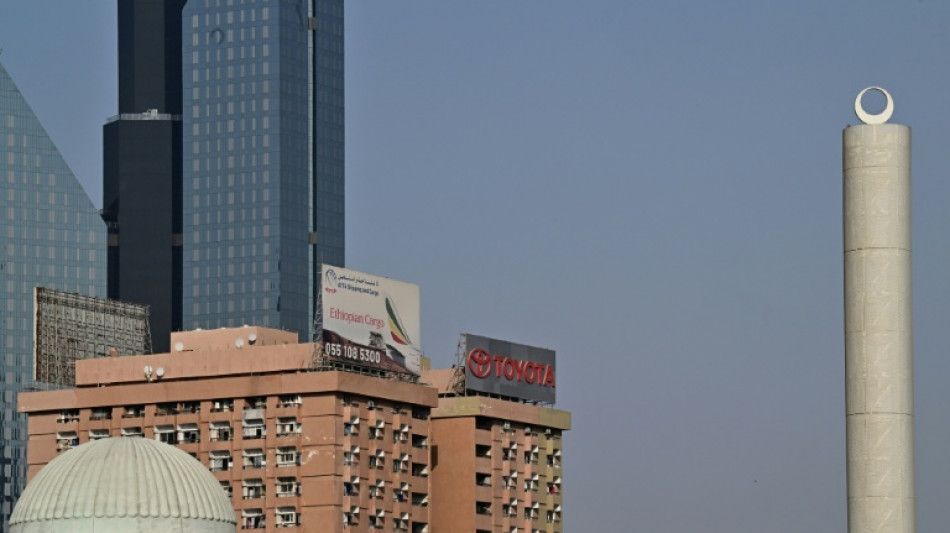
Dubai building that saw city's rise from desert due for demolition / Photo: © AFP

When it was built on the edge of the desert more than four decades ago, one 15-storey building rose proudly above what was then a quiet, unassuming Dubai.
Now appearing incongruous against a backdrop of luxury skyscrapers, the so-called Toyota Building is due for demolition, its residents having moved out a few weeks ago.
Situated near towering structures like the 163-storey Burj Khalifa, the building has witnessed Dubai's boom, growing from a city of less than 200,000 people in the 1970s into a global hub now home to more than four million people.
Hani Al-Qassem, 57, a longtime resident of Dubai, recalls: "The area (where the building stands) was once considered the gateway to the desert."
Qassem, who settled in Dubai with his family in 1974, recounts that residents used to identify the area by the so-called "Defence Roundabout" -- a landmark that has since evolved into an intersection leading to commercial buildings, offices and luxury hotels, as well as the glitzy Dubai Mall.
Architect and author Todd Reisz said construction of the building began in 1974, coinciding with the development of the Dubai World Trade Centre.
He points to a photograph in his book, "Showpiece City: How Architecture Made Dubai", taken in February 1979, which shows the structure nearing completion.
- Evacuation -
The building stood in contrast with the "transformation of Sheikh Zayed Road -- known until the 1990s as Abu Dhabi Road -- into the major spine organising development in Dubai", Reisz said.
Originally named the "Nasser Rashid Lootah" building, it became associated with Japanese carmaker Toyota when it installed its red advertising sign there in 1981, displaying the company's name in English.
Today, while the structure appears dated when compared to the skyscrapers around it, some see it as a rare link to a past Dubai that has all but disappeared.
The Nasser Rashid Lootah Group, which manages the property, previously informed local media of the decision to demolish it by 2027. It declined to respond to requests for comment from AFP.
Himanshu, 29, who lived in the building for three years before being forced to vacate recently, said the decision came as a surprise.
"Suddenly, the authorities came and they cut off the electricity. It has been a very hard time for us. We don't know anything," he said.
Dubai attracts millions of visitors annually as well as workers from all around the world.
The city's image as a safe haven in a tumultuous region took a hit during the Middle East war, with Iran striking some of its major landmarks.
Reisz notes that since the turn of the century, the Toyota Building has been "inhabited by some of the city's less wealthy residents and largely South Asian, as the surrounding area was marked for much more luxurious development".
From his modest room, Himanshu enjoyed an unobstructed view of Burj Khalifa, all while paying a monthly rent of 1,600 dirhams (approximately $430) -- a far cry from the typical rental prices in the neighbourhood, often up to five times higher.
Jacques Brent, the managing director of the Al-Futtaim Toyota retailer, notes that the building's "prominent location provided an exceptional opportunity to showcase the billboard".
He told AFP that for many, landmarks like the Toyota Building are "linked to an earlier era of Dubai".
- 'Very special building' -
But it is a final relic of a history that is rapidly disappearing.
"It was a very special building for me," said Himanshu, who founded a travel agency.
"This building is part of my professional journey also. I started my business from this building."
The building's evacuation coincides with efforts by authorities to crack down on illegally partitioned rooms and overcrowding.
In August, the emirate enacted a law to regulate shared housing, curb overcrowding and unregulated living arrangements, and preserve the city's aesthetic appearance.
The Toyota Building was not exempt. According to Himanshu, a single apartment would sometimes house as many as 15 people.
Dubai authorities did not respond to a request for comment from AFP.
For Rana, a 29-year-old Pakistani national who lived in the building for six years and managed a cafeteria on the ground floor, the building holds "a lot of memories".
"The Toyota Building was my family... I'll miss it."
J.Barnes--TFWP