Nepal's hydropower ambitions face climate reality check / Photo: © AFP

Nepal's hydropower boom has long been touted as a cornerstone of economic growth and renewable energy, but the devastating flood in August exposed its vulnerability.
The disaster triggered by a glacial mountain collapse on the China-Nepal border killed more than 1,400 people and left thousands missing -- while knocking 410 megawatts (MW), or about 10 percent of the generation capacity, out of Nepal's power system.
More than 90 percent of Nepal's electricity comes from hydropower, but extensive damage to its river projects has prompted questions about its energy security as climate and geological risks intensify.
"Hydropower has been a major driving force in growth of the country... generating jobs and income," Uttam Bhlon Lama, senior vice president of the Independent Power Producers' Association (IPPAN), told AFP.
"It was bringing huge hope and future prospects to the people," he said, adding that the country would now have to rethink its dam-building spree.
"We have to prepare... This is our new normal."
Over the past decade, the Himalayan nation has increased hydropower output more than fourfold to about 4,120 megawatts, according to government figureshelping connect nearly all its 30 million people to the grid.
The country had previously moved to export surplus electricity to neighbouring India and Bangladesh, seeking to turn its glacier-fed rivers into a source of revenue. Authorities suspended electricity exports after the disaster.
The major destruction of hydropower infrastructure underscored the risks of that strategy in a region where glaciers are retreating, permafrost is thawing and extreme hazards are becoming harder to predict.
- 'Serious lessons' -
Nepal's energy sector accounted for about half of the infrastructure damage from the disaster, according to government assessments.
Seven hydropower projects were directly hit while generation was halted at others, removing 410 MW from the national grid.
Six hydropower projects under construction, with a combined capacity of 508 MW, were also damaged.
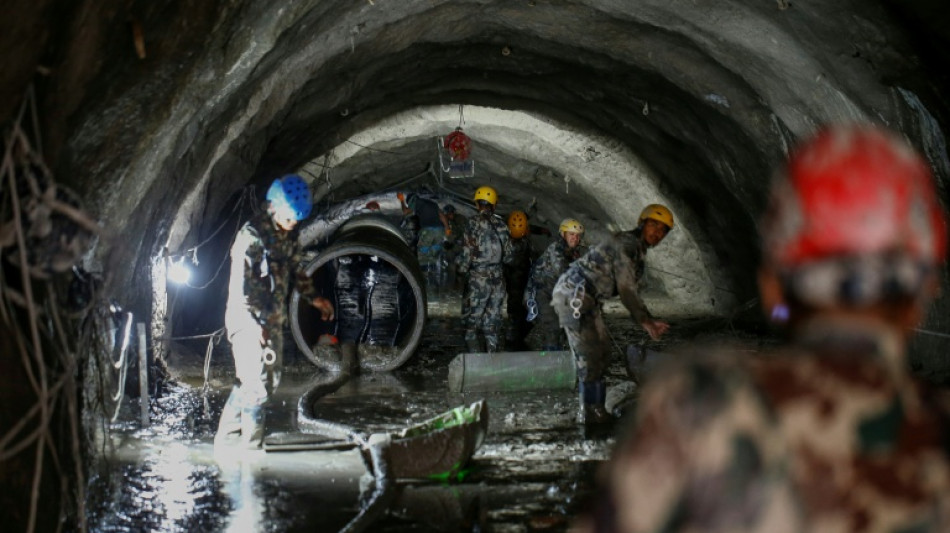
Rescuers have continued searching hydropower tunnels for hundreds of missing workers, engineers and other personnel, weeks after the disaster.
The scale of the damage has prompted calls for a rethink of how projects are designed and built.
The disaster has "taught us serious lessons for the future", Energy, Water Resources and Irrigation Minister Biraj Bhakta Shrestha told parliament on Wednesday.
"We must not only take stock of the damage but also learn from it and develop systems to reduce future risks," he said.
The World Bank warned that Nepal needs to build a hydropower system capable of anticipating, absorbing and recovering from increasingly complex Himalayan hazards.
Scientists say the August disaster was caused by a complex chain of geological and climatic factors rather than a single extreme weather event.
According to the World Weather Attribution group, the massive rock-and-ice collapse was shaped by long-term warming, glacier retreat and geological instability.
- 'Existential threat' -
Much of Nepal's hydropower infrastructure lies along steep river valleys fed by glaciers -- terrain exposed to floods, landslides and cascading geological hazards.
"Powerhouses need to be moved higher up from the riverbeds to protect them against floods, we need better evacuation plans and stocked safehouses," IPPAN's Lama said.
"We should explore remotely operated systems so people are not stuck inside in case anything happens."
The flooding has also renewed calls for diversifying the power mix in Nepal, which lacks coal or gas-fired generation capacity.
"Nepal's electricity system, currently strained and heavily dependent on hydropower, could be made more robust through well-planned additions of solar electricity," Germany's development agency GIZ said in a 2024 report.
The challenge extends beyond Nepal.
Glaciers in the wider Himalayan and Hindu Kush ranges are a crucial water source for around 240 million people in the mountainous regions, as well as for another 1.65 billion people in the South Asian and Southeast Asian river valleys below.
Basanta Raj Adhikari, director at the Centre for Disaster Studies at Tribhuvan University, said the Himalayas must be monitored regionally for hotspots to develop early warning systems.
"I call it the fate of the Himalayan people," he told AFP.
"It can happen anywhere in the world but the Himalayas are experiencing adverse impacts due to climate change and anthropogenic activity," he said.
"We have to design climate-resilient infrastructures. That is our top priority because we are (facing) existential threat."
C.Rojas--TFWP