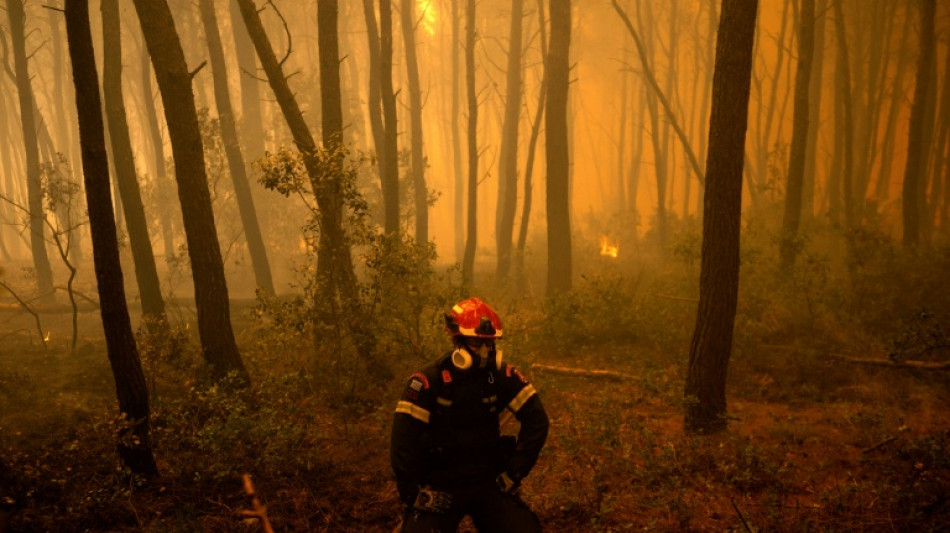
Greece wildfire expert says season 'one of the worst' in a decade / Photo: © AFP

As Greece grapples with a succession of massive wildfires, Theodore Giannaros, a senior wildfire meteorologist at the National Observatory told AFP on Monday the country faced "one of the worst fire crises" in recent memory.
Hundreds of firefighters have been battling multiple blazes across Greece, which have claimed five lives over the past two weeks.
"I would say that it is definitely one of the worst fire crises I've seen in the past, maybe eight to 10 years."
But he added they cannot make right now a direct comparison in terms of burnt areas or number of ignitions.
"We will have to wait until the end of the fire season to do such a quantitative comparison," he added.
More than 12,000 hectares of forest and agricultural land have burned over the past week, according to analyses by the European Union's Copernicus Earth observation programme.
Explaining the drivers behind the fires, Giannaros said it would be easy to blame climate change and weather alone.
"Climate change is indeed creating conditions that are highly conducive to these kinds of fires, allowing them to spread very easily and become uncontrollable," he said.
But, he argued, the broader picture in Greece and across Europe also points to failures in land management.
- 'Human activity' -
"Climate change definitely sets the stage for fire, but climate change and weather do not ignite fires. Unfortunately, 95 percent, or even more, of ignitions are caused by human activity, either through arson, negligence or land management," he said.
Greece, he added, has long neglected many of its rural and forested areas.
"We have abandoned our rural areas. Our forests are not being managed efficiently," he said.
"The climate crisis is simply increasing the toll."
Over the weekend, Giannaros said the fires around Porto Germeno, about 70 kilometres (45 miles) by road northwest of Athens in the region of Viotia, were likely to be classified as a megafire.
Asked why, he said that while there was no universally accepted definition of a megafire, a commonly used US benchmark classifies a wildfire as such when it burns more than 10,000 hectares.
"Based on a preliminary assessment of satellite data, it appears that this particular fire in western Attica is going to exceed that threshold," he said.
"It is therefore highly probable that we will end up classifying it as a megafire."
From the deadly Mati wildfire in 2018 to the massive Evros blaze in 2023, Greece endured a succession of destructive fire disasters between 2018 and 2025, cementing the eastern Mediterranean's status as one of Europe's most vulnerable regions to wildfires.
The country was hit by an exceptional heatwave in 2021, enabling wildfires that ravaged large parts of northern Evia, an island close to Athens, and destroyed tens of thousands of hectares of forest. The blaze was later classified as a megafire.
- 'More remains to be done'-
Asked about Greece's fire-weather forecasting and early-warning systems, Giannaros said significant progress had been made in recent years.
"The most recent development that makes me somewhat optimistic is that Greece now has a new civil protection law," he said, referring to the Active Battle legislation approved by parliament this spring.
"Unfortunately, there was very little time between the law's adoption and the start of the fire season, so it has yet to be fully implemented."
Asked whether Greece is better prepared today than in previous years, the senior researcher replied: "I want to believe the answer is yes," though he stressed that much work remains to be done.
The new law, he said, provides another important tool by introducing a 10-year integrated fire-management plan.
"It establishes that our approach to wildfire management will not change if the government changes, and that is really important."
S.Rocha--TFWP